<?xml version="1.0" encoding="utf-8"?><feed xmlns="http://www.w3.org/2005/Atom" ><generator uri="https://jekyllrb.com/" version="4.3.2">Jekyll</generator><link href="https://josh.works/feed.xml" rel="self" type="application/atom+xml" /><link href="https://josh.works/" rel="alternate" type="text/html" /><updated>2026-04-06T01:09:45+00:00</updated><id>https://josh.works/feed.xml</id><title type="html">Josh Thompson</title><author><name>Josh Thompson</name><email>joshthompson@hey.com</email></author><entry><title type="html">Continuos Glucose Monitors (part 2)</title><link href="https://josh.works/cgm-part-2" rel="alternate" type="text/html" title="Continuos Glucose Monitors (part 2)" /><published>2026-03-12T13:00:00+00:00</published><updated>2026-03-12T13:00:00+00:00</updated><id>https://josh.works/continuous-glucose-monitors-part-2</id><content type="html" xml:base="https://josh.works/cgm-part-2"><![CDATA[<p>About a year ago, I wrote <a href="/cgm">this post about continuous glucose monitors</a>, that’s sorta ‘part 1’ of these two parts.</p>

<p>Since then, and parallel to this most recent time with the sensor, I’ve encountered improvements to the ecosystem. The sensor technology is way better, as is the app/rendering of the data.</p>

<h2 id="the-long-story-and-comparison-between-the-new-system-and-the-old">The long story and comparison between the new system and the old</h2>

<p>the technology has gotten <em>way better</em> and now costs $50/sensor instead of the $100/sensor it was as recently as a year ago, and I’ve updated my mental models in this space. It was time for an update on that post. Here it is.</p>

<p>My disappointment with the original implementation of the CGM device was that it was difficult to obtain and expensive, at $100 per two-week-long sensor, the sensor stored only a few hours of data on itself and needed frequent syncing, and the syncing was delicate. The phones NFC reader had to be almost exactly on the sensor itself. The apps for viewing the data were clunky and slow as well. There were two of them.</p>

<p>That’s all gone now! The default Amazon device is finally good enough! <a href="https://www.amazon.com/dp/B0DRVD8TH8?ref=nb_sb_ss_w_as-reorder_k0_1_5&amp;amp=&amp;crid=2BD9SVPN24QS1&amp;amp=&amp;sprefix=lingo">Lingo Continuous Glucose Monitor</a>.</p>

<p>I also don’t have diabetes, and don’t have any warnings signs of pre diabetes or ‘metabolic syndrome’. I’m simply an intensely curious person.</p>

<p>The last time I checked the ecosystem for continuous glucose monitors, the sensors were still costing $100 per sensor, which lasted for two weeks. Wildly expensive, for something that doesn’t have too much going on inside of it. The actual cost to manufacture the sensor must be low numbers of dollars, to perhaps maybe even less than a dollar per sensor, at a certain scale of production.</p>

<p>Anyway, <a href="https://www.goodreads.com/book/show/41725763-how-to-hide-an-empire">in the greater united states</a> the price is now down to $53 per two week sensor, and <a href="https://www.amazon.com/dp/B0DRVD8TH8?ref=nb_sb_ss_w_as-reorder_k0_1_5&amp;amp=&amp;crid=2BD9SVPN24QS1&amp;amp=&amp;sprefix=lingo">is finally available via Amazon</a>, instead of jumping through insurance-related hoops.</p>

<h3 id="improvements-in-the-sensorapp">improvements in the sensor/app</h3>

<p>The sensor collects the data, the app displays it. The old sensor had a crappy app, and allowed for a brittle and slow third-party integration so the data could get off the ‘walled garden’ of the company that produced the sensor, and into a usable app. The integration was so slow I’d mostly use the default app, even though it was pretty bad.</p>

<p>Now the default app has a better UI than the third party app I used before, and the data syncs immediately. The device uses bluetooth to talk to the phone. The old CGM used near-field communication (the same technology for a cell phone’s ‘tap to pay’ feature. I had to tap my phone against the CGM to read it)</p>

<p>Now, because the device uses bluetooth, I no longer have to tap my phone to my upper arm to read the data. I open the app, and it pulls the data in in just a few seconds.</p>

<p>The app supports meal logging and exercise logging. (when one is exercising, often enough blood glucose goes up. Muscles are requesting energy, the liver responds by dumping a little bit of the 150 grams of glycogen it stores into the blood stream as glucose.)</p>

<p>The app is opinionated, and is designed f with diabetes, and labels all spikes in glucose as potentially troubling - if you log exercise it won’t count the rise as a negative thing. If it’s food-related, it counts the rise as a bad thing.</p>

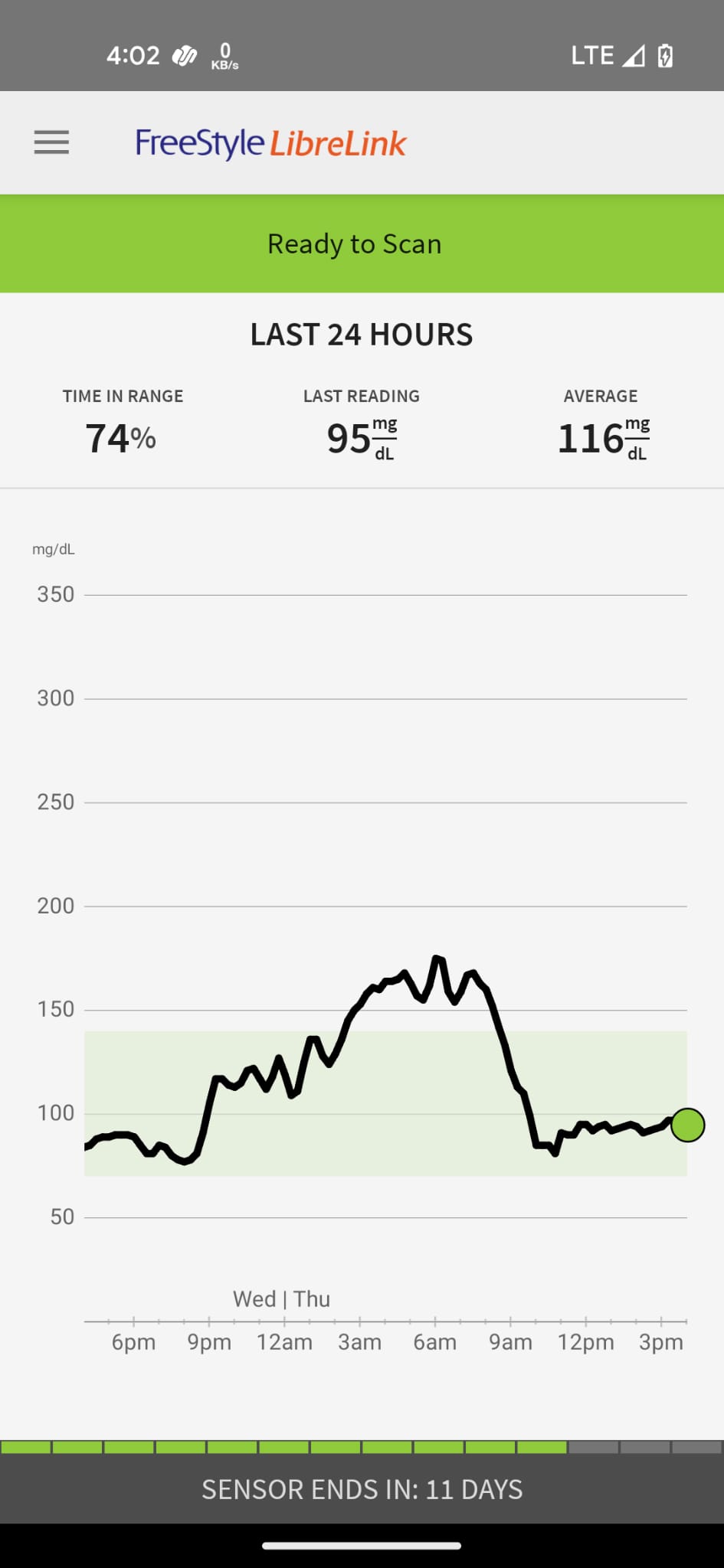
<p>When I eat low-carb, no-sugar meals (which is my default meal) it’s sorta uncanny to see my blood sugar change <em>not at all</em> compared to the giant rise and eventual fall in my blood sugar after eating something carb-y and/or sugary.</p>

<h3 id="how-much-glucose-is-in-a-human-body-anyway">How much glucose is in a human body anyway?</h3>

<p>At one point I was trying to figure out how much glucose <em>was</em> in my body anyway. Here’s my math, I was surprised at how small the actual figure was.</p>

<p>Supposedly, people who weigh what I do have about 4.5 liters of blood in their body. Imagine four 1 liter bottles side by side.</p>

<p>normal blood glucose readings are above 70mg/dL and below 140 mg/dL</p>

<p>if we were to convert those readings to grams per liter, what would it be?</p>

<p>How much sugar would i add to each liter of water, before it has the same sweetness level is normal in blood?</p>

<p>Does 7 gram per liter sound right? It sounded plausible to me - 7 grams of sugar mixed into a liter of water would make it perceivably sweet. it couldn’t be 70 grams of glucose per liter of blood.</p>

<p>What about .7 grams of glucose per liter of blood?</p>

<p>TURNS OUT THAT IS THE CONVERSION!</p>

<p>so my entire circulating supply of blood, when the reading is on the lower side, contains 3.15 grams of glucose. And at the higher side, contains 6.3 grams of glucose. That’s wild to me. That figure is so much less than I expected.</p>

<p>I use a food scale for brewing coffee and baking, so I know how small 5 grams of something is. That’s how much baking soda I’ll put in a single loaf of banana bread. I might put 70 grams of brown sugar into that loaf.</p>

<p>so, when my blood glucose is on the lower side of things, at .7 gram of glucose per liter of blood, with 4.5 liters of blood, I’d have 3.15 <em>grams</em> of glucose, in my entire blood stream.</p>

<p>A high level of glucose is 140mg/dL, or 1.4 grams of glucose per liter of blood.</p>

<p>My whole blood stream would be containing about 6.3 grams of glucose, max. I notice that this is less than I expected, and I’m sorta impressed with how quickly perhaps my body can use what’s in the blood stream, and can get more glucose into it.</p>

<p>Now I’m more impressed with my body’s ability to metabolize carbs and sugar than I was before. I was sorta off by a factor of 5 or 10, in my mental model for how this worked in my body. Whoops. I’m also impressed at my body’s ability to manage digestion in such a way, that even when I eat tons of sweet and carby things, the blood sugar doesn’t go through the roof.</p>

<h2 id="giant-qualifications-about-health-and-eating">Giant qualifications about health and eating</h2>

<p>Supremacy and purity culture/abstinence goes together. I talk a lot about food, but I don’t abstain from anything (including sex! but also food!) sorta ever. I’d rather feel extremely nourished, and when it comes to food, I do. When I talk about fasting or fasting essentialism stuff, it’s from a place of satiation and curiosity, sorta a sense of <em>wow, I’m shocked to not yet feel hunger, how convenient all the other things I can do with my time/life/energy…</em> sorta way. Not suffering. This concept is why I hate the concept of ‘counting calories’, either in or out. More on that another time.</p>

<p>I also try pretty hard to avoid anything that feels too eating-disorder adjacent. For fun, I read a memoir from someone with an eating disorder, to see if my relationship with food seemed sufficiently different than the one modeled in the book. Indeed, my suspicion/hope is satisfied, it doesn’t seem like an eating disorder.</p>

<p>It’s simply an idiosyncratic, adaptable/flexible/consistent form of feeding myself, alternating between periods of not eating, interspersed mostly with eating really nice, healthy meals.</p>

<p>I mix in a bit of ‘working out’. Same as how I sorta hate american hunting culture, I sorta hate gym culture.</p>

<p>anyway… I’ve been freaking loving <a href="/isometric-deadlift-holds">these “isometric bar holds” I’ve been doing</a>. That’s part 1, and I have a part 2 soon to land. It’s been huge, for me, and a bunch of friends have tried these lifts with me, and they give pretty good reviews.</p>

<h2 id="mixing-it-all-together---slightly-timing-meals-and-eating-plant-fat--mushrooms--cruciferous-stuff">mixing it all together - slightly timing meals, and eating plant fat + mushrooms + cruciferous stuff</h2>

<p>The original thesis was mostly that intermittent fasting is cool (like skipping breakfast) and otherwise model sugar as to be avoided and bread-type-things as overall delicious but best avoided. Fat, especially olive oil, I treat as a health food. The more the better.</p>

<p>I hope we all add at least 10-15 g of olive oil to every meal for the rest of our lives.</p>

<p>if there’s enough fat, and/or glucose isn’t extremely plentiful/overly-saturating, eventually the body burns through some glucose stores (seemingly mostly in the liver, a few hundred grams of it) and then turns on this whole cool-as-heck freaking ‘energy generation via ketone bodies’ thing.</p>

<p>the tl;dr is the body CAN make glucose out of fat, and can metabolize fat directly for energy.</p>

<p>The liver can make molecules out of fat (it can also make glucose out of fat), and some of these molecules are called ‘ketones’.</p>

<p>and then mitochondria, which usually use glucose to generate energy can also generate energy via these ketone bodies.</p>

<p>There’s urine tests one can use to measure ketones, or breath ketone detectors, or blood ketone detectors. All look at different molecules, but in all cases nearly levels of any of the looked-for molecules count as ‘being in ketosis’</p>

<p>Mid levels of ketone readings, in the blood, is like .4 grams per liter, once that system is in operation. Close in amount to the amount of glucose that is in the blood.</p>

<p>And it’s not ‘glucose OR ketones’, it’s always ‘glucose AND ketones’. There simply will not be any ketones made by the liver until the glucose levels stay low for a long enough time. Then the liver begins to make ketone bodies, along with glucose.</p>

<h2 id="a-reluctant-book-recommendation-brain-energy">A reluctant book recommendation: Brain Energy</h2>

<p>I encountered a few more books. Turns out the brain functions pretty differently in a high/medium sugar environment vs. low-sugar and ketones environment.</p>

<p><a href="https://www.goodreads.com/book/show/61129785-brain-energy">Brain Energy</a> by Christopher Palmer was… adequate. I sorta hate books written by western doctors, usually. They seem patronizing and self-aggrandizing, but maybe that’s me projecting my own least favorite parts of myself onto the author. lol.</p>

<p>The book <a href="https://www.goodreads.com/book/show/17333302-grain-brain">Grain Brain</a> was interesting enough to justify renting it from the library and listening to the audiobook. I dislike something that seems to be common among books written by medical professionals. It seems nakedly condescending, and paternalistic, at times. alas, still worth sifting through. The focus on the brain was distinctive. After reading it, I began to appreciate that my brain is like three pounds of pure fat, and my spinal cord and the main parts of the 11 or 22 cranial nerves is probably most of another pound of fat.</p>

<p>Another splash of olive oil. Some coconut oil, too. Those are the two plant fats I eat lots of.</p>

<h2 id="crucial-point-of-distinction-it-can-be-done-without-meat">Crucial point of distinction: it can be done without meat</h2>

<p>Nearly every book I’ll link to, in this piece, and in most books one encounters about a low-carb high-fat consumption pattern, seems to take as a given that meat can or should be consumed, daily, or in every single meal, and the authors (maybe they’re too propagandized by the american agricultural industry) cannot bring themselves to even mention the possibility of this thing being done with zero or very low amounts of meat. Some of the books seriously advocate for the ‘carnivore diet’, which is mostly eating pure meat.</p>

<p><em>sidebar: after originally writing these words I sorted out what ‘glutamate’ was, and how interesting it is now when I notice that some cancer cells are known to be able to ferment glutamate IF glucose isn’t available.</em></p>

<p>I <em>almost</em> don’t eat any meat. I do sometimes eat some fish. (salmon or sardines, very occasionally. Certainly at least once a month, never close to daily)</p>

<p>Mushrooms are a complete protein - every essential amino acid is available via mushrooms.</p>

<p>The paper <a href="https://www.researchgate.net/publication/318622070_Edible_mushrooms_a_potential_source_of_essential_amino_acids_glucans_and_minerals">Edible mushrooms: A potential source of essential amino acids, glucans and minerals. Int. J. Food Sci. Technol. </a> could be an interesting read. It was for me.</p>

<p>So, a few years ago, I started ensuring mushrooms are present in my diet regularly, as consistently as some people might eat meat, and I think with a similar sense of savory nourishment. <a href="/mushroom-foraging-in-the-park">I literally tripped over the <em>agaricus bisporus</em> mushrooms at a local park</a>, and have since then been picking all my mushrooms from there and I eat them regularly. I’ve foraged dozens of pounds of mushrooms from the park, now.</p>

<p>But before foraging them from the park, I’d always have mushrooms on hand from a local grocery store, and would add them to my meal, described below.</p>

<h3 id="autophagy">Autophagy</h3>

<p>The body is always taking old cells apart for parts, and rebuilding structures as needed. Some cell types (epethelial cells) regenerate/renew relatively quickly, lasting for just a few days or weeks, and others turn over slowly, lasting for months.</p>

<p>‘Autophagy’ is the sciency term for this. The process is determined by mitochondria. The cell doesn’t decide it’s time for itself to die, <em>mitochondria</em> decide it’s time for the cell to die, and basically induce a suicide for the cell. (the book, <a href="">power, sex, and suicide</a> is all about mitochondria and their rather interesting relationship to the cells they operate within and around)</p>

<p>healthy mitochondria are hella smart, and it’s very very nice for the body to do some autophogy. Fasting and fasting-mimicking nutrition patterns encourage autophagy. The cool thing is, it seems mitochondria are smart enough to consume to unhealthiest parts of the body. So, one can sorta replace the oldest/most-worn-out parts of oneself, if one is having lots of autophagy going on.</p>

<p>Augophagy is low when glucose levels are high. Atophagy is high when glucose levels are low and ketone bodies are high.</p>

<h4 id="meat-is-wildly-over-consumed">Meat is wildly over-consumed</h4>

<p>Something that annoys me a little in the ketosis-discussing books is how the authors (or posters online) seem to all hold oddly strong beliefs about the “obvious” need for nearly daily consumption of meat!</p>

<p>I find this super disappointing. It seems possible that meat is not bad for you. Yet the consumption of factory-raised-and-slaughtered animal products, the scale at which it’s happening, and the legit concerns about the actual product, even if one had no ethical qualms about the animal slaughter itself… i remember when I was eating meat regularly and couldn’t imagine stopping eating it. Bacon was in my daily omelette, I didn’t think I could give it up. Then I read <a href="https://www.goodreads.com/book/show/6604712-eating-animals">eating animals</a> and that’s basically the last time I ate meat. I have had a few bites of meat here and there in the decade that’s elapsed since I read the book.</p>

<p>I’m certainly not a vegan.</p>

<p>I eat eggs, so many eggs, almost never less than three per day, and I put heavy cream in my coffee, usually, and sometimes eat cheese, and I bake with butter. It’s been almost ten years since I’ve bought meat in a grocery store and taken it home to cook, but it’s been twenty years since I’ve not eaten at least three eggs every single day, except for rare days when I’m fasting. I keep dancing around the idea of eliminating eggs from my consumption, but have not found a way yet.</p>

<p>I now think it probable that eating a lot of meat is unhealthy. Drinking milk seems obviously problematic, for the same reasons as meat, and maybe some extra ones as well. (animals when drinking milk in normal states are in a period of growth, so the rich hormone profile of animal milk, reasonable for babies, makes less sense for adults. Milk to me is sorta carby, too. Anything that ends in <code class="language-plaintext highlighter-rouge">-ose</code> is a sugar. Glucose, fructose, lactose)</p>

<p>So, if one takes meat and most dairy away, and if one treats grains like bread and rice as unhealthy and best avoided - is there even anything left to eat?</p>

<p>yes. endless varieties of vegetables, mushrooms, eggs, and an abundance of olive oil.</p>

<p>So, that’s what I eat, nearly exclusively. For things to taste ‘good’ vs. bland (I grew up in a white peoples cooking culture - bland and unseasoned) I use lots of spices. I keep a big bag of ginger and garlic nearby - every meal gets a little of that, diced. Spicy peppers. Salt &amp; pepper, of course, and I’ve lately been spicing the meal with garam masala, curry, tumeric, cumin, and more. I’ll splash some lemon juice and scallions over the whole thing when plating it, and the food is so good that even now, after making variations of this meal hundreds of times, it is still remarkable to me how good it tastes.</p>

<h4 id="on-meat--protein--gaining-muscle">On meat &amp; protein &amp; ‘gaining muscle’</h4>

<p>sometimes I’m a bit angry when I’m penning some words, if it’s not obvious.</p>

<p>there is something in gym culture that is distasteful to me. Seems like ‘getting big muscles’ is the presumed good and ideal outcome of nearly all exercise? At least from one POV. There’s people who add tons of protein powder to every meal. There’s things floating around that says someone “should” eat 1 gram of protein per pound of lean body mass, or per kg of lean body mass. I’ve never counted calories and never counted grams of protein. When I do count up my regular protein consumption, it works out to way less than half the ‘recommended’ amount of protein. I rock climb, and would gladly accept a lower weight, if it didn’t come with any strength penalty, or hunger. No meat, no protein powder, and I’m doing just fine, though I must mention I don’t consider myself to be particularly good at rock climbing.</p>

<p>even a gram of protein per KG of lean body mass is wild, to me. No one’s body is simply adding muscle to the frame because there’s extra protein in the system.</p>

<p>I simply wanna name that, because I’ve been seeing a comical amount of new muscle lately with these isometric bar holds, for the first time in my life. Small amounts of muscle, small amounts of protein, small amounts of high-quality exercise-adjacent stimulus.</p>

<h3 id="calories-incalories-out">Calories in/Calories out</h3>

<p>I hold the Calories In/Calories Out model, for what is implied on both the inputs side, and energy expenditure side. Literally never in my life have I looked at the calory count on a food package. literally all I look at is the quantity of carbs.</p>

<blockquote>
  <p>But it’s physics …</p>
</blockquote>

<p>say the CI/CO people.</p>

<p>I also don’t know what it means to ‘burn a calorie’. Like, whatever is meant when someone says “walking burns so and so calories.” or “i ate a <bad thing="">, so now I have to &lt;'exercise' a certain amount&gt;."</bad></p>

<p>I think that mental model is unhelpful at best.</p>

<ol>
  <li>The body manages itself pretty well. weight gain is driven by insulin levels. If insulin is stuck in the system, cells that can store fat, will store fat. If insulin is low, the body can access energy in normal ways, including metabolizing fat that already exists in the system. If insulin is kept high, eventually ‘insulin resistance’ happens, all sorts of other troublesome effects happen.</li>
</ol>

<p>‘Weight gain’ is extremely NOT related to ‘eating more calories than one expends’. <a href="https://www.goodreads.com/book/show/29874881-the-case-against-sugar?ref=rae_1">The Case Against Sugar</a> goes through the stories of so many different people groups who encountered industrialized food systems, even into the 1950s. Sugar/carbs causes the blood glucose levels to rise, and eventually insulin gets secreted to bring the glucose back down, but if more and more stuff is in the system resulting in insulin needing to stay up, bad things happen.</p>

<p>Sustained, ‘chronic’ reliance upon insulin leads straight to <a href="https://en.wikipedia.org/wiki/Metabolic_syndrome">metabolic syndrome</a>. Metabolic syndrome is the same as insulin resistance, is the same as pre-diabetes.</p>

<p>Fasting will very, very quickly bring back insulin sensitivity, if it’s been absent. “exercise” cannot address the issues of elevated levels of insulin, except for a bit of movement after eating, maybe?</p>

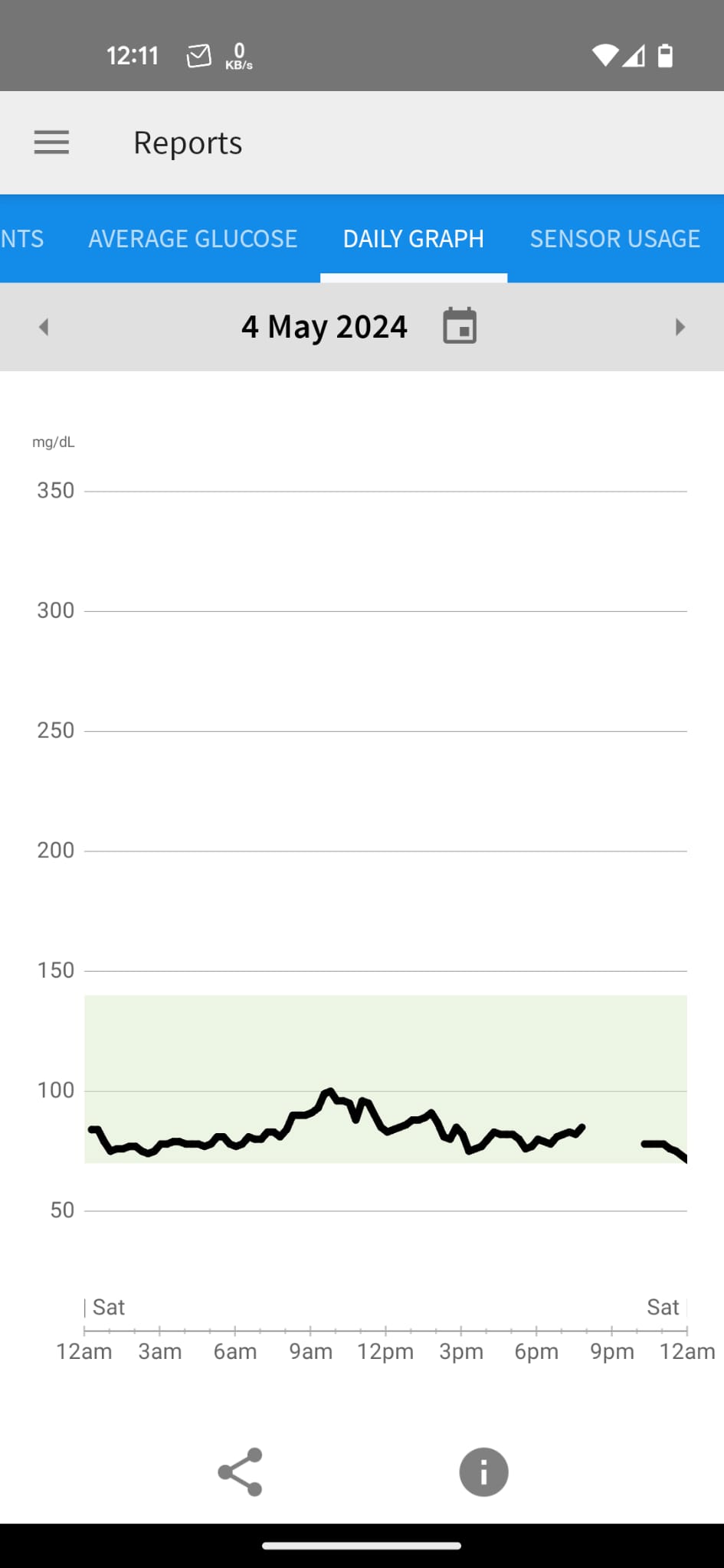
<p>I use my glucose sensor, a low carb meal + a five minutes of walking sometims around seems to let the blood sugar levels stay completely flat. Even if I don’t walk around at all, after this ‘sorta weird’ meal I usually eat, there’s zero bump to blood sugar, in a way that I maybe seems surprising. It was to me, at least.</p>

<h3 id="sidebar-on-oral-health">Sidebar on Oral Health</h3>

<p>This whole thing is talking about food, and digestion. The gut is pretty cool. (I really liked <a href="https://www.goodreads.com/book/show/23013953-gut">Gut: The Inside Story of Our Body’s Most Underrated Organ</a>).</p>

<p>Part of oral health is keeping the mouth clean and inhospitable to bacteria while letting the mouth do its own thing.</p>

<p>Fasting and/or no-sugar eating seems obviously gentle on the teeth, compared to using the mouth constantly.</p>

<p>I stumbled across a thing called <a href="https://en.wikipedia.org/wiki/Oil_pulling">oil pulling</a> once. I saw that coconut oil was one of the suggested oils.</p>

<p>I already think of coconut oil as nearly pure ketones. The story goes:</p>

<blockquote>
  <p>MCT (medium chain triglycerides) Oil is really expensive and fancy ‘pure liquid ketones’, supposedly.</p>

  <p>Coconut oil has a lot of the biological precursors of those ketone-specific form of MCTs, and is antibacterial, and great for the skin, lips, body anyway.</p>

  <p>It seems that most people who subscribe to oil pulling spit out the oil, but it cannot go into a sink because it contributes to clogged pipes.</p>
</blockquote>

<p>The solution that seemed easiest to me is to pick an oil I already consume and think highly of, and simply swish it around for a bit before eating it, so that’s now what I do with coconut oil, in a way that relates to oral health.</p>

<p>I also found some gum with nano-hydroxyapatite, seems to help resurface the teeth, and floss, and have a home de-scaler so I can make sure plaque doesn’t build up around my permanent retainer.</p>

<p>So far, my oral health has been nice in a way it’s historically not been, but the biggest intervention I made was <a href="/tongue-tie">fixing my tongue tie</a> and my mouth no longer is open when I sleep or when I’m awake, so that alone could have more of an improving effect on my oral health than all over interventions combined.</p>

<h3 id="mitochondria-are-cool-as-heck">Mitochondria are cool as heck</h3>

<p>I was one of the folks with a certain mental model of mitochondria as sorta passive ‘energy making things’, left over from some high school biology textbook.</p>

<p>I quite liked this book about cellular biology: <a href="https://www.goodreads.com/book/show/39001.Power_Sex_Suicide">Power, Sex, Suicide: Mitochondria and the Meaning of Life</a>. Mitochondria as energy generation (including the aerobic oxygen+glucose pathway, the anerobic glucose fermentation pathway, and the pathway that uses ketones to generate energy, when there’s not glucose in the environment).</p>

<p>The ‘suicide’ part of the title of that book refers to how mitochondria decide “for the cell” when the cell is to be deconstructed for parts. From the cell’s POV, it’s an induced suicide, from the mitochondria’s POV, it’s taking apart a structure for the bare materials and re-assembling a fresh or related or different structure. In american scientific english, that is called ‘autophagy’, and healthy/happy mitochondria do a lot of selective, necessary cell removal.</p>

<p>Related, <a href="https://www.goodreads.com/book/show/145624879-change-your-diet-change-your-mind">Change Your Diet, Change Your Mind: A Powerful Plan to Improve Mood, Overcome Anxiety, and Protect Memory for a Lifetime of Optimal Mental Health</a></p>

<p>I hate the title. Again, american medical establishment paternalistic talk. And yet, worth sifting through. Talks about low-sugar brain function vs. high-sugar brain function. The former is quite a bit different and improved from the latter.</p>

<p>I’d never conceived of a high-fat low-carb feeding pattern as a tool for ‘managing moods’ until pretty recently, but I encountered it on reddit (<a href="https://www.reddit.com/r/keto/search/?q=mood">example search</a>), eventually found the above book, and was glad I did.</p>

<h3 id="other-reading">Other Reading</h3>

<ul>
  <li>Just a few months ago, I found <a href="https://www.goodreads.com/book/show/50355140-ravenous">Ravenous: Otto Warburg, the Nazis, and the Search for the Cancer-Diet Connection</a>. I’d long heard of Otto Warburg, in the history of cancer research for his encounter of that interesting feature of call cancer cells - that their normal cellular metabolic functioning is broken and they laboriously ferment blood sugar. The book is fascinating, Otto Warburg was a bit of an ass, and the vignettes about Hitler and other Nazis were top notch. (Lots of american purity culture is in common with some nazi norms around purity culture).</li>
  <li><a href="https://www.goodreads.com/book/show/52424370-tripping-over-the-truth">Tripping over the Truth</a> this book is nearly the origin story, I first read it many years ago now, and still think of it regularly. Seems reasonable now to say “cancer is a reasonable result of ‘everything is too sugary too much of the time’.”</li>
</ul>

<p>that means resolving THAT issue, and keeping things low-sugar for a while and seeing what happens, works so well.</p>

<h3 id="note-on-fast-adjacent-things">note on fast-adjacent things</h3>

<p>I keep noticing a pattern when medical people talk about this low-glucose state, and I think they’re overstating aspects of it. But maybe the technology wasn’t available when they wrote these books - a good continuous glucose monitor + app integration became widely available only in 2024 or however long Lingo figured out how to get $50 two-week CGM sensors on Amazon available to anyone with a credit card.</p>

<p>as I’ve read some of the books like finally finding an e-book copy of [Thomas Seyfried’s book]https://www.goodreads.com/book/show/13719723-cancer-as-a-metabolic-disease?from_search=true&amp;from_srp=true&amp;qid=B9UvTfpzvN&amp;rank=1() that kept getting mentioned in other texts.</p>

<p><a href="https://thepiratebay.org/search.php?q=cancer+as+a+metabolic+disease&amp;all=on&amp;search=Pirate+Search&amp;page=0&amp;orderby=">Cancer as a metabolic disease</a>, libraries and had no luck getting a physical copy….</p>

<p>I found the PDF on thepiratebay, and started skimming around the document. I notice that I sorta find myself eating in a way that could be called ‘keto-ish’ sometimes, was curious to see what they said about it all.</p>

<p>For instance, they talk about caloric restriction a lot, but I don’t think that’s part of the solution at all. Turns out cancer can also or maybe ferment something besides <em>exclusively</em> glucose - sometimes maybe it can do glutamate too? (if your next question is the same as mine, ‘what he hell is glutamate?’ and you google ‘sources of glutamate’, you’ll say “oh that makes sense”)</p>

<p>If someone drops meat out of their diet, and backfills it with cruciferous vegetables, mushrooms, eggs, and olive oil &amp; coconut oil, and occasional salmon &amp; sardines (those fish in particular!), that person probably wouldn’t consider themselelves to be starving, but while keeping that pattern, their blood sugar will go to levels that some medical people think is ‘dangerously low’ (it’s not) and their body will go into pretty hefty ketosis.</p>

<p>I think then there’s no sugar in the system for fermentating energy systems to ferment. Supposedly cancer cells can also ferment glutamine. I didn’t know what glutamine was and how it was different than glutamate, or what their relationships to anything else was. <a href="https://www.reddit.com/r/medicalschoolanki/comments/biqjpd/comment/em4j76r/">a med student on r/medicalschoolanki had a beautiful answer.</a></p>

<p>anyway, knowing now what glutamate is, could you imagine a way to have less of it floating around, because just like glucose the body can apparently fabricate it itself? One would simply stop eating meat, if one was eating meat. Knowing that perhaps cells can ferment glutamine same as glucose, or that they can in at least some situations, was an interesting connection for me to make. I think there’s plenty of other good reasons to gnerally not eat meat, though. (except for, again, occasionally, sardines and salmon, or maybe fish overall but not very much. Certainly never pigs, dinosaur birds (chickens) or cows).</p>

<p>So I think a crucial mistake ppl might make when thinking they’re avoiding sugar is not avoiding the glutamate. Model an ideal nutrition source as ‘not glucose’ and ‘not glutamate’, and drop meat out of one’s diet completely, and good things might happen. all the meat-based amino acids float around the blood stream perhaps, same as sugar?</p>

<p>anyway…. I want to introduce ‘the meal’ and eating it once or twice-ish a day. And always eating once or twice-ish a day. If this meal is one of those regular meals, it might count as…. I donno. solves a lot of problems, in a pretty humble package, kinda. But still enough pretentiousness that it can be appreciated, and it’s delicious <em>enough</em> and can be done in just a few steps. A preference for spending most of the time <em>not eating</em> also gets fun. perhaps.</p>

<h2 id="visualizing-mitochondria">Visualizing Mitochondria</h2>

<p>I had always thought of mitochondria as sorta passive blobs that did biochemistry to generate ATP, which was used by the body to ‘do shit’.</p>

<p>Turns out they are busy as hell.</p>

<p>A book titled <em>Power, Sex, and Suicide</em> really did it all for my brain when it comes to mitochondria. (The book is about mitochondria)</p>

<p>For instance, cells do not want to ‘die’ and strenuously resist apoptosis until the very end. It’s mitochondria that get in there, and in a rather surgical and ruthless way, sorta eviscerate the cell from the inside out, <em>and then they leave the cell and carry on in other places</em></p>

<p>I thought mitochondria were stuck inside of cells, floating, sorta like plastic balls floating on the surface of a pool.</p>

<p>Turns out that isn’t the case <em>at all</em>.</p>

<p>The first 3 of these videos were the first ones I saw and really surprised me. As I’ve since tried to re-find those videos from years ago, I’ve linked a few other short timelapse videos of mitochondrial movement/dynamics</p>

<p><a href="https://www.youtube.com/shorts/DKEYnwUpeSg">5 hr timelapse mitochondria, in like 6 seconds </a></p>

<p><a href="https://www.youtube.com/watch?v=YyFQ51bayws"> 30 minutes of Mitochondrial transport along microtubules, 10 second timelapse </a></p>

<p><a href="https://www.youtube.com/watch?v=bdkkVjWCJv8">11 second video, mitochondria moving in a cell</a></p>

<p><a href="https://www.youtube.com/shorts/r5gwVcfVOJU">Mitochondrial transfer between pre-adipocytes?</a></p>

<p><a href="https://www.youtube.com/watch?v=qxeUZT8lgu8">mito movement (12 seconds)</a></p>

<p><a href="https://www.youtube.com/shorts/uFYIAdwqAac">Golgi and Mitochondria Dynamics in Fibroblast Cells Under a Fluorescence Microscope</a></p>

<p><a href="https://www.youtube.com/shorts/KrnTUO46d00"> Visualizing mitochondrial trafficking in neurons </a></p>

<p><a href="https://www.youtube.com/shorts/CuNFjsFsudY"> Mitochondrial dynamics through cell division </a></p>

<h2 id="a-note-on-calories-incalories-out">A note on calories in/calories out</h2>

<p>this model, ‘calories in calories out’, is total bullshit. so many issus with the input side of calories, and in the ‘output’ side of calories.</p>

<p>I AM SO SORRY I CANNOT HELP BUT LEAD WITH HOW I FEEL ABOUT IT! I’ll explain.</p>

<p>Unfortunately, though, I never really ever thought CICO was true, it felt intuitively wrong to me my whole life.</p>

<p>Even the last youtube video above, right after the timestamp it opens to, the creator says “too much nutrition”.</p>

<p>It’s not that! It’s not too much energy or nutrition or over-feeding, it’s <em>too much glucose</em> and ‘too much’ and ‘too long’.</p>

<p>Body composition things is OBVIOUSLY a hormone issue! It’s so screamingly obvious and assumed as true by every other related domain that it’s wild that anyone still says CICO! If that were the case, hormone therapies of all kinds would not be an option! Weight gain and loss and muscle recomposition is such a known part of horomone therapies. They’re either the entire point, or they’re the entire obvious downside.</p>

<p>if the body is soaked in sugar for too much of the time, insulin gets created and sent into the system in excessive quantities. Insulin has an effect on hormones of all sorts. Insulin resistance is synonymous with miss-calibrated everything else.</p>

<p>“working hard” is a waste compared to “moving enough that the muscles are involved in drawing glucose out of the blood, <em>if there is 1) too much sugar in the blood, or 2) there is sugar in the digestive tract that needs to be metabolized and released into the bloodstream, _because there’s no where else for it to go</em>.</p>

<p>Is it possible for the intestines to preferentially avoid digesting sugar and/or carbs? Can it be ‘spent’ in the gut biome, instead of going into the blood stream? If a dog were to eat shit post-sugary meal, would it taste sweeter than a regular shit?</p>

<p>the body absolutely does not need any sort of steady input of nutrition, to maintain itself in a perfectly suitable fashion.</p>

<p>‘calorie restricted’, ‘calorie deficit’ is the same attitude</p>

<h2 id="calorie-deficit-is-propaganda-counterproductive">calorie deficit is propaganda, counterproductive</h2>

<p>to think in the concept of calorie deficit, <em>or to try to retain it like an emotional pool noodle</em> is harmful.</p>

<p>source is everything. Fat is far better as fuel than sugar, which is obvious when you see both burn in a fire. fat will puddle, bubble, it obviously has a higher heat retention capacity, catagorically different than cellulose (woody stuff, bready stuff, wet sugar).</p>

<p>That said, here’s some interesting videos I recently watched on mitocohndria.</p>

<p>(I was looking for some videos I’d seen where mitochondria were ‘tagged’ with some thing and able to be seen moving around)</p>

<p><a href="https://www.youtube.com/watch?v=KQBmtzT4VTU">https://www.youtube.com/watch?v=KQBmtzT4VTU</a></p>

<hr />

<h2 id="mitochondria-generate-energy-inside-of-neurons--mitochondria-prefer-to-consume-ketone-bodies">Mitochondria generate energy inside of neurons &amp; mitochondria prefer to consume ‘ketone bodies’</h2>

<p>ketone bodies are made by the liver, same sorta process as the liver makes glucose. (the liver makes glucose, it stores it, and releases into the blood stream if the muscles or whatever asks for it)</p>

<p>ketone bodies theoretically generate like 10x molecules of ATP per input molecule than glucose molecule. (8 in, 30 out?) I don’t exactly remember. It’s the ‘krebs cycle’ or ‘cytric acid cycle’.</p>

<p>The krebs cycle happens <em>inside</em> of the physical structure of a mitochondria. That sorta grooved membrain thing. It’s a shape that maximizes internal surface area, same as the folding grooves of the brain.</p>

<p>mitochondrial health and ‘brain/neuron health’ are 1:1. I did not know until like a year ago that there was any correlation between ketone bodies and mental/emotional stuff. <em>read that again</em></p>

<p>the book <em>power sex and suicide</em> posits that mitichondria <em>are their own type of organizem</em> and sorta colonized/invaded/helped regular cells, sorta an inside out version of the harmonious relationship between bacteria and plants in the “rhiozome”. (in the top layer of soil, plants deposit sun/water combined energy, it’s eaten by bacteria, bacteria create as a result certain metabolic products that is then taken up and used by the plant.)</p>

<p>These systems could be considered to have their own independent existences, but happily exist with each other, wherever there’s metabolizing to be done.</p>

<p><a href="https://www.goodreads.com/book/show/61129785-brain-energy">brain energy</a> was an adequate read.</p>

<p>a huge tldr of all this is to just get a continuous blood glucose monitor, eat a high fat, low-carb, low protein meal next, and then begin successive 18 hour fasts. perhaps within one day (for me) but maybe more one will see one’s glucose levels stay pretty low, except during exercise or activity. climbing, walking, running, throwing a frisbee, walking stairs, etc.</p>

<p>Though if I did those things after eating a big meal, and seeing my blood sugar go up, with a little activity, it would sorta dive right back to normal. At least until a little more of the meal was digested, then it might go up again.</p>

<p>big part of the demand side for getting blood sugar down is ‘any process in the body requesting energy’ so if one walks long/fast enough (or, my favorite stim, walking up and down a few flights of stairs) for the body to request energy, one can see one’s blood sugar plummet, in the space of a few minutes.</p>

<p>It’s like wringing out a sponge, how quickly the few nalgine bottles worth of blood in our body to pick up 4 grams of glucose, it gets pulled out of the blood and the digestive tract can dump another few grams of glucose, which it’ll do smartly and with reasonable timing, if you set it up well enough for success.</p>

<p>more on that later</p>

<p>(I can be fasted for one, two, three days, and my glucose levels stay pretty similar during the day to when I’m eating normal low-carb type shit. )</p>

<p>in the space of a few minutes, if I do intense exercise, like hill sprints or climbing or lifting, or walking around for five minutes, or walking up and down the stairs in the six-floor building in which i live….</p>

<p>while wearing a cgm, i can see blood sugar go up, then down, then up, then down, quickly, right after having a big meal of bread, or doughnuts, or pizza, or indian food buffet with naan, or this, or that, or whatever…</p>

<p>so, it’s not ‘too much calories’. blood sugar <em>does not budge at all</em> when I eat this meal.</p>

<p>TODO: insert a few screenshots of Libre CGM data? this needs to be it’s own blog post.</p>

<p>anyway, this meal is good, everyone loves it.</p>

<h2 id="-the-meal-">✨ The Meal ✨</h2>

<p><em>todo: make this its own page</em></p>

<p>I have a meal that I eat basically every day. If I eat a meal that isn’t this meal, my other meal for the day will be this meal. I eat almost exclusively twice-ish a day. Sometimes less, sometimes more, never breakfast.</p>

<p>TODO: Add a photo of the finished result?</p>

<p><a href="https://docs.google.com/document/d/16FRfqSiJB9DxsnZ5B80AhdFZiMMUs5IC-IEqGoIhrTk/edit?usp=sharing">Google doc of printable instructions</a></p>

<p>I like it because while I can cook it easily, I always make it in bulk and get a few meals out of a single session with the cutting board/cast iron skillet meal vibe.</p>

<p>I note that it is something that in some communities is a big deal, or even <em>an impossibility</em>.</p>

<p>It’s a ‘keto-friendly’ meal, functionally zero carbs or zero net carbs. This meal as eaten is both <em>deeply</em> satiating and will cause not a single point increase in your blood sugar. It HATE counting calories and never have and never will, and i dislike the concept of ‘macros’, but this meal is zero carb, high fat, medium protein, zero meat, some eggs.</p>

<p><em>i don’t eat meat</em> which matters to me when I talk about keto things, because some keto communities eat wild, horrifying amounts of meat. Cows, pigs, chickens. I don’t eat those anymore. I do sometimes eat fish.</p>

<p>But I can easily go weeks without eating any sort of meat, not even fish, and not miss it or think about it or feel that I am in any way nutrient deficient.</p>

<p>I’ve cooked this meal or a version of this meal <em>every day for at least 12 years</em>. I’ve cooked this meal in like 18 countries, many dozens of kitchens. It’s easy to grocery shop for, flexible based on if any produce is in the refrigerator and going bad, but can also be made out of vegetables that only slowly go bad.</p>

<p>onions and carrots, for instance, will keep for a long time (weeks), and can be a perfect base of the meal. But it can also take spinach or any other ‘delicate’ vegetable.</p>

<p>I cook it because I am dumb and lazy and am sometimes using unfamiliar kitchens. I am not dumb, but some people have <em>literally made fun of me</em> for learning some of the things I’ve learned related to the kitchen, making fun of me for <em>not having already known something</em>. what the fuck.</p>

<p>for instance, mushrooms can be/want to be cooked ‘dry’ on a pan. No oil needed. Lots of veggies can accommodate this method.</p>

<p>Also, if the pan is getting hot <em>or you want to steam the contents a bit</em> you can add water to a hot pan while the food is cooking, and the temperature of the pan goes down, food sticks a bit less, and sometimes steam is created. I was 36, burning food to the bottom of a stainless steel pan in an unfamiliar kitchen, trying unsuccessfully to scrape burnt food off the bottom of that pan, when I learned this, and immediately found the obviousness of ‘add water to a pan’ breathtaking. I use it often when cooking, now, even in my cast iron, and love it for me.</p>

<p><a href="https://m.xkcd.com/1053/">today’s 10,000</a>, <a href="https://www.explainxkcd.com/wiki/index.php/1053:_Ten_Thousand">explanation</a></p>

<p>it’s good as hell. I’ve gotten particularly good with it in the last year or so, but even the ‘basic’ version of this meal is delicious, and many others have reported as such to me.</p>

<p>When I do my standard, current, at-home meal, it’s mouth wateringly good. And still, I cook it because it’s the fastest way of putting heat and food together and then shoveling the results into my mouth.</p>

<p>People who know what they’re talking about have remarked on the speed and voracity with which I sometimes consume my food. The first time this was pointed out to me, in such a gentle and interesting way, I was instantly shocked that I’d never noticed it before. I’ve since gained lots of ‘mindfullness’ around food, or at least I can observe myself and have awareness when I’m deep into what seems to be pouring food into my body (and sometimes water) in a way that gives ‘camel’.</p>

<p>todo: insert photo of the pan sitting one step away from where I type these words…</p>

<p>I have a printable version of this ‘recipe’/instruction combination.</p>

<p>I could/should include perhaps a timelapse video that shows the prep. It’s relatively quick, and I consider myself skillful with a chef’s knife and enjoy the chopping of the veggies and the prep of the meal.</p>

<p>Because of a few decisions/tools/workflows, this meal is also for me easy to set up and easy to clean up. I can finish cooking with a cleaner workspace than what I start with, because most of the meal time is spent with the food sitting quietly &amp; sauteeing, not needing active tending. It makes zero dirty pots and pans.</p>

<p>side note, the convection cook top unit I use makes it <em>even easier</em> to get this meal done quickly and effortlessly. It’ll maybe show up in the time lapse some day.</p>

<p><a href="https://docs.google.com/document/d/16FRfqSiJB9DxsnZ5B80AhdFZiMMUs5IC-IEqGoIhrTk/edit?usp=sharing">Google doc of printable instructions</a></p>

<p>interestingness is next to beauty, sorta. I think deliciousness is next to beauty, too, and this meal sometimes tastes delicious and interesting.</p>

<p>Basically, as many of the first line with one or two items from the second line for bulk:</p>

<p>mix as much of this as possible: garlic, ginger, tumeric, lemon juice. Salt, cumin. Mushrooms. Spiciest peppers possible, at least a little</p>

<p>Fill volume of cooking container with one: Broccoli, cabbage, carrots, onions,</p>

<p>Oil/fat: olive oil or coconut cream.</p>

<p>Acid: lemon.</p>

<p>Mix it all together, cook it up, add eggs, mix the eggs in somehow, cook it all through, serve it up. Top with green onions, squeeze a lemon slice over it if you can, and then pour a HEAVY drizzle of EVOO, maybe sriracha or something spicy. It’s a meal, satisfying as hell.</p>

<p>I can eat this meal once a day and hardly even detect hunger in my body between meals.</p>

<p>Cast Iron is crucial, and a <a href="https://www.amazon.com/Dexter-Russell-CECOMINHK02900-Dexter-Pancake-Turner/dp/B0015R7P6O?crid=BZBJSFA39LVP&amp;dib=eyJ2IjoiMSJ9.wlmVBOmcJUBDcuDVFTl4T6aBa0tlN9utgUbqrrAmg2fOBX0IUQxRZbQnG__kHlm8wg0l3nYIKIaV1IdAEb5pjaJQlJ-RzJ_vBIY9aWSsoBhDvlGkTjhm_68hy3JX_gceqvfx_qS03uW6JQnQvGufKSSA2Z95GVuSxssPiXMaj2VzL90Zs7QFUB6mEbdNo6Kor3qBVVY9gwbe4cFib6N_O0ZIIAWFmwT25Jya7DHPCA0.CoU5dzuHPZxaqFV28fuxnCCrvrihdJp6G--9lcrymyI&amp;dib_tag=se&amp;keywords=dexter+spatula&amp;qid=1774025560&amp;sprefix=dexter%2Caps%2C214&amp;sr=8-1">‘cookie turner’ spatula</a>. This would mean there’s iron in a very healthy way.</p>

<p>The point isn’t iron, it’s ease and effortlessness. I can scrape my pan clean with a metal spatchula if I want, i never have to put water on it to clean.</p>

<p>It perhaps makes sense in the video timelapse… that I’ve not yet published. I’ve got some time lapses of chunks of this meal prep. Maybe I’ll just combine them all and link it here.</p>

<p>i recently started adding fresh squeezed lemon to all sorts of things. And energy generation in the body is named the <a href="https://en.wikipedia.org/wiki/Citric_acid_cycle">citric acid cycle</a>, so maybe the deliciousness relates to how useful it is to have in the body.</p>

<p>Similar as the ‘lemon in lots of things’, I started wearing socks inside of my climbing shoes, virtually 100% of the time, from the first time I tried it. I never want to stick my bare feet in a climbing shoe again and it’s unlikely I ever will. <em>consider trying it with a sense of curiosity, if you can</em>. I’m weird, but not for this. Thank you, person who introduced me to these things.</p>

<p>Garlic, as much as I can get in a meal and in my life. I found <a href="https://www.goodreads.com/book/show/334888.The_Healing_Power_of_Garlic?from_search=true&amp;from_srp=true&amp;qid=0vZevWyhIs&amp;rank=1">this delightful book</a> in the library attached to the botanic gardens. I was already pro-garlic because of taste, and now I’m all the more pro-garlic.</p>

<p>Garlic is a ‘natural antibiotic’, but unlike most normal antibiotics, it works on both <a href="https://en.wikipedia.org/wiki/Mycobacterium">gram positive</a> and <a href="https://en.wikipedia.org/wiki/Mycoplasma">gram negative</a> <a href="https://en.wikipedia.org/wiki/Gram-negative_bacteria">bacteria</a> cell wall types. penaccilin works on only one of those types of bacteria. something something all bacteria have cell walls that are either gram positive or gram negative, but it affects how they interact (or don’t interact) with traditional antibiotics.</p>

<p>Super cool. Again, this book that I stumbled across was great. Garlic has been used sorta by everyone, across time, to do useful things for all sorts of life-related domains. <a href="https://www.goodreads.com/book/show/334888.The_Healing_Power_of_Garlic?from_search=true&amp;from_srp=true&amp;qid=0vZevWyhIs&amp;rank=1">this 1996 book is a nice compendium of what is known in english about garlic, the chemical compounds within it, why they seem to do what they do</a></p>

<h2 id="pulse-oximiter-blood-oxygen-level--breath-holding">Pulse oximiter, blood oxygen level &amp; breath holding</h2>

<p><em>this could be it’s own article.</em></p>

<p>There’s an interesting little device one can get off amazon, it’s quite cheap, a fingertip pulse measuring device, it also detects blood oxygen levels.</p>

<p>footnote? “technically something about oxygen carrying capacity of available total as detected in the capillary network of the fingertip”</p>

<p>I got it around the same time that I started using a <a href="https://getstamina.app/">‘breathholding training’ app</a>. I wanted to know what my pulse was, and this was a simple way to measure.</p>

<p>So, I can clip this to my finger, and immediately see my pulse printed out, and the blood oxygen level.</p>

<p>And, turns out that when doing breath holding training, the blood oxygen level sometimes does really interesting things, and I’ve not seen other people talk about this yet.</p>

<p>I can watch my blood oxygen level change (or not change) as I hold my breath. Sometimes I’d be at the end of my breath, it felt like my body was screaming for me to take another breath, and my blood oxygen level would be close to the max value, 99 or 100%.</p>

<p>I noticed this but it didn’t really mean anything of interest to me, for months.</p>

<p>I can do some breath holding training, and do a ‘one rep max’ breath hold test, and always was able to do above two minutes, maybe close to three. with a little practice, I found myself easily doing three-something minutes.</p>

<p>Sometimes during long breath holds, when my body was still, I’d see the blood oxygen level tick downward to the low 90s or 80s. Nothing too severe.</p>

<p>And then a tiny realization clicked, it was based off observations of how I sometimes observed my blood oxygen level going down, and then DOWN QUITE A LOT! and then popping right back up within seconds once I started breathing again. I gained an appreciation for how quickly blood that was allowed to pick up oxygen would reach the tips of my finger, to be read by the blood oxygen level sensor.</p>

<p>turns out the thing that makes you want to breath is buildup of CO2, not lowering blood oxygen levels. This was always something I knew academically, but I’d not had much experience with it.</p>

<p>So, a few weeks ago, a new mental model of my own respiration and metabolic processes clicked into place. I’ll do deep breathing for at least 30 seconds before starting a breath hold - in my mind, I’m running blood that has some amount of CO2 in it through my lungs, and i’m draining it of CO2 faster than my body is placing CO2 back in the blood cells.</p>

<p>I believe my body circulates my entire 4.5 liters of blood at least once a minute, so this deep breathing moves more CO2 out of my blood than normally would be displaced if I were not doing that deep breathing.</p>

<p>Then, when I take a deep breath and hold it, I have much more space in my blood supply to store CO2, which is being generated, slowly, throughout the breath hold.</p>

<p>This means I can hold my breath much longer before the same amount of ‘pressure to breath’ builds. And, consequentially, much more of the oxygen that is in my blood gets consumed, before I take another breath.</p>

<p>The same day I had this realization, I did far and away the longest breath hold that I’d ever done - over four minutes. I was shocked! It’s so interesting.</p>

<p>I also was able to see my blood oxygen level go far lower than I ever had before. At no point did I experience any sort of cognitive effect or any sort of loss of conciousness, but I was comforably holding my breath while watching the pulse oximiter show values in the 70s, and then even into the 60s.</p>

<p>It always dips a few more points after I start breathing, so the lowest values I’ve ever seen are always a few seconds after I begin breathing. This time I even saw it dip down to 51% for a brief moment, and then a few breaths later it was back to 100%.</p>

<p>It feels like a form of training, no different than sprint workouts or heavy isometrics or climbing - I am imagining that some aspect of my respiratory or circulatory system is getting ‘tuned up’ by this practice. I find it deeply regulating and peace-promoting.</p>

<p>I use the ‘STAmina Apnea Trainer app’ for android. it’s free. There seems to be an iphone version too.</p>

<p><a href="https://getstamina.app/">here’s the app</a></p>

<p>I always do the breath holding while lying in my bed or hammock, by the way. Zero interest in water, never will have any.</p>

<p>I also sometimes am in deeper-than-usual ketosis, when doing the breath holding training, and that almost certainly extends how long I can hold my breath. I’ve not tested it very much, but maybe i’ll update this section with more on that sometime.</p>

<h2 id="ketone-bodies-whatever-the-heck-those-are">‘ketone bodies’ whatever the heck those are</h2>

<p>this is extra drafty, I’ve been curious about this all, and I’ve long ago occasionally used some ‘ketone urine test strips’ (like <a href="https://www.amazon.com/KETO-MOJO-Ketosis-Ketogenic-Low-Carb-Extra-Long/dp/B088C3GF9T?crid=27076FUA1NDIJ&amp;dib=eyJ2IjoiMSJ9.-SdF-9EZQsGtp2jJW0pKhc_RO-J8GChWkHDxnxkyPl47_K0Omd7Bhh1AcWD2RsONrFJqbRcuajhDKzHz5VvGhy5PpKJK-T95be1NDftbcWDjsZqWlhqVO75yjDTy_iV5ps7rq1KNJ5h_R5IDyjQv4GmjKIu6C8hZybzt_R7hAYIHeywLhPQUca4tuWsVkPq7kUmpsHcFpIwLKxA-kokOdanOYNHkOVcYMNNqJ3get7JKqiKmlAhYTZ8WsEzDeW6k0DAM6KR-4u4Cg43aonqHdE30uRVSFQF7H2Vr-HWKFVN9bfgCz1lJJCDKRNOjbt93mtgWiP7gUSa6n8KHLBBXU5iDpSVWowaWiJ5jPC8sOb8.GAhmfgpZizp8495-eG2GdXDS8Q86IsWCKpdndbIDN4U&amp;dib_tag=se&amp;keywords=ketostix&amp;qid=1743438084&amp;s=hpc&amp;sprefix=ketosti%2Chpc%2C190&amp;sr=1-5">this on amazon, i don’t do affiliate anything fwiw)</a></p>

<p>and those are fine, whatever, but sorta hard to read, and usually I was sorta low, but way more often than I’d expected I was getting positive ketone measurements.</p>

<p>also, I didn’t/don’t have too much of a mental model of how much is what, what it means. blah blah blah.</p>

<p>Those are just a few dollars on Amazon, so just a few cents per test. But still not free.</p>

<p>More expensive per test, but something that was more interesting to me was a blood ketone testing kit. It’s basically a blood sugar testing kit (finger prick, then measure with a disposable stick) which I’ve used in the past, prior to my first test with the continuous blood glucose monitor. I’d never had them both at the same time. Anyway, the first batch of those tests, I remember being surprised at how often my body was in slight ketois. .2 mmol/liter or .3 or .4, and ‘nutritional ketosis’, whatever that is, is generally considered by american medical people to begin at .5 mmol/liter. I’d be at/above that value quite often, too, when doing my normal nutritional pattern around ‘the meal’, I describe elsewhere.</p>

<p>Anyway, that was a long time ago.</p>

<p>More recently though has been a breath ketone measuring device! <a href="https://www.amazon.com/KETO-MOJO-Ketosis-Ketogenic-Low-Carb-Extra-Long/dp/B088C3GF9T?crid=27076FUA1NDIJ&amp;dib=eyJ2IjoiMSJ9.-SdF-9EZQsGtp2jJW0pKhc_RO-J8GChWkHDxnxkyPl47_K0Omd7Bhh1AcWD2RsONrFJqbRcuajhDKzHz5VvGhy5PpKJK-T95be1NDftbcWDjsZqWlhqVO75yjDTy_iV5ps7rq1KNJ5h_R5IDyjQv4GmjKIu6C8hZybzt_R7hAYIHeywLhPQUca4tuWsVkPq7kUmpsHcFpIwLKxA-kokOdanOYNHkOVcYMNNqJ3get7JKqiKmlAhYTZ8WsEzDeW6k0DAM6KR-4u4Cg43aonqHdE30uRVSFQF7H2Vr-HWKFVN9bfgCz1lJJCDKRNOjbt93mtgWiP7gUSa6n8KHLBBXU5iDpSVWowaWiJ5jPC8sOb8.GAhmfgpZizp8495-eG2GdXDS8Q86IsWCKpdndbIDN4U&amp;dib_tag=se&amp;keywords=ketostix&amp;qid=1743438084&amp;s=hpc&amp;sprefix=ketosti%2Chpc%2C190&amp;sr=1-5">this is what I got</a></p>

<p>It’s cost-per-use is <em>free</em>, and I’ve always noticed and/or wondered about value changes around exercise, fasting, pseudo-fasting, binging-on-pizza-and-ice-cream or having regular or occasional foods like that.</p>

<p>Sorta testing the Standard American Diet on myself sometimes, and also testing my normal/default eating pattern.</p>

<p>the breath meter is super easy, way easier than a BLOOD PRICK of course, generates zero waste, is just battery powered. Perfect.</p>

<p>But then I was like “what tf is this thing measuring”, and what is the possible relationship between the number this thing prints out, and metabolic processes inside my own body.</p>

<p>I’ve so far seen plenty of readings as low as 1 for myself, including times that I had thought I wouldn’t be in any form of ketosis, and values of 4-6 WAY more frequently than I would have thought.</p>

<p>It does read zero, as well, at reasonable times. I’ve also seen values as high as 46!!!</p>

<p>I’m pretty healthy, I like how I eat, and it turns out I’m in ketosis way more than I ever thought I would be, and I think it’s a big deal.</p>

<p>Basically, it’s easy, healthy, and I’m low-key advocating for more people to consider some of the same patterns. It’s a bit feral, unconventional, and even low-capitalism. My personal implementation of these norms are very interesting to me, and I’d have done more of this long ago if I knew some of what I know now.</p>

<p>breath acetone is what the breath thing measures - acetone is one of the three main ‘ketone bodies’ (whatever the heck those are) the other one is what is measured in the urine test strip, and the third is measured in the blood.</p>

<p>Turns out they all seem to sorta follow each other, but I don’t know how closely.</p>

<p>breath meter -&gt; acetate (might be/probably ‘downstream’ of being burned for energy)</p>

<p>urine stick -&gt; ACETOACETIC ACID (might be ‘upstream’ of being burned for energy)</p>

<p>blood stick -&gt;</p>

<p>I sometimes have done all this experimentation while exercising, or various amounts of time since my last meal, or my last high-glucose meal. I now have an intuition for the answers to all these options.</p>

<p>I seem to usually have positive values on the breath ketone meter, even at times I thought I wouldn’t. Sometimes the values are quite high, _even when I am consuming my normal eating patterns, which doesn’t set out to accomplish any of this kind of thing.</p>

<h2 id="more-lists-of-books-that-have-been-quite-interesting-to-me">More lists of books that have been quite interesting to me</h2>

<ul>
  <li><a href="https://www.goodreads.com/book/show/13719723-cancer-as-a-metabolic-disease?from_search=true&amp;from_srp=true&amp;qid=B9UvTfpzvN&amp;rank=1">Cancer as a Metabolic Disease: On the Origin, Management, and Prevention of Cancer</a> I was able to find the PDF on the <a href="https://thepiratebay.org/search.php?q=Cancer+as+a+Metabolic+Disease&amp;all=on&amp;search=Pirate+Search&amp;page=0&amp;orderby=">peer to peer file sharing prot=ocol</a></li>
  <li><a href="https://www.goodreads.com/book/show/39001.Power_Sex_Suicide">Power, Sex, Suicide: Mitochondria and the Meaning of Life</a> best cell biology book I’ve read. Dense, I was able to get it via the library’s interlibrary loan system, was exceptional, mitochondria have a sorta…. adversarial relationship with the cell. Seems like mitochondria developed independent/before cells, very interesting relationship between volume of mitochondria, density of them within cells, some biological power laws that are the energy equivalent of the size/volume power laws. And the book has a great name! which serves as an outline of the concepts: the three big divisions of what mitochondria as active organelles do is: 1) generate power in impressive and diverse ways, 2) drive and control the different sorts of functions and roles the cells create, like sexual bimorphism, and 3) if mitochondria decide the cell needs to die, even if the cell does not quite want to die (it does not) the mitochondria induce the cell to kill itself. It’s no more difficult to read then <a href="/robert-moses">the power broker/the story of robert moses</a></li>
</ul>

<h2 id="footnotes">Footnotes</h2>]]></content><author><name>Josh Thompson</name><email>joshthompson@hey.com</email></author><category term="continuous-glucose-monitor" /><category term="mitochondria" /><category term="cooking" /><summary type="html"><![CDATA[Finally, innovation in the CGM space]]></summary></entry><entry><title type="html">Demonstration Junction Repair on Downing in Denver</title><link href="https://josh.works/demonstration-on-downing" rel="alternate" type="text/html" title="Demonstration Junction Repair on Downing in Denver" /><published>2025-12-09T13:00:00+00:00</published><updated>2025-12-09T13:00:00+00:00</updated><id>https://josh.works/cones-on-downing</id><content type="html" xml:base="https://josh.works/demonstration-on-downing"><![CDATA[<p><em>author’s note:  This is a story about an demonstration I filmed. I demonstrated a proof-of-concept for ‘intersection repair’.</em></p>

<p><em>Lots/most intersections are broken in many ways. They don’t work very well, at least some of the time, for some of the users. Like anything broken, it can be repaired. I’ve got an interesting-to-me approach to repairing a broken intersection.</em></p>

<p><em>Traffic cones are the main tool, and I use those cones to shape and define the spaces for the cars.</em></p>

<hr />

<p>on a recent warm saturday night I stumbled across of traffic cones, spread rather widely in a local neighborhood.</p>

<p>Earlier in the week Silva Construction had been doing concrete work all around the area. <strike>I'm not sure what they were doing, but they were scattered all about the neighborhood.</strike> turns out they’re repairing broken sidewalk! I’ve wanted this to happen for so long, Silva Concrete is great! Not only did they informally sponsor this proof of concept, monday morning they showed up and used the cones to block of the concrete they were repairing. 🎉</p>

<p>TODO: add link to photo album of the before/after treatment of Corona</p>

<p><a href="/on-coning">I’ve done a lot with cones before, of course</a>. Its come to be a refined process.</p>

<p>There were many, many more traffic cones in the vicinity than I used. I set the cones up on the way to a local climbing gym, did a board session, checked in on them on the way home. Every cone was exactly where I placed it.</p>

<p>Shout out Silva Concrete, for sure, for the cones.</p>

<p>So, the next morning, sunday morning, I was at cheesman, and from the park, one can see down maybe six blocks of 10th ave, and I could see that even the next day, the cones remained.</p>

<p>TODO link to photos down 10th from cheesman</p>

<p>so I did the park thing, then walked from the park to corona, where I’d placed the cones the night before. I passed more cones, and dotted those into the road in spots that caused delination and a bit of attention to be attracted.</p>

<h2 id="timelapse-of-me-placing-the-cones--observations">Timelapse of me placing the cones &amp; observations</h2>

<p>The treatment (moving the existing traffic cones from the adjacent curb to this particular pattern on the Downing &amp; 10th junction) brought about many, many changes.</p>

<p>Here’s a silent video. Literally. No audio, no commentary, and almost no editing. Thus, not necessarily a lot of story-telling.</p>

<p>I just wanted to get a first pass up, as I make it more self-explaining I’ll update this section. Below the video I list some of the changes. The video is a 4 minute long, 4x timelapse of the junction.</p>

<p>Here’s a graphic of the shape I had in my mind, as I placed the cones. I didn’t have as many as I’d like to have, else the finished shape would more closely match the green shape:</p>

<p><img src="images/junction-before-after.jpg" alt="cones on downing" /></p>

<iframe style="width: 100%;aspect-ratio: 16/9;" src="https://www.youtube.com/embed/l96-8uzb8DM?si=pD8eX7_rBmlxkzRF" title="YouTube video player" frameborder="0" allow="accelerometer; autoplay; clipboard-write; encrypted-media; gyroscope; picture-in-picture; web-share" referrerpolicy="strict-origin-when-cross-origin" allowfullscreen=""></iframe>

<h2 id="changes-from-placing-these-cones">Changes From Placing These Cones</h2>

<p>Some phenomina is hard to even write about. It’s best seen with the video slider going back and forth, showing something about the path a car took on a turn or whatever.</p>

<p>Alas, plenty of the changes are visible in the timelapse (like the effect the cones have on the path a vehicle takes), I’ll list that and more.</p>

<p>here’s a list:</p>

<p>before: 30 foot crossings for pedestrians on all sides, having to look left and right in some cases, sorta at the same time
after: max crossing is 15 feet, with possible car traffic arriving from one side only</p>

<p>before: regular vehicle speeds of 40 mph
after: most vehicle speeds much closer to 20 mph (no speed bump or stop sign or path deviation required)</p>

<p>more things:</p>

<p>reduced width means:</p>
<ul>
  <li>reduced time spent in the crossing for pedestrians AND other vehicles.</li>
  <li>Much less space one has to be concerned about being inside of. Sharper delineations between the spaces</li>
</ul>

<h3 id="reduced-junction-size">Reduced junction size</h3>

<p>A huge component of this roads and junctions thing is that to dramatically increase the junction efficiency, one has to be able to reduce the size. Huge and inefficient becomes small and efficient.</p>

<p>The way to get some space back is to sorta ‘scribe’ the outer edge, define it with cones. Compare these two shapes:</p>

<p><img src="images/junction-before-after.jpg" alt="cones on downing" /></p>

<p>They may look almost the same in size, but the inner shape is like 40% smaller than the outer one.</p>

<p>Here’s how I see in my mind the unimproved junction shape, and then the improved junction shape:</p>

<p><img src="images/from-downing.jpg" alt="POV from downing" /></p>

<ul>
  <li>before-size: 300 square meters. After-size: 180 sq meters<sup id="fnref:junction-efficiency" role="doc-noteref"><a href="#fn:junction-efficiency" class="footnote" rel="footnote">1</a></sup></li>
  <li>the sounds improved. It used to be that many vehicles were accelerating through the junction. It’s one block from a traffic light and super market exit and it looks super open and wide. With the cones, almost every vehicle coasted or at worst very gently accelerated through it.</li>
</ul>

<h3 id="shared-space-vibes">shared space vibes</h3>

<p>In theory, someone should not be eligible to be destroyed by a car, simply for being in the wrong spot at the wrong time. Nor should they have to wait and defer a crossing to a person that is still hundreds of yards away, which is what happens when pedestrians are waiting to cross unbroken streams of vehicular traffic.</p>

<p><img src="images/shared-space.jpg" alt="shared space" /></p>

<p>At the 2:51 point, a person in a car stops it to let some people on foot cross. This is a big deal. No signs demanded that the right of way be given to pedestrians in the crosswalk. There wasn’t a stop sign or a speed bump. It was a chill handoff of that space.</p>

<p>A little more squeezing of the lanes with the cones, and more and more of the passing vehicle traffic would stop as soon as pedestrians showed up to cross.</p>

<p>my ideal junction treatment turns it into a ‘shared space’ (vs a car-dominated space) where the larger/motorized vehicles defer to smaller/non-motorized/leg-powered vehicles. (counting walking people as vehicles here)</p>

<ul>
  <li>the experience for turning left and right off of downing is much improved</li>
</ul>

<h3 id="notice-the-changed-shape-of-left-and-right-turns">Notice the changed shape of left and right turns</h3>

<p>I could imagine overlaying a line representing all the possible different left and right turns - sometimes cars turn fast, taking a wide turn. Sometimes too wide, too fast. Once the cones go out, some of the least desireable possible turning paths are eliminated, and more vehicles take a slower, defined turn.</p>

<p>That sort of turn makes it much safer for pedestrians crossing the road at the same time.</p>

<p>The turning into and out of the darkness of the shadow also complicates the junction. Reducing speed and complexity (as I did) makes everything move in a much flowier way.</p>

<h3 id="rear-endingtailgatingracing-past-behavior-is-eliminated">Rear ending/tailgating/racing past behavior is eliminated</h3>

<p>since both sides of the junction are constrained, if a vehicle stops to make a left or right turn and is waiting for the path to be clear, the vehicle behind them cannot fit around and race past.</p>

<p>There’s a tremendous rear-ending danger in the original intersection design.<sup id="fnref:danger-still" role="doc-noteref"><a href="#fn:danger-still" class="footnote" rel="footnote">2</a></sup></p>

<p>If a car were turning right, for instance, and suddenly stopped, noticing a pedestrian in the space in front of it, and got rear ended, it could end up bouncing into the space the person was occupying anyway.</p>

<h3 id="the-sounds-so-much-better">The sounds. so much better.</h3>

<p>cars are loud. so freaking loud. especially when accelerating up a hill, which is what every single car going north on downing is doing. this cone treatment encouraged gentler driving. While I was standing near it, I noticed that while some vehicles still drove very fast straight through the junction, the vast majority would at least remove their foot completely from the gas and would <em>coast</em> through the junction.</p>

<p>The acoustics were very improved. And the sound of racing/tailgating/rushing is unmistakable, even from a great distance.</p>

<h2 id="manifesting-repair-as-a-service">manifesting <code class="language-plaintext highlighter-rouge">Repair as a Service</code></h2>

<p>In this capitalistic hellscape we live in, I could imagine <code class="language-plaintext highlighter-rouge">Repair as a Service</code>, sorta like <code class="language-plaintext highlighter-rouge">Software as a Service</code>. (in some circles, SaaS is <em>the</em> stuff).</p>

<p>TODO: add a section about why this satisfies capitalism, and not just via general harm reduction, risk mitigation, though there are billions of dollars of industry doing just that. Maybe this improves customer access. It’s known that foot traffic makes money, this is all in line with pedestrianizing/making pedestrian friendly spaces.</p>

<p>I have <a href="/parking">this thing about parking</a> that’s conceptually related. A bit more capitalistic.</p>

<p>if something were a service, that means it can be purchased, and this is america, so if something is available <em>for purchase</em>, that means it’s available <em>at all</em>. Currently, however, one cannot, to my knowledge, quite purchase a repaired junction, the same way one can purchase a repair to some commonly repaired physical items, like vehicles, houses, devices.</p>

<p>In the spirit of <a href="/write-it-now">write it now</a> and the iterative nature of the internet, here’s two different options plausible ‘junction repair as a service’ solutions, and everything technically works so I can get this page live.</p>

<p>the ‘let josh truthfully say at any point in the future “someone has hired me/is hiring me at this very moment to run a pop-up experiment <em>right here</em>”:’ option:</p>

<p>👉 <a href="https://buy.stripe.com/aFa9AM7yGd6Va0ld1P8Vi0a">purchase ‘Josh’s Junction Coning’</a> via Stripe. google pay/apple pay works</p>

<p>A three-cheers-for-capitalism option. Includes above plausibility beard, and some recorded outputs and magical calculations:</p>

<p>👉 <a href="https://buy.stripe.com/aFa9AM7yGd6Va0ld1P8Vi0a">purchase ‘Josh’s Junction Repair Writeup’</a> via Stripe.</p>

<p>I’m pleased to talk about any of this. Email or Whatsapp or a walk is preferred, ranked by preference, reverse sorted.</p>

<h2 id="additional-reading">Additional Reading</h2>

<ul>
  <li><a href="/on-coning">prior coning adventures</a></li>
  <li><a href="/traffic-bean">the traffic bean</a></li>
  <li><a href="/vehicles-per-sq-meter-per-minute">calculating vehicle efficiency metrics</a></li>
</ul>

<h2 id="footnotes">Footnotes</h2>
<div class="footnotes" role="doc-endnotes">
  <ol>
    <li id="fn:junction-efficiency" role="doc-endnote">
      <p>I popped this open on google earth. 300sq meters to 180 sq meters is a 40% reduction in size. WE REDUCED THE SIZE OF A CRITICAL PIECE OF INFRASTRUCTURE BY ALMOST HALF. It’s interesting to me.  the junction was never ‘maxed out’ in terms of vehicles moving through it for a time frame, so a direct count of vehicles per minute doesn’t quite make sense, but the principal of it’s efficiency being unaffected even as the space required is reduced by over a third is, I think, clear enough. <a href="/vehicles-per-sq-meter-per-minute">Here’s much more about this <code class="language-plaintext highlighter-rouge">vehicles per square meter per minute</code> value</a> <a href="#fnref:junction-efficiency" class="reversefootnote" role="doc-backlink">&#8617;</a></p>
    </li>
    <li id="fn:danger-still" role="doc-endnote">
      <p>and of course ‘danger still persists’ with this treatment. ‘spot fixing’ a mobility network isn’t a thing. One fixes a route, for a vehicle class, at minimum ‘legs’ is a vehicle class, and ‘the other side of the street’ is a valid route, but most trips will include at least a few junctions in sequence. This treatment is best applied to junctions in sequence, a little of the video I have shows an adjacent junction a block away I fixed. I think three fixed junctions in a row is a nice thing, so doing two in a row is getting close. To appreciate three of these in a row starts with experiencing one. <a href="#fnref:danger-still" class="reversefootnote" role="doc-backlink">&#8617;</a></p>
    </li>
  </ol>
</div>]]></content><author><name>Josh Thompson</name><email>joshthompson@hey.com</email></author><category term="mobility_networks" /><category term="mobility_networks" /><category term="roads" /><category term="traffic-bean" /><summary type="html"><![CDATA[demonstrating how junction repair works]]></summary></entry><entry><title type="html">On Foraging Mushrooms at Cheesman Park</title><link href="https://josh.works/mushroom-foraging-in-the-park" rel="alternate" type="text/html" title="On Foraging Mushrooms at Cheesman Park" /><published>2025-10-30T13:00:00+00:00</published><updated>2025-10-30T13:00:00+00:00</updated><id>https://josh.works/mushroom-foraging-in-cheesman-park</id><content type="html" xml:base="https://josh.works/mushroom-foraging-in-the-park"><![CDATA[<h2 id="introduction">Introduction</h2>

<p>I live quite close to this park in Denver, Cheesman Park. Last year, <a href="/botanic-gardens">I wrote something about accessing the Botanic Gardens from Cheesman</a>.</p>

<p>A few months later I updated it, noting that I’d found mushrooms in the park and began feeding them to the fish.</p>

<p>I also regularly am in the park doing these <a href="/kettlebell-swings-and-sprints">barefoot hill sprint things</a></p>

<p>The koi fish obviously love the mushrooms, I’ve fed them to the fish dozens of times, now.</p>

<p>&lt; todo: add a photo or video of the koi busily eating mushrooms &gt;</p>

<p>As I spent more attention on the mushrooms, I got some books about mushrooms identification, from the botanic gardens library, so I could positivity identify whatever kind of mushroom this was with more confidence than the seek app + me looking at photos of things online.</p>

<h2 id="agaricus-bisporus">Agaricus Bisporus</h2>

<p>turns out it’s not too difficult to classify mushrooms. It’s a bit of a flow chart one works through. I learned to positively identify these mushrooms, as well as the two kinds of mushrooms responsible for 100% of fatal mushroom ingestions.</p>

<p>It helps to be able to easily observe the mushroom across all stages of development. I made my first spore prints.</p>

<p>This mushroom variety is known as ‘the common mushroom’, <em><a href="https://en.wikipedia.org/wiki/Agaricus_bisporus">agaricus bisporis (wikipedia)</a></em>. It’s the most commonly consumed mushrooms in the world also the same as what you could buy in the grocery store.</p>

<p>The common mushroom! And so abundant in the park. I love common things. It’s the most commonly sold mushroom in grocery stores. I often note the mushrooms for sale, when I pass by them in a grocery store. I’v not bought a mushroom in the better part of a year.</p>

<p>Here’s some of what the page on wikipedia says:a</p>

<blockquote>
  <p>It is cultivated in more than 70 countries and is one of the most commonly and widely consumed mushrooms in the world. It has two color states while immature – white and brown – both of which have various names, with additional names for the mature state, such as chestnut, portobello, portabellini, button, cremini, and champignon de Paris.</p>
</blockquote>

<h2 id="-from-the-park-vs-the-grocery-store">🍄 from the park vs the grocery store</h2>

<p>Since that moment over a year ago, I’ve fully replaced my mushroom purchasing from grocery stores with mushrooms chosen from Cheesman park, and it’s been a persistent source of interestingness, and a quality-of-life improvement across many dimensions.</p>

<p>I pass by the park far more frequently than I go to a grocery store, and I pass through the park on my way to other places, <a href="/scootering">on my scooter</a>, all the time, and I can, with a glance from my scooter as I ride by, check different spots I’ve seen mushrooms growing, or a quick walk about. There’s almost always many, many more findable mushrooms than I could ever pick, even on the days that I’ve picked 35 pounds of mushrooms.</p>

<p>Getting mushrooms from the park sort of reminds me of the experience of having a corner store that sells produce, right around the corner from wherever I’m living, and I can dash inside and get vegetables for dinner that night or the next day, any time of day and night, as I’m walking home.</p>

<p>This experience (the ‘corner grocery store’) is common in so many cities around the world, but is ‘banned’ in america because supremacists got their way and still do. <sup id="fnref:zoning" role="doc-noteref"><a href="#fn:zoning" class="footnote" rel="footnote">1</a></sup></p>

<p>I have been willing but unhappy to be giving money to capitalism, especially the kind of capitalism of local chain grocery stores. A corner, neighborhood grocer, I’d prefer to give my money too, but that’s not even a viable option, because of “zoning”.</p>

<p>with this park mushroom encounter, however, I now have something with the convenience of a veggie stand a half block away, yet it doesn’t even allow for money to be transacted, and it’s always open. As long as it’s not too wintery outside, the park has had mushrooms in it 100% of the times I’ve been there. The park is watered regularly, and that helps there be lots of mushrooms continuously.</p>

<p>No one is forced to run a checkout machine, no electronic devices are used to collect money. There is no concept of ‘price per pound’. I usually walk through the grass barefoot. There’s no florescent lighting. I can collect in large-enough quantities that if I wanted to go weeks between a visit to the park, I could. The largest amount I once collected was just as much as I could fit in my backpack and the two grocery bags I had with me, and it was 35 lbs of mushrooms. It was still only a small fraction of the ripe, edible mushrooms available in the park at that moment.</p>

<p>I’ve certainly become much more attentive to how the grass and dirt feels under my toes, the presence of moisture, the temperatures that I notice, when walking around the park, too. Less capitalism and more nature and walking barefoot in wet grass? Yes please. I am still using it for my <a href="/kettlebell-swings-and-sprints">barefoot hill sprints</a></p>

<h2 id="where-in-the-park-to-find-them">Where in the park to find them</h2>

<p>The mushrooms grow in very reasonable patterns throughout the park. Often they grow on the edges of root balls, the root balls of long-dead cedar trees, where not even a stump remains. My mental model is that a certain kind of mycelial network is metabolizing the roots, and as it metabolizes, when the water is abundant and conditions are right it sorta takes a breath, and exhales a flush of mushrooms.</p>

<p>They might develop for 3 days, eventually open up and drop spores, and then fade back into the grass. Any time they’re above ground, as long as they’ve not gotten stepped on or smashed or dried out, they could be good for the plucking and eating.</p>

<p>It can go from ‘no mushrooms are visible anywhere’ to ‘wow that is a lot of mushrooms’ overnight.</p>

<p><img src="images/in-the-park.jpg" alt="in the park" /></p>

<p>some people call the patterns in the grass, left by these underground root balls ‘fairy circles’. They’re sometimes faint, sometimes quite distinct. This is exactly where the mushrooms seem to like growing.</p>

<p><img src="images/fairy-circle.jpg" alt="more mushrooms" /></p>

<p>This single blob of mushrooms might be 3 lbs of mushrooms, maybe more:</p>

<p><img src="images/mushrooms.jpg" alt="even more" /></p>

<p>The abundance is distinctive.</p>

<p>I have made mushrooms an intentional, specifically sought out part of my diet for years. Now I don’t even pay for them, and I eat even more of them than I did before.</p>

<p>Sometimes at the park I pick just a few handfuls of mushrooms, enough for me to add to my meals regularly for a few days. Some single mushrooms are so big that I will eat only half of it with my next meal.</p>

<p>Sometimes I’ve collected many more mushrooms than I could eat in just a few days, and I suspect mushrooms are unlikely to grow year-round, so I baked them down in the oven at 350 degrees for a while, then vacuum sealed them and stored them in the freezer.</p>

<p>I have already been surprised by how late into the year the mushrooms continue to grow and the mycelial networks continue to fruit. (It’s currently almost November, and I picked a kilo of mushrooms a few minutes ago, I’ll eat them later today, two days ago I filled a reusable grocery bag, it was like 12 lbs of mushrooms)</p>

<p><img src="/images/bagofmushrooms.jpg" alt="mushrooms in a bag" /></p>

<h2 id="mushrooms-and-fungal-networks-are-cool">Mushrooms and fungal networks are cool</h2>

<p>I’ve been a huge fan of mushrooms for many years, but it was only a few days ago that I learned after encountering <a href="https://pmc.ncbi.nlm.nih.gov/articles/PMC10088739/">this document</a>, that mushrooms technically contain all of the essential amino acids, just some sort of amino acid that cannot be manufactured within the body.</p>

<p>The documentary <a href="https://www.youtube.com/watch?v=bxABOiay6oA">fantastic fungi</a> has tons of beautiful time laps photography/videography of fruiting fungal networks.</p>

<p>The book <a href="https://www.goodreads.com/book/show/52668915-entangled-life">Entangled Life: How Fungi Make Our Worlds, Change Our Minds &amp; Shape Our Futures</a> is worth snagging at a library, too.</p>

<p>something feels particularly right about at least a few bites of mushroom in with the egg and veggies that I eat every day.</p>

<h2 id="fat-is-cool-too">Fat is cool, too</h2>

<p>Seems worth mentioning that I also make sure to be eating what feels like an adequate amount of fat, in the form of olive oil and coconut oil.</p>

<p>I spoon a tablespoon or 2 of coconut oil into meals as I sauté them, often enough, or add coconut cream (stored in the freezer if I don’t use it all) to some dishes, and virtually always pour 10-20 grams of olive oil (a few table spoons) on every meal I have.</p>

<h3 id="sidebar-on-fermented-food">Sidebar on fermented food</h3>

<p><em>this piece is turning into being about more than just mushrooms, so sorry</em></p>

<p>I also would advocate for kimchi, sourkrout or kombucha. any sort of fermented food. I make my own kombucha, so at least every few days will have at least a few sips of kombucha. I imagine nice things happening in my gut when I do that. I don’t think more than a tablespoon or two is needed for a full dose of active culture of whatever is being fermented. So, i try to get at least a little fermented food with most meals. I have a friend that gets me costco kimchi containers, and i’ll make one last for a while. I will make my own kimchi someday. I love fermented food of all types, and appreciate what my gut bacteria do for me. I try to be a reasonable enough host for that collection of bacteria.</p>

<p>Fat is the main portion of the structure of our a brain such as ours, as well as the spinal cord. Fat also can be metabolized by the liver for energy generation stuff, same same but different as sugar can be metabolized for energy. <sup id="fnref:fat-and-sugar" role="doc-noteref"><a href="#fn:fat-and-sugar" class="footnote" rel="footnote">2</a></sup></p>

<h2 id="foraged-mushrooms-vs-capitalism">Foraged mushrooms vs capitalism</h2>

<p>Anyway… Mushrooms now compromise a meaningful amount of my food consumption, and it’s been over a year since I’ve bought mushrooms.</p>

<p>I didn’t get into this with the intent of decapitalizing any my food consumption, and I note now having done so it feels satisfying. In the same way that hunting an animal might engender a sense of accomplishment, or raising plants in a garden might spark accomplishment, finding mushrooms in the park feels appealing. I had nothing to do with any part of the process besides showing up and plucking the mushroom, and there isn’t even <em>time</em> invested. This is vastly preferable to all forms of gardening I’ve ever encountered in my life, until now.</p>

<p>I dislike capitalism, and would like to see dramatically less of the human experienced affected by the intrusion of currency, money, into the human experience<sup id="fnref:foraging-with-others" role="doc-noteref"><a href="#fn:foraging-with-others" class="footnote" rel="footnote">3</a></sup></p>

<p>I’d love to see infinite food available for all. I don’t believe in political authority, but if there WAS a case for political authority, it would look like ‘using resources to cafe for those in need’, and providing food to anyone who wanted it checks the book. I wish no other bombs or cars were ever allowed to be created again until everyone in the USA, maybe in the world, who wanted food, had it, for free, no obligations or dehumanizations involved, and american cities were covered again with streetcars, trams, rail transport. Such is my fantasy.</p>

<h2 id="foraging-mushrooms-respectfully">Foraging Mushrooms respectfully</h2>

<p>I dislike capitalism, and I dislike colonialism, slavery, and genocide, and all of those things are sorta opposed to healthy relationships (between us and ourselves, us and each other, us and the land people live on top of and travel around on).</p>

<p>Robin Wall Kimmerer wrote this article: <a href="https://www.allcreation.org/home/honorable">‘the honorable harvest’</a>.</p>

<p>I’ve read many books, but never <a href="https://www.goodreads.com/book/show/17465709-braiding-sweetgrass?ref=nav_sb_ss_1_14">Braiding Sweetgrass: Indigenous Wisdom, Scientific Knowledge, and the Teachings of Plants</a>, also by by Robin Wall Kimmerer. I’m listening to the audiobook right now, and it’s a delight.</p>

<p>Foraging has sometimes been a less-than-innocuous activity when it comes to issues of political power, but it’s also the activity that quite directly encourages a certain respectful relationship between people and nature. It’s a stark contrast to agriculture, which is synonymous with the State and its armies and slave labor.</p>

<p>For some fascinating takes on the state and the people living beyond the state, and foraging and the many other forms of how life existed outside the strictures of agriculture &amp; the state, I suggest <a href="https://www.goodreads.com/author/show/11958.James_C_Scott">James C Scott</a>. I just finished <a href="https://www.goodreads.com/book/show/6477876-the-art-of-not-being-governed">The Art of Not Being Governed: An Anarchist History of Upland Southeast Asia</a> and found it to be exceptional. (It’s nominally an examination of state formation and un-formation in a region centering on modern-day thailand.) It deserves its own blog post. <sup id="fnref:a-teaser" role="doc-noteref"><a href="#fn:a-teaser" class="footnote" rel="footnote">4</a></sup></p>

<h2 id="long-term-storage">Long-term storage</h2>

<p>I’ve also only recently made some big improvements in how I prep the results of this foraging.</p>

<p>Sometimes I’ve collected far more than I can eat in a few days.</p>

<p>&lt; as I type these words I have a ten pound bag of mushrooms in my fridge waiting for prep - add the photo &gt;</p>

<ul>
  <li>Bake mushrooms whole</li>
  <li>Pan fry whole too</li>
  <li>Treat like steaks - crispy on the outside, seasoned, v uniform and juicy on the inside. Different energy than chopping them up, prior way I prepped all mushrooms.</li>
</ul>

<p>&lt; insert photo of using torch to sear outsides of the mushrooms &gt;</p>

<p>They seem to bake and do even better in the fridge with this treatment, which makes sense.</p>

<p>When they’re growing in the earth, and maintain their shape and structure, they grow successfully, but if smushed or cut or kicked or they already dropped spores and are thus expired, some other stuff, depending on the stage of development, different sorts of failure set in. An undisturbed, normally-growing mycilial network fruiting body is a neat capsule that retains mosture and structure with a pretty distinctive outermost shell that’s a bit flexible and rigid at the same time.</p>

<p>So far I believe mushrooms have been spotted in the park surprisingly many months of the year. Through November for sure, and it was sometime this last spring I spotted them for the first time this season.</p>

<p>I have noticed that I spend less at the grocery store; I no longer buy mushrooms, which per-pound are sorta expensive, and since it’s abundant and free to me, I have shifted my regular veggie mix (a rotation of broccoli, zucchini, squash, cauliflower, cabbage, asparagus, brussel sprouts…) more towards mushrooms.</p>

<p>I mostly don’t eat meat<sup id="fnref:exceptions" role="doc-noteref"><a href="#fn:exceptions" class="footnote" rel="footnote">5</a></sup>, and low-key I wish more did the same. I dislike enslavement and forced/coerced suffering. Chattel slavery was some shit, in the American south, that energy continues today and something in the meat industry too willingly embraces enslavement in so many directions. I stopped eating meat in 2017 after reading <a href="https://www.goodreads.com/book/show/6604712-eating-animals?ref=nav_sb_ss_1_14">Eating Animals</a>. I’ve tried to reduce the amount of enslavement and suffering my eating habits rely upon. If you are what you eat, I wonder what I am. I eat almost exclusively mushrooms, eggs, cruciferous veggies, olive oil and coconut oil.</p>

<p>Now that mushrooms are available abundantly, for free, three blocks from my house, well, my meat consumption continues to stay at almost 0, and my mushroom <em>spending</em> is 0, but my mushroom consumption has gone up, nicely.</p>

<h2 id="mushrooms-and-amino-acids">Mushrooms and amino acids</h2>

<p>I didn’t know until quite recently that <a href="https://pmc.ncbi.nlm.nih.gov/articles/PMC10088739/">mushrooms seem to contain all essential amino acids</a> (and maybe the non-essential ones, too). I didn’t know that. I’ve been wanting to reduce my egg consumption, so when I heard this my ears perked up, and I’m sorta playing with reducing egg consumption. I’ve done some days where I eat only two eggs, so far so good. <sup id="fnref:amino-acids" role="doc-noteref"><a href="#fn:amino-acids" class="footnote" rel="footnote">6</a></sup></p>

<h2 id="how-to-prep--eat-mushrooms-deliciously">How to prep &amp; eat mushrooms, deliciously</h2>

<p>No one likes to feel dirt or sand in their teeth, so give the mushrooms a good scrub in water. Maybe two scrubs. Trim the stem where it connected to the mycilial network, to remove the dirt embedded there. Or, scrub it all off. Or trim it, sorta making the shape of the tip of a pencil, to remove the dirt from that part of the mushroom. Rinse it with water again.</p>

<p>I’d been cooking and eating these mushrooms for almost a year before I ever ate one raw. The thought had never crossed my mind. Then it did, and I was immediately brought back, taste-wise, to the experience of eating salads with raw mushrooms on them. Familiar and normal. Now I eat these (after rinsing them) raw, regularly, and I don’t know why I didn’t start long ago.</p>

<p>They are fine raw, but finer with some olive oil and salt. Usually I’d chop and sauté them, and they go great with onions, garlic, ginger. maybe some broccoli or zucchini. once everything is soft add some eggs, and drizzle some olive oil when plating. It’s delicious.</p>

<p>They can be sliced up before cooking, but my most recent innovation has been to <em>not</em> slice them up before cooking! I’ve been pleased with the results. Sometimes I’ll slice them up after cooking, like a little fillet.</p>

<p>I’ve recently started cooking them whole, it’s been great:</p>

<p><img src="images/whole-mushrooms.jpg" alt="whole mushrooms" /></p>

<p>I’ll probably add more to this post soon. I was noticing big improvements in the <em>cooking</em> part of the mushrooms, and lamented that I’d not even created a single page about them on this website, even though so much of my actual, day-to-day life has been affected, improved, by this encounter.</p>

<p>I’ve told many people about this, in person, but still have not yet encountered a single other person foraging mushrooms for their own use. I hope to someday meet someone else, or many others, doing just this.</p>

<p>I’ve found these mushrooms growing in other parks, too. I don’t know other parks like I know cheesman, but I’ve sometimes spotted some. Maybe explore around wherever you live. I’ll maybe update this if I find other parks with abundant quantities of mushrooms growing in them, especially if <em>agaricus bisporus</em>.</p>

<h2 id="foraging-and-pesticides">Foraging and pesticides</h2>

<p>The city of denver’s website says they don’t use pesticides broadly, and when they do use them, it’s on specific trees, and they place a yellow flag saying ‘pesticides recently applied here’ next to the tree. I’ve occasionally seen the yellow flags, but infrequently.</p>

<h2 id="additional-reading">Additional Reading</h2>

<ul>
  <li><a href="https://pmc.ncbi.nlm.nih.gov/articles/PMC10088739/">Nutritional Quality and Biological Application of Mushroom Protein as a Novel Protein Alternative</a></li>
  <li><a href="https://www.goodreads.com/book/show/52668915-entangled-life">Entangled Life: How Fungi Make Our Worlds, Change Our Minds &amp; Shape Our Futures</a></li>
  <li><a href="https://www.youtube.com/watch?v=qIsS6PBLvu8&amp;t=533s"> Yunnan people are currently obsessed with one thing: mushroom foraging in the mountains…【滇西小哥】 </a> (I watched this video a few times when cleaning and prepping my foraged mushrooms)</li>
  <li><a href="https://www.goodreads.com/book/show/6604712-eating-animals?ref=nav_sb_ss_1_14">Eating Animals, Jonathan Foer</a></li>
  <li><a href="https://www.goodreads.com/book/show/17465709-braiding-sweetgrass?ref=nav_sb_ss_1_14">Braiding Sweetgrass: Indigenous Wisdom, Scientific Knowledge, and the Teachings of Plants by Robin Wall Kimmerer</a></li>
  <li><a href="https://www.allcreation.org/home/honorable">The Honorable Harvest (Robin Wall Kimmerer)</a></li>
  <li>Anything by <a href="https://www.goodreads.com/author/show/11958.James_C_Scott">James C Scott</a></li>
</ul>

<h2 id="footnotes">Footnotes</h2>
<div class="footnotes" role="doc-endnotes">
  <ol>
    <li id="fn:zoning" role="doc-endnote">
      <p>This thing we could call ‘american-style zoning’, or ‘euclidean zoning’, ‘separation of use zoning’, ‘segregated land use zoning’, etc. It’s a scheme where boxes drawn on a map determine quite a lot about what can be built there, and was used to devestating effect all across the greater united states. The original designation for R1 neighborhoods was in a section titled, and I am not kidding in the slightest, ‘race zoning’. It says more: <code class="language-plaintext highlighter-rouge">r1 - wh*te, r2 - c*lored</code>. <a href="/full-copy-of-1922-atlanta-zone-plan">Here’s the link to the whole thing</a>. <a href="/full-copy-of-1922-atlanta-zone-plan#race-zoning">Here’s a deep link to the above section</a>, and the goal was create something of a mix of enclaves, and reservation-type conditions, and to segregate a city by the fantasy of race. these people used zoning to push all economic activity to the ‘edge’ of the enclave. Everything about it is rooted in this energy to dominate others. It’s why the united states has lost the ‘cultural technology’ of the corner store, <em>a</em> corner store, and we’re all vastly harmed by it.</p>

      <p>This pamphlet trying to hype the concept of zoning was written by people who loved the enslavement of others at scale. The mayor of Atlanta! I’m bummed to see so many people tirelessly working on replicating his kinky fantasy of a world separated by race, created by a violent and stupid person, small groups of likeminded people. <a href="#fnref:zoning" class="reversefootnote" role="doc-backlink">&#8617;</a></p>
    </li>
    <li id="fn:fat-and-sugar" role="doc-endnote">
      <p>The comparisons and contrasts between ingested sugar-based things (any food that is an <code class="language-plaintext highlighter-rouge">-ose</code>, like sucrose, glucose, fructose, lactose) as energy and ingested fatty things as energy is riveting. <a href="/cgm">I wrote a thing about wearing a continuous glucose monitor</a>. The experiences and observations from that monitor continue to be some of the more interesting and impactful-in-an-ongoing-way of my life. Sorta like psychedelics, or an experience of the numinous. I walked away from the experience with an increased gratitude and appreciation for what my own body did for me, when it comes to energy generation, digestion, energy storage, response to exercise, etc. managing blood sugar levels, raising it when exercising, lowering it via insulin or activity if I ate carby stuff. <a href="#fnref:fat-and-sugar" class="reversefootnote" role="doc-backlink">&#8617;</a></p>
    </li>
    <li id="fn:foraging-with-others" role="doc-endnote">
      <p>I sometimes entertain the idea in my mind of starting a little ‘forage mushrooms from cheesman park’ group. When it’s producing mushrooms, <em>hundreds</em> of pounds of mushrooms can be found in the park. Could represent meaningful money savings from some people. Many, many people could be fed. <a href="#fnref:foraging-with-others" class="reversefootnote" role="doc-backlink">&#8617;</a></p>
    </li>
    <li id="fn:a-teaser" role="doc-endnote">
      <p>This book deserves its own book review, for now I’ll copy/paste a sentiment I agreed with, from <a href="https://www.goodreads.com/review/show/475893066">this comment</a>:</p>

      <blockquote>
        <p>It covers far too much to try to sum up. I found the most thought-provoking chapters to be the three last.</p>

        <p>Though in fact he calls one of them chapter 6 ½, because he’s just feeling his way: it’s on **‘Orality, Writing and Texts’, and talks about possible attitudes to writing that go dead against civilized assumptions. Might a people reject writing, the orthodoxy of a text, that is a foundation-stone of states, and feel they are better off with oral history?</p>

        <p>That was fascinating, and the next chapter is <strong>‘Ethnogenesis: A Radical Constructionist Case’ on the artificiality or fictionality of tribes.</strong> He comes at this from two sides. Administrators have to order populations into tribes that weren’t there beforehand; but the peoples themselves have uses for a fictional ethnicity – several uses that Scott explores. This chapter includes the why of state mimicry, or what he calls ‘cosmological bluster’ – where tribal peoples take on the trappings of states, in ways that may be more subversive than subservient. 
Lastly, <strong>‘Prophets of Renewal’, on the question of how and why (and what type of) religion has served in revolts of the marginal and the dispossessed</strong>. This is a terrific chapter, that does begin on explanations, and those might not be what you thought. (emphasis added)</p>
      </blockquote>
      <p><a href="#fnref:a-teaser" class="reversefootnote" role="doc-backlink">&#8617;</a></p>
    </li>
    <li id="fn:exceptions" role="doc-endnote">
      <p>i do <em>technically</em> eat some meat. it’s been almost a decade since I’ve eaten cows, pigs, or chickens, and I wish those industries were dramatically reduced, or eliminated. Native people ate bison, i say stop growing corn and turn all the land back to native people and bison herds. Ending concentrated animal feeding operations/slaughterhouses would be so cool.</p>

      <p>95% of my meat consumption is the occasional consumption of sardines and salmon. Even then, I eat these much less than weekly. At restaurants, I might order something with shrimp (the other 5%). Otherwise, a vegetarian dish for me.</p>

      <p>before 2017 I ate lots of cows, pigs, chickens, then read <a href="https://www.goodreads.com/book/show/6604712-eating-animals?ref=nav_sb_ss_1_14">eating animals</a>, and stopped all meat consumption. I do eat and have always have eaten a lot of eggs, and sorta wish I ate <em>less</em>. Not even none, but have not yet found my way to low egg consumption. I eat at least three a day, maybe closer to 4 or 5 sometimes. I don’t drink milk, I sometimes eat cheese, certainly sometimes eat ice cream, and a little heavy cream is sometimes tasty in the coffee. I do not avoid butter. <a href="#fnref:exceptions" class="reversefootnote" role="doc-backlink">&#8617;</a></p>
    </li>
    <li id="fn:amino-acids" role="doc-endnote">
      <p>I still don’t quite know what an amino acid <em>is</em>. Why is there exactly 22 of them for human animals? can existing amino acids be reused or recycled? My mental model was always that my body can mostly fabricate the amino acids it needs, and the stuff it cannot, it’ll scavenge it from the environment or the self (reusing, recycling). My mental model of a cell is not that it ever spontaneously falls apart and washes away, but that the structural elements can be taken apart and re-used. Like taking down a brick wall, moving the bricks, and re-building the wall. I also happen to view eggs as a source of everything the body could need, so <em>if</em> I needed external sources of compounds or molecules, I’d get it in eggs. I don’t begrudge my body at all if it decided to take down some tissue to reuse the components elsewhere. <a href="https://en.wikipedia.org/wiki/Autophagy">autophagy</a> is cool, I theorize that I might get more of it than some people, because my protein consumption is not so high, + the occasional intermittent fasting vibe. <a href="#fnref:amino-acids" class="reversefootnote" role="doc-backlink">&#8617;</a></p>
    </li>
  </ol>
</div>]]></content><author><name>Josh Thompson</name><email>joshthompson@hey.com</email></author><category term="food" /><category term="foraging" /><category term="cheesman_park" /><category term="nutrition" /><summary type="html"><![CDATA[I've collected probably a hundred pounds of mushrooms from the park. I eat more mushrooms now than I once did. Here's the story.]]></summary></entry><entry><title type="html">Movies I went out of my way to watch</title><link href="https://josh.works/movies-i-went-out-of-my-way-to-watch" rel="alternate" type="text/html" title="Movies I went out of my way to watch" /><published>2025-10-22T13:00:00+00:00</published><updated>2025-10-22T13:00:00+00:00</updated><id>https://josh.works/movies-to-go-out-of-your-way-to-watch</id><content type="html" xml:base="https://josh.works/movies-i-went-out-of-my-way-to-watch"><![CDATA[<h2 id="introduction">Introduction</h2>

<p>I’ve long liked to accrue certain lists of things I like within certain categories. to list appreciable books invites a similar list for movies and movie-like things.</p>

<p>It feels strange to list all of these movies like this, in some ways, especially the first two documentaries, juxtaposed against some of the other recommendations I have around here.</p>

<p>Some of these shows I found or watched on Netflix, or Jeff Bezos’ internet. Some I searched the pirate bay, and found them there. Example: <a href="https://thepiratebay.org/search.php?q=homebodies+1974&amp;cat=0">https://thepiratebay.org/search.php?q=homebodies+1974&amp;cat=0</a>. I’m using Folx as my torrent manager most recently, and NordVPN.</p>

<h2 id="two-documentaries">Two documentaries</h2>

<p>I <em>just</em> finished an incredible documentary. One of the more substantial I’ve ever seen. By a distinctively-named Joshua Oppenheimer.</p>

<p>Full warning, it’s about recent acts of genocide, ethnic cleansing, a coordinated campaign of mass killing, in Indonesia.</p>

<h3 id="the-act-of-killing">The Act of Killing</h3>

<p>The first is about recent, <em>recent</em> events in Indonesia. <a href="https://www.imdb.com/title/tt2375605/?ref_=nm_knf_t_2">The Act of Killing, 2012, IMDB</a>. It’s worth skimming <a href="https://en.wikipedia.org/wiki/The_Act_of_Killing">the wikipedia page</a></p>

<p>Useful additional contextual reading could be the book <a href="https://www.goodreads.com/book/show/53054943-the-jakarta-method?from_search=true&amp;from_srp=true&amp;qid=Jo6AXroH5q&amp;rank=1">The Jakarta Method</a>, and <a href="https://www.goodreads.com/book/show/41725763-how-to-hide-an-empire">How to Hide An Empire</a> <sup id="fnref:mass-death" role="doc-noteref"><a href="#fn:mass-death" class="footnote" rel="footnote">1</a></sup></p>

<h3 id="the-look-of-silence">The Look of Silence</h3>

<p>Oppenheimer did another documentary, after that one, with a similar theme. <a href="https://en.wikipedia.org/wiki/The_Look_of_Silence">The Look of Silence, 2014</a></p>

<p>Joshua Oppenheimer’s documentaries repeatedly land in unexpected ways. he shows interviews of the people who carried out the killing campaigns in Indonesia, and movies they direct about what they did. They speak very openly, and approvingly, of their own actions.</p>

<p>The last ten minutes of <em>The Look of Silence</em> were distinctive. <sup id="fnref:horrifying" role="doc-noteref"><a href="#fn:horrifying" class="footnote" rel="footnote">2</a></sup></p>

<h2 id="scooter-themed">Scooter-themed</h2>

<p>Of <em>course</em> I will find something arbitrarily more interesting than otherwise if it involves a Vespa-style scooter, in any way. <a href="/scootering">I like scooters, of course</a>.</p>

<p>I once looked through a few lists of movies having scooters in them, and have since watched at least a few from the list. That’s how I encountered some of the following.</p>

<h3 id="super-cub">Super Cub</h3>

<p>Super Cub is about that super classic motorcycle-style vehicle that is very similar to a scooter.  It’s a peaceful show (sorta gives Studio Ghibli at times) about a kid who gets a moped and the unfolding of adventures around it. I found it <a href="https://www.crunchyroll.com/series/GJ0H7QM1J/super-cub">on Crunchyroll</a>. Here’s <a href="https://www.youtube.com/watch?v=CKlzh_AgEC8">a youtube video</a> about the series.</p>

<h3 id="the-interpreter">The Interpreter</h3>

<p>From the same list (‘all movies that feature scooters in any way’), I encountered <a href="https://www.imdb.com/title/tt0373926/?ref_=fn_all_ttl_1">The Interpreter, 2005</a>, and quite liked it. It ended up having satisfying and subversive messages throughout, in my opinion. I have a page of notes I took, as I watched it, I might add here or in it’s own post.</p>

<p>The protagonist’s mode of transportation is a scooter, which is how it got on the list of movies I considered watching. I ended up liking the movie a lot more than I expected!</p>

<p>The person’s use of the scooter is unrealistic in only one way - at one point there is a vehicular chase, and the people in the car are able to keep up with the person on the scooter. I kept wishing the scooter user would pass through a gap too narrow for the car and ‘solved’ the problem that way, instead of failing to utilize it’s primary beneficial attribute.</p>

<p>I liked many other parts of the movie, too.</p>

<h3 id="amalie">Amalie</h3>

<p><a href="https://en.wikipedia.org/wiki/Amelie">wikipedia</a></p>

<blockquote>
  <p>2001 French-language romantic comedy film directed by Jean-Pierre Jeunet</p>
</blockquote>

<p>absolutely delightful in 100 ways. One of the best I’ve ever seen. Totally unexpected. I was moved, watching it. The description only touches on a portion of what is delightful about it. It’s about love, indeed.</p>

<h2 id="robert-moses-themed-movies">Robert-Moses-themed movies</h2>

<p>I still maintain Robert Moses as a delightful conceptual compression for ‘why are things the way they are’ (I.E, why do the greater united states not have any functioning inter/intra-city rail system? why are highways virtually always approved with dollars and permissions and signed contracts and rights of way, seemingly of their own volition? Why is the american urban transit system devoid of the people that built the tram systems of the 1920s?)</p>

<p>Robert moses ran those kinds of people out of the industry. Not only did he employ thousands of engineers, and would fire anyone who advocated for rail transit solutions, but he would instruct the people he issued contracts to, to not hire those people either.</p>

<p>The theme here is <code class="language-plaintext highlighter-rouge">movies directly featuring Moses and/or his slum clearance/urban renewal/ethnic cleansing-via-displacement programs</code>.</p>

<p>Often enough reading about it feels very academic, talking about him as an urban planner. He’s so worth discussing because his effect on the world was not academic at all.</p>

<p><a href="/robert-moses">I discuss Robert Moses quite a bit more here</a></p>

<h3 id="motherless-brooklyn-2019-edward-norton">Motherless Brooklyn, 2019, Edward Norton</h3>

<p><a href="https://en.wikipedia.org/wiki/Motherless_Brooklyn">Motherless Brooklyn, 2019 film written, directed, produced by edward norton</a></p>

<p>a bunch of well known actors, including the person playing robert moses himself.</p>

<p>I wish I could cut the scene that is lifted directly from <em>the power broker</em>. Robert Moses (called Moses Randolph, in this movie) is in a very distinctive way <em>bullying</em> the mayor into giving him another board seat, for instance.</p>

<p>It’s all about Robert Moses, and the way he was destroying a neighborhood and community in pursuit of whatever it was he was pursuing.</p>

<p>Told in a film-noir murder-mystery style. I’ve not (yet) read the book it’s based on (the book titled <em>motherless brooklyn</em>, but I have read the other book it’s obviously based on, <em>The Power Broker: Robert Moses and the Fall of New York City</em>)</p>

<h3 id="i-wont-go">“I Won’t Go”</h3>

<p>a 1960s-era 25 minute comedy show, titled “I Won’t Go”, <a href="https://youtu.be/OKp-8I6q1xM?si=dAUlrFED3YopYIfQ">available on youtube</a> from the 1960s, depicting a 1950s-era event - the destruction of housing in order to make way for a piece of a highway, an approach to the George Washington Bridge.</p>

<p>I cannot help but think of the land of Palestine, and the many different forms of settler colonialism/occupation pushed into that area. The kinds of justifications used for this sort of action, all around the world. the many similar themes (bulldozers, the different authorities and permits and men with guns)</p>

<p>about an entire municipality and police force evicting an old lady from her house, and her various ways of trying to remain in her own house.</p>

<p>Episode ends with her pointing out to everyone where her house <em>used</em> to be, under what was then turned into an approach road for one of Robert Moses’ bridges.</p>

<h3 id="homebodies-1974-satirical-comedy-horror">Homebodies, 1974 satirical comedy horror</h3>

<p><a href="https://en.wikipedia.org/wiki/Homebodies_(film)">Homebodies</a>, 1974 satirical comedy horror film</p>

<blockquote>
  <p>The film centers on a group of elderly residents in a Cincinnati tenement building who resort to murder when their building is condemned in the wake of urban redevelopment. (<a href="https://en.wikipedia.org/wiki/Homebodies_(film)">wikipedia</a>)</p>
</blockquote>

<p>It is, in short, a close up and personal, look at what it was like for the residents of a <em>single building</em>, as they were being made to be without housing. Please note how similar the scenes in that movie are, and the genocide and ethnic cleansing of the palestinian people. The buildings, the torn up streets.</p>

<p>It’s a lovely film. To find it online, <a href="https://thepiratebay.org/search.php?q=homebodies%2B1974&amp;cat=0">something like this might work</a>. Or Jeff Bezos’s internet, i believe.</p>

<p>Lots of bulldozers, urban renewal, wrecking balls, destruction of neighborhoods for highways and luxury apartments. This movie is entirely centered in <a href="/robert-moses">robert moses’ world</a>.</p>

<p>So many poignant scenes. A cool depiction of a certain use of power, defensive power, perhaps.</p>

<h2 id="no-particular-theme">No particular theme</h2>

<p>Maybe anime?</p>

<h3 id="delicious-in-dungeon">Delicious in Dungeon</h3>

<p><a href="https://en.wikipedia.org/wiki/Delicious_in_Dungeon">Delicious in Dungeon</a></p>

<p>A delightful show, prominently featuring cooking, food prep, foraging, creative problem solving, and lots of other nice things. It keeps delivering delight.</p>

<h3 id="suzume">Suzume</h3>

<p><a href="https://en.wikipedia.org/wiki/Suzume">Suzume</a> is a delightful film in 100 different ways. I’ve seen it at least three or four times, probably will watch it at least three or four more times.</p>

<h3 id="the-way-of-the-house-husband">The Way of the House Husband</h3>

<p><a href="https://en.wikipedia.org/wiki/The_Way_of_the_Househusband">wikipedia</a>, also delightful.</p>

<p>Synopsis:</p>

<blockquote>
  <p>Tatsu, an infamous and feared yakuza boss nicknamed “the Immortal Dragon”, retires from crime to become a househusband so that he can support Miku, his kyariaūman wife. The episodic series depicts a variety of comedic scenarios, typically wherein Tatsu’s banal domestic work as a househusband is juxtaposed against his intimidating personality and appearance, and his frequent run-ins with former yakuza associates and rivals.</p>
</blockquote>

<p>It’s delightful, at least the first season or two. I feel like I remember some of the later episodes of the latest season sometimes trailing off, but overall an incredible and delightful show. Subversive in delightful ways!</p>

<h3 id="charlie-wilsons-war">Charlie Wilson’s War</h3>

<p>The story of a person named Charlie, and the war he wanted and got.</p>

<p><a href="https://www.imdb.com/title/tt0472062/?ref_=fn_all_ttl_1">Charlie Wilson’s War</a> on IMDB.</p>

<p>Based on <a href="https://www.goodreads.com/book/show/29358.Charlie_Wilson_s_War?from_search=true&amp;from_srp=true&amp;qid=VjKrjpC0QJ&amp;rank=1">the book</a> by the same title.</p>

<p>Similar theme be said to emerge with <a href="https://www.goodreads.com/book/show/193388249-killers-of-the-flower-moon?from_search=true&amp;from_srp=true&amp;qid=zOTmQKgN8l&amp;rank=1">Killers of the Flower Moon: The Osage Murders and the Birth of the FBI</a>. I believe a movie or a show was released, based on the book, but I’ve not seen it.</p>

<p>Anything by Chalmers Johnson is thematically similar, like <a href="https://www.goodreads.com/book/show/40709.Blowback?ac=1&amp;from_search=true">Blowback: The Costs and Consequences of American Empire</a></p>

<p>America’s/american attitude towards the rest of the world is similar to ‘its/their’ attitude towards native people (genocide, displacement, reservation-ization, not unlike Palestine) and the enslaved people that found themselves existing within ‘its’ borders, among “them”.</p>

<p>War, death, enslavement. What a disaster to have unfolded on this continent. I wish it had never been like this.</p>

<h2 id="additional-reading">Additional Reading</h2>

<ul>
  <li><a href="/recommended-reading">Recommended Reading (and watching)</a></li>
  <li><a href="/studio-ghibli-a-favorite-production-studio">A Love Letter to Studio Ghibli</a></li>
</ul>

<h2 id="footnotes">Footnotes</h2>
<div class="footnotes" role="doc-endnotes">
  <ol>
    <li id="fn:mass-death" role="doc-endnote">
      <p>I view all acts of mass killings as some enactment of supremacy. I dislike the concept of refinements in the USA of some sorts of supremacy as ‘white supremacy’. The phrase ‘white’ cedes too much to the supremacists. Supremacists of all flavors commit acts of dehumanization, of all flavors, against all/most/enough people they encounter, and themselves, of course.</p>

      <p>I’ve always been interested in how and why (and THAT) things go wrong.</p>

      <p>Have you yet crossed paths with the <a href="https://en.wikipedia.org/wiki/Rwandan_genocide">Hutu massacre of the people of Tutsi heritage/ethnicity/class</a>? The 1991 genocide in rwanda? in a small number of days, many people were murdered, often-enough by machete. It’s close enough to the distinctively american tradition of <a href="https://www.goodreads.com/book/show/61676927-i-saw-death-coming">night riding</a>. <a href="#fnref:mass-death" class="reversefootnote" role="doc-backlink">&#8617;</a></p>
    </li>
    <li id="fn:horrifying" role="doc-endnote">
      <p>I’d first written <code class="language-plaintext highlighter-rouge">horrifying</code>, in a slow, unfolding way. The subject, who murdered a lot of people and then made a documentary about it, determined that <em>because he played a role in a movie</em>, being pretend-tortured and pretend killed, he had appreciation for the experiences of his victims, and thus <em>was forgiven for his actions</em>!!! Maybe I’m wrong. You watch it and tell me if you get something else. <a href="#fnref:horrifying" class="reversefootnote" role="doc-backlink">&#8617;</a></p>
    </li>
  </ol>
</div>]]></content><author><name>Josh Thompson</name><email>joshthompson@hey.com</email></author><category term="movies" /><category term="movies" /><summary type="html"><![CDATA[These movies really got me]]></summary></entry><entry><title type="html">Words and Phrases I Find Myself Using and Avoiding, with Kid</title><link href="https://josh.works/words-i-use-and-avoid" rel="alternate" type="text/html" title="Words and Phrases I Find Myself Using and Avoiding, with Kid" /><published>2025-09-18T13:00:00+00:00</published><updated>2025-09-18T13:00:00+00:00</updated><id>https://josh.works/words-and-phrases-i-use</id><content type="html" xml:base="https://josh.works/words-i-use-and-avoid"><![CDATA[<h2 id="introduction">Introduction</h2>

<p>As is common for how I write these posts, this began as a few pages of paper notes, collected across weeks and months.</p>

<p>This is a list of words and phrases and sentiments I find myself using around Eden, and a list of some words and sentiments I <em>never</em> use around Eden.</p>

<p>I noticed, for instance, that I don’t say ‘nice work’ or ‘good job’, and many, many other people DO say those things in the face of many aspects of any sort of accomplishment.</p>

<p>I’m much more likely to say something like:</p>

<ul>
  <li>“that looked cool”</li>
  <li>“that seemed like it was tricky”</li>
  <li>“whoaa!!!!”</li>
  <li>“was that interesting to you/did you find that to be difficult?”</li>
  <li>“i see you!/I saw that!”</li>
</ul>

<p>I intentionally don’t say <code class="language-plaintext highlighter-rouge">good job</code> or <code class="language-plaintext highlighter-rouge">nice work</code>.</p>

<p>When explaining it to someone else, I’ll say something like:</p>

<blockquote>
  <p>Capitalism already runs the world in so many ways, I prefer to not let it further intrude into such special emotional space as ‘delight’ and ‘interestingness’ by saying a child is ‘doing a job’ or ‘doing work’ when they’re experiencing some unrelated aspect of the human experience.</p>
</blockquote>

<p>Often enough I thought of these in pairs. Something I <em>do</em> say has a corresponding common phrase that I do not say.</p>

<p>Here those notes, in the order in which I wrote them:</p>

<h2 id="page-1-things-i-do-and-do-not-say-to-kids">Page 1, things I do and do not say [to kids]</h2>

<p>I don’t issue commands. I try to not interrupt.  I don’t say:</p>

<blockquote>
  <p>“good job”, “nice work”</p>
</blockquote>

<p>I say:</p>

<blockquote>
  <p>that looked interesting!</p>
</blockquote>

<p>or</p>

<blockquote>
  <p>was that tricky to you?</p>
</blockquote>

<p>I try to not center it being about me validating her. Her validating herself, for sure. And sometimes even more, making the comment be more about taste, interestingness, awareness.</p>

<h3 id="how-i-compliment">how I compliment</h3>

<blockquote>
  <p>(the choice you made/thing you exhibited) seems:</p>

  <ul>
    <li>reflective of a refined awareness or sensitive taste.</li>
    <li>inherently interesting</li>
    <li>funny</li>
    <li>laudible</li>
  </ul>
</blockquote>

<h3 id="things-i-say">things I say</h3>

<ul>
  <li>mmm</li>
  <li>hmm</li>
  <li>oh, that <em>is</em> interesting</li>
  <li>oh, that is <em>interesting</em></li>
  <li>hmm, [thing they did] looked tricky.</li>
  <li>was that tricky? (balancing on rocks, one foot, jumping, catching something, throwing something, riding a strider bike in a certain way.)</li>
  <li>I usually say ‘tricky’ instead of what might be called ‘difficult’ <sup id="fnref:tricky-vs-difficult" role="doc-noteref"><a href="#fn:tricky-vs-difficult" class="footnote" rel="footnote">1</a></sup></li>
  <li>was that interesting to you?</li>
  <li>you looked so smooth and controlled doing {something they just did}</li>
  <li>oh? what do you like that it/that/them?</li>
  <li>what do you notice about it/that/them?</li>
  <li>that took such balance!</li>
  <li>you used such strength!</li>
  <li>you kept at that for a long time</li>
  <li>I feel that way too sometimes</li>
  <li>you keep yourself safe!</li>
  <li>thank you for helping keep yourself safe! <sup id="fnref:you-keep-yourself-safe" role="doc-noteref"><a href="#fn:you-keep-yourself-safe" class="footnote" rel="footnote">2</a></sup></li>
</ul>

<p>paying attention to tripping hazards, wearing a helmet when on the bike, not bumping into something or falling off something, ensuring there’s not food in the mouth when jumping or rolling around on the floor</p>

<ul>
  <li>thank you for helping me help you be safe!</li>
  <li>you help you stay safe (listening for cars when we’re out and about on foot/jogger, holding railings when going down stairs, reminding me to bring shoes for her to ride her strider bike later, holding my hand/staying close when crossing roads or slippery/slip/fall-prone surfaces)</li>
</ul>

<p>Say the following things when they are true, and find ways to make these things true when hanging out with kids.</p>

<ul>
  <li>that is a great idea</li>
  <li>I’m pleased to help</li>
  <li>thank you for letting me know that</li>
  <li>I wish we/you could do that</li>
  <li>maybe, some day, exactly that thing will happen!</li>
  <li>I’d love to do something like that with you some day (riding horses, eating dumplings, many things inspired by what she sees others do, IRL or movies)</li>
</ul>

<p>[another page of notes]</p>

<h2 id="i-do-not-say">I do not say</h2>

<ul>
  <li>because, because I said so</li>
  <li>compliance countdowns. (“one… two… three…”)</li>
  <li>say ‘please’, say ‘thank you’</li>
  <li>any form of language or grammar correction. <sup id="fnref:grammar-nazi" role="doc-noteref"><a href="#fn:grammar-nazi" class="footnote" rel="footnote">3</a></sup></li>
  <li>be careful, stop, come here <sup id="fnref:commands" role="doc-noteref"><a href="#fn:commands" class="footnote" rel="footnote">4</a></sup></li>
</ul>

<h2 id="i-say-instead">I say instead</h2>

<ul>
  <li>thanks for letting me know?</li>
  <li>how is this? (food, the size the food has been cut to, temperature of water, the selection of an item of clothing)</li>
  <li>good idea</li>
  <li>you’ve got great taste</li>
  <li>I easily use labels for things that work for her. When she says ‘lets go to cheese park’, I know exactly what she’s saying, and I call it cheese park. I don’t say ‘do you mean cheesman?’ or ‘I think you mean cheesman’. I use my own language skills to help reach towards whatever it is she’s trying to express, and then often-enough confirm with her that I’m understanding what she said.</li>
</ul>

<h2 id="i-solicit--treat-with-warmth">I solicit &amp; treat with warmth:</h2>

<ul>
  <li>expressions of interest</li>
  <li>curiosity, observations, introspection (she once said, when 3 years old ‘i used to not have so many words, but now I have so many words’. She was referring to things as far back as when she was 2, remembering when it was harder to communicate with me/other adults)</li>
  <li>guidance &amp; instruction (‘i need water’, ‘i need the bathroom’, ‘let me up’, ‘put me down’)</li>
</ul>

<p>I might comment when I see a skill or interesting decision. I think kids experience beauty via interestingness. <sup id="fnref:interestingness" role="doc-noteref"><a href="#fn:interestingness" class="footnote" rel="footnote">5</a></sup> So, in the same way some people might look for or note beauty (sunsets, people, a tree) I look for and note interestingness.</p>

<ul>
  <li>“what skill you have”</li>
  <li>“I see you moving so fast, jumping over things, spinning, balancing. wow.”</li>
  <li>“wow that looked tricky”</li>
  <li>not ‘good job’, but ‘hmm, i see so much fastness, quick turning, smooth movement. You seem so focused and graceful.’</li>
</ul>

<h2 id="another-page-of-notes">Another page of notes:</h2>

<p>Not exactly phrases, but…</p>

<p>I speak well of, and celebrate, my own body/skillfulness, all the time. I do not criticize other people’s bodies or skills.</p>

<p>I dislike being around people who often speak of themselves in critical ways. It’s less common to hear people speak positively about themselves.</p>

<p>I grew up around lots of AFAB people criticizing their own appearance and bodies. <sup id="fnref:looks-policing" role="doc-noteref"><a href="#fn:looks-policing" class="footnote" rel="footnote">6</a></sup> This is America, that energy is tragically strong, obviously, in many different manifestations. A way that I move to counteract this energy is that I allow Eden to hear how I express appreciation for what my body lets me do (climb, balance, jump, play, move myself and other things around, how it keeps me cool in the heat and warm in the cold) and I express appreciation and gentleness towards it when I feel sore or tired.</p>

<p>I’ll also say things like “I like how I look in this hat” or “I like the look of these pants” or “I like how I look today.”</p>

<blockquote>
  <p>Wow, my body carried me so far today on my feet, it is quite tired. we walked miles! how cool that my feet and legs can do that.</p>
</blockquote>

<p>I speak well of my own skills. Not bragging, simply no false modesty. For instance, sometimes I crash to the ground under a tension board, pop to my feet, and state to myself (or anyone else) with complete seriousness:</p>

<blockquote>
  <p>That was some damned good rock climbing there.</p>
</blockquote>

<p>Or I send something, and I say the exact same thing, with as much seriousness. I often enough direct the same sentiment at others, when I witness it.</p>

<p>why? bc sometimes I do some damned good rock climbing, by my book. If I saw someone else do some of those moves, and they thought well of themselves, I’d never dream of diminishing their accomplishment. So I don’t diminish my own. I’m skillful at climbing, usually plenty of times in a gym session I’ll do a move in such a way that I think “nice, that was pretty good”.</p>

<p>I also have great respect for quality efforts, without any particular results. Trying a hard move 8 times in a row, and I didn’t really get it any of the times? And each try felt full effort, or some subtle body positioning thing was gained? <em>nice</em>.</p>

<h2 id="how-the-why-questions-sometimes-go">How the ‘why’ questions sometimes go</h2>

<p>Eden, at three years old, asks why-based questions, often enough. If she’s asking about something, she’s likely thinking about it, so I’ll give her the floor:</p>

<p>She asks a question, I might respond with:</p>

<blockquote>
  <p>hmm, that’s an interesting question. why do <em>you</em> think that might be?</p>
</blockquote>

<p>…I listen to her thoughts…</p>

<blockquote>
  <p>ah, yes. you’re saying that maybe [rephrase what she said]?</p>
</blockquote>

<blockquote>
  <p>yeah, that could be it. <sup id="fnref:that-could-be" role="doc-noteref"><a href="#fn:that-could-be" class="footnote" rel="footnote">7</a></sup></p>
</blockquote>

<h3 id="food-things-with-kid">Food things with kid</h3>

<p>a collection of norms I’ve noticed with Eden, including food norms from when she was first beginning to eat solids, which started as simply augmenting the nutrition she was getting from her mom. Because of the norms of <a href="/on-peeing">elimination communication</a>, it was natural to observe her expressions of hunger and thirst. As natural as observing the patterns of elimination.</p>

<ul>
  <li>food is/was always given, either what parents were making for themselves, and/or whatever she could communicate to us as wanting.</li>
</ul>

<p>Long before she could use words, she could say more, no, and yes, (in that order) with sign language. So, we could present options one at a time, and she could say “no, no, no, more” and get exactly the food that she wanted (the 4th thing in the list), and we could easily sort whatever it was that was needed.</p>

<ul>
  <li>if it’s around, in the house, it’s available to eat.</li>
  <li>no rigid eating times. I, Josh, <a href="/cgm#strong-defaults-will-win">do not eat breakfast</a>, obviously kids usually eat food in the mornings; I get her food when she expresses an interest. Sometimes it’s upon waking up, sometimes not. Sometimes it’s for a traditional breakfasty thing, sometimes it’s not.</li>
  <li>some of the unconventional favorite foods that Eden often requests: broccoli, mushrooms, brussle sprouts, asparagus, ‘mustard eggs’, sardines, salmon, kimchi, sriracha, pickles (not olives), almonds. She likes dark chocolate, vanilla ice cream, casadillas of many varieties. <sup id="fnref:i-make-good-food" role="doc-noteref"><a href="#fn:i-make-good-food" class="footnote" rel="footnote">8</a></sup></li>
</ul>

<p>a <a href="https://lilhelperusa.com/collections/mats">little helper</a> lifesaver mat, original size is what I have, and it’s great. Waterproof and very absorbent. helpful for meals, and a nighttime sleeping mat for her, for any night time urination.</p>

<h3 id="misc">Misc</h3>

<ul>
  <li>Eden very confidently ensures that her mouth is empty of food or gum before jumping on/off of things, or flipping upside down. Always spits gum out, if any is in the mouth.</li>
  <li>She is intentional about putting her hands out and trying to not hit her head or face when she falls.</li>
  <li>happily puts on shoes and a helmet when riding her strider bike. (<a href="/masks-breathing-helmets">I love helmets</a>. For me, and anyone else)</li>
</ul>

<p>It’s easy to embody a collaborative and peaceful energy with her.</p>

<h2 id="additional-reading">Additional Reading</h2>

<ul>
  <li><a href="https://takingchildrenseriously.com/punishment-as-a-teaching-tool/">Punishment as a Teaching Tool</a></li>
  <li><a href="https://takingchildrenseriously.com/we-shall-not-coerce/">We Shall Not Coerce</a></li>
  <li><a href="https://takingchildrenseriously.com/children-do-not-want-parental-coercion/">Children do not want parental coercion</a></li>
  <li><a href="https://takingchildrenseriously.com/the-primary-function-of-teachers-is-to-coerce-children/">The primary function of teachers is to coerce children</a></li>
  <li><a href="/on-peeing">On Peeing</a></li>
  <li><a href="/studio-ghibli-a-favorite-production-studio">A Love Letter to Studio Ghibli</a></li>
</ul>

<h2 id="footnotes">Footnotes</h2>
<div class="footnotes" role="doc-endnotes">
  <ol>
    <li id="fn:tricky-vs-difficult" role="doc-endnote">
      <p>I could write a whole blog post about tricky things vs difficult things. Often a difficult thing has a bunch of unknown/hard-to-see patterns to it. But once the pattern is learned, it’s hard to unsee it. Easy example, in the same way that someone can use their hips to generate power inside of a punch, one can use their hips to generate power when throwing a frisbee. Someone who doesn’t know/has never experienced using their hips and ‘hip rotation’ to add power to their limb (be it for throwing an empty hand or a hand holding something) might find some of those throws to be (correctly) quite difficult, regardless of how they power them. Someone who <em>can</em> move power from hips to frisbee will find it sometimes effortless. I always describe these things as tricky. It’s tricky to do, but many things are, and a little practice could make a big difference. <a href="#fnref:tricky-vs-difficult" class="reversefootnote" role="doc-backlink">&#8617;</a></p>
    </li>
    <li id="fn:you-keep-yourself-safe" role="doc-endnote">
      <p>catching herself with her hands when she falls, noticing tripping hazards, being thoughtful and cautious around roads, stairs, when climbing up and down things, noticing things. Emptying her mouth of food before rolling around on the ground or jumping up and down. putting cushions down to soften potential falls. many different potential decisions when riding her bike. This is just a few things from a 3-year-olds perspective <a href="#fnref:you-keep-yourself-safe" class="reversefootnote" role="doc-backlink">&#8617;</a></p>
    </li>
    <li id="fn:grammar-nazi" role="doc-endnote">
      <p>My estranged mother is/was a self-proclaimed ‘grammar nazi’, in both english and spanish. Have you encountered the sentiment, ‘Every joke works because there is some truth to it.’ 😬 ‘Correcting’ someone every time they try to express something, <em>even though you knew what they meant</em>, can become very cruel, and can be used to build a wall between oppressor and victim. This is an extension of: high-authoritarian language, a form of social control, and is common enough in how colonialists replicated themselves onto/into their own/other people’s children. Think the horrible catholic schools that demand endless perfect formulaic compliance from the students, used to break up the communities of native peoples. <a href="#fnref:grammar-nazi" class="reversefootnote" role="doc-backlink">&#8617;</a></p>
    </li>
    <li id="fn:commands" role="doc-endnote">
      <p>I said before, <em>I do not issue commands</em>. I think it’s a big deal, I could give it many more words than just this. <a href="#fnref:commands" class="reversefootnote" role="doc-backlink">&#8617;</a></p>
    </li>
    <li id="fn:interestingness" role="doc-endnote">
      <p>Here’s a coherent case for why many things (more than just people) find humor, novelty, interestingness to be delightful, adjacent to beauty. <a href="/driven-by-compression-progress-novelty-humor-interestingness-curiosity-creativity">Driven by Compression Progress</a> <a href="#fnref:interestingness" class="reversefootnote" role="doc-backlink">&#8617;</a></p>
    </li>
    <li id="fn:looks-policing" role="doc-endnote">
      <p>I consider this collection of dispositions and decisions ‘looks policing’. If someone says positive things about your appearance when, and only when, someone else puts on makeup and does their hair a certain way and wears certain clothing, that’s a form of ‘training via neglect’, but it’s identically as dehumanizing as punishing someone for non-compliance. to ‘reward’ behaviors as a strategy is simply encouraging compliance with whatever norm is being accorded to. The thing called ‘evangelicalism purity culture’ relies upon this sentiment. Having survived long enough/well enough to exit the cult I was raised in (evangelical purity culture) I now assess purity culture as rape culture. <a href="#fnref:looks-policing" class="reversefootnote" role="doc-backlink">&#8617;</a></p>
    </li>
    <li id="fn:that-could-be" role="doc-endnote">
      <p>there’s a fundamental difference between ‘can something be true’ and ‘must something be true’.</p>

      <p>I’m pretty imaginative, so I don’t need expressions to be particularly literal, in order to find lots of potential truth in it. Poetic expressions can be just as true (or even more true) than any other form of expression. Kids speak in poetic expressions more than most adults I know. Eden never encounters a squelching, punishing, shaming energy from me in response to her expressions. She’s not always poetic, but I take her words seriously because they’re as likely to contain something true and reasonable as anyone else’s expression. I know many adults that dismiss/diminish the words of young people, casually, out of hand, because the person is young. I dislike that energy. <a href="#fnref:that-could-be" class="reversefootnote" role="doc-backlink">&#8617;</a></p>
    </li>
    <li id="fn:i-make-good-food" role="doc-endnote">
      <p>I generally can make pretty delicious food, eden loves to eat it with me. I customize things for her, but I don’t think she has a ‘childish’ pallet - she eats spicy things, sometimes, and <a href="#fnref:i-make-good-food" class="reversefootnote" role="doc-backlink">&#8617;</a></p>
    </li>
  </ol>
</div>]]></content><author><name>Josh Thompson</name><email>joshthompson@hey.com</email></author><category term="parenting" /><category term="parenting" /><summary type="html"><![CDATA[I find myself using some words and phrases regularly enough, especially with my kid, and I also avoid with intent some other words/phrases. Here they are, and why]]></summary></entry><entry><title type="html">A Junction Efficiency Metric: Vehicles Per Square Meter Per Minute</title><link href="https://josh.works/vehicles-per-sq-meter-per-minute" rel="alternate" type="text/html" title="A Junction Efficiency Metric: Vehicles Per Square Meter Per Minute" /><published>2025-09-13T13:00:00+00:00</published><updated>2025-09-13T13:00:00+00:00</updated><id>https://josh.works/vehicles-per-square-meter-per-minute</id><content type="html" xml:base="https://josh.works/vehicles-per-sq-meter-per-minute"><![CDATA[<p><em>still sorta drafty, but also its entirely possible the point is easily apprehended, and I’m way over-explaining</em></p>

<h2 id="introduction">Introduction</h2>

<p>Elsewhere, I’ve been referring to a ‘vehicles per square meter per minute’ calculation, when talking about junctions on mobility networks. The first place was this substack piece, <a href="https://zoningverydifferentthanours.substack.com/p/a-pattern-of-repair-the-traffic-bean">A Pattern of Repair: The Traffic Bean</a>, then again in depth in <a href="/traffic-bean">The Traffic Bean: An Idea Applied to 17th &amp; Monaco</a>.</p>

<p>Overall I’m arguing that the traffic bean concept is one or two orders of magnitude more efficient than a traditional american-style light-mediated junction. Those are big claims. This metric (<code class="language-plaintext highlighter-rouge">vehicles per square meter per minute</code>) is part of the math part of these claims.</p>

<p>Again, later, I did a <a href="/demonstration-on-downing">demonstration on Downing</a>, and addressed how by placing some cones, I got the junction size down by almost half, and the situation for everyone was dramatically safer/smoother.</p>

<p>Here’s a bit of an example of what we’re about to discuss: It’s possible that this single graphic perfectly encapsulates everything I’m trying to share in the following <em>thousands</em> of words:</p>

<p><img src="images/junction-before-after.jpg" alt="cones on downing" /></p>

<p>See how those two shapes have different dimensions? and also specific, knowable dimensions? Now add the concept of ‘counting numbers of vehicles that can pass through the space in a given time’ and we have everything we need for a junction efficiency metric.</p>

<p>I’ve noticed wishing for better ways to calculate some of the stunning differences in efficiency of certain road junctions.</p>

<p>I’ve put this together partially by cutting the relevant pieces of other posts, and aggregating it here.</p>

<p>Having a metric like this allows someone to say something like:</p>

<blockquote>
  <p>configuration A gave 1 vehicle per 20 square meters per minute throughput. Configuration B gave 3 vehicles per 20 square meters per minute, and was preferable in many other ways, so we’re going with configuration B.</p>
</blockquote>

<p>or:</p>

<blockquote>
  <p>the current junction moves .5 vehicles per 10 square meters per minute</p>
</blockquote>

<p>It allows two different junctions, of different sizes, to be compared. If one junction moves 30 cars per minute, and a different design moves 45 cars per minute, which one is better? If the 2nd junction is twice the square meters of the first one, it’s less efficient per square meter, even though it moves more vehicles.</p>

<h2 id="how-to-calculate-vehicles-per-square-meter-per-minute">How To Calculate Vehicles per Square Meter per Minute</h2>

<p>every junction moves vehicles, and can move a certain number of vehicles through it, in a certain time, and that junction has a certain shape/area.</p>

<h3 id="1-determine-the-size-of-the-junction">1. determine the size of the junction</h3>

<p>I think this is the easy part. Crack open Google Earth, and draw boxes around junctions. I’ve got a bunch of examples of other junctions here:</p>

<p><a href="https://zoningverydifferentthanours.substack.com/p/traffic-congestion-as-solvable-part-510">https://zoningverydifferentthanours.substack.com/p/traffic-congestion-as-solvable-part-510</a></p>

<p>There’s a few different ways a junction could be shaped. Everything is full of tradeoffs!</p>

<p>Consider reading that piece (or the entire series) as context for this junction efficiency metric.</p>

<p>It lets one say:</p>

<blockquote>
  <p>such-and-such junction is 290 square feet/26 sq meters, and such-and-such number of cars moved through it in five minutes. (3-5 minutes is probably the minimum time you’d want to do counts on a junction to get a per-minute time. One probably doesn’t need to count for a full hour to get an accurate time)</p>
</blockquote>

<p>If a junction was 600 square meters, and in a 5 minute time at rough hour counted it as moving 150 cars, we could calculate it’s ‘vehicles per square meter per minute’ value. in this case, it would be:</p>

<div class="language-plaintext highlighter-rouge"><div class="highlight"><pre class="highlight"><code>v/m²/min = 
150 vehicles / 600 sq meters × 5 minutes = 
150 / 3000 = 0.05 
</code></pre></div></div>
<p>thus, it could be expressed as:</p>

<p><code class="language-plaintext highlighter-rouge">.05 vehicles per sq meter per minute</code></p>

<p>or could be expressed in <code class="language-plaintext highlighter-rouge">square meters per minute per vehicle</code>:</p>

<div class="language-plaintext highlighter-rouge"><div class="highlight"><pre class="highlight"><code>1 vehicle per 20 m² per minute
</code></pre></div></div>

<p>Who knows yet what the actual values are we might see for a junction.</p>

<p>The expression seems reasonable enough, aids in reasoning about different junctions or plans.  I think it might make more intuitive sense once we start looking at certain junctions.</p>

<h3 id="2-do-some-vehicle-counts-example-from-the-17th--monaco-junction">2. do some vehicle counts (example from the 17th &amp; Monaco junction)</h3>

<p>What do you think the value might be for the junction in question, in terms of <code class="language-plaintext highlighter-rouge">vehicles per square meter per minute</code>?</p>

<p>How many square meters do you think the junction is?</p>

<p>These are the two questions I posed in the above drone video. Without actually doing the counts or looking yet at google earth, my predictions are:</p>

<blockquote>
  <p>the junction size is probably about 40 meters in both directions/on two sides, which is 1600 square meters</p>
</blockquote>

<p>as far as throughput:</p>

<blockquote>
  <p>The vehicles in 5 minutes is probably ~150.</p>
</blockquote>

<p>Thus, <code class="language-plaintext highlighter-rouge">150 vehicles / 1600 square meters / 5 minutes</code> would be how many <code class="language-plaintext highlighter-rouge">vehicles per square meter per minute</code>?</p>

<p><code class="language-plaintext highlighter-rouge">≈ 0.01875 vehicles per square meter per minute</code></p>

<p>gonna round that to .02, which is <em>two percent</em> of a vehicle per square meter per minute!</p>

<p>Or flipped:</p>

<p><code class="language-plaintext highlighter-rouge">1 vehicle per ~53.3 m² per minute</code></p>

<p>rounding it to <code class="language-plaintext highlighter-rouge">1 vehicle per 54 square meters per minute</code>. Or <code class="language-plaintext highlighter-rouge">1 vehicle per 580 square feet per minute</code></p>

<p>I contend that 1 vehicle per square meter per minute (1 vehicle per 10 square feet per minute) is a better reasonable expectation for an efficient, performant junction. I’ll accept getting half-way there as a mid-point. :)</p>

<p>this <code class="language-plaintext highlighter-rouge">1 of a vehicle per square meter per minute</code> goal would be like two orders of magnitude higher than it currently is. that’s a ludicrous improvement, i say impossible in the USA, but i’ll settle for half of that improvement. 1 half of a vehicle per square meter per minute, or 1 vehicle per two square meters per minute. This is, I think, realistic. A typical sedan is 90 square feet. 1 square meter is 11 feet. so, a normal vehicle is about 10 square meters. or 10% per square meter per minute.</p>

<p>This isn’t the first intersection I’ve done this evaluation for, I’m developing an ability to estimate, the last time I did the math on Colfax &amp; Franklin, the final figure was atrocious. Like 2% of a vehicle per meter per minute. :(</p>

<p>I’m going to watch the video again and count the total vehicles for a five minute period.</p>

<h3 id="21-the-counts-examples--time-lapse-video">2.1 the counts, examples &amp; time lapse video</h3>

<p>The video is running at a 3x timelapse, in a continuous fashion, so every vehicle can be counted. It was taken at the peak of a morning rush hour. On my scooter I’m unimpeded by traffic, so it’s effortless for me to pop out to somewhere, even when traffic is maxed out.</p>

<iframe style="width: 100%;aspect-ratio: 16/9;" src="https://www.youtube.com/embed/5W8BM-LBG-Q?si=rO_7NKSgpCcDsNpu" title="YouTube video player" frameborder="0" allow="accelerometer; autoplay; clipboard-write; encrypted-media; gyroscope; picture-in-picture; web-share" referrerpolicy="strict-origin-when-cross-origin" allowfullscreen=""></iframe>

<p>five minutes is 300 seconds, and since the video is a 3x time lapse, that means I’m going to count the total number of vehicles that pass through the marked polygon in 100 ‘video seconds’:</p>

<p>Before we start counting, lets determine exactly how large the junction is:</p>

<p><img src="images/17th_and_monoco_polygon_options.jpg" alt="options for junction polygon" /></p>

<p>Lets see the square foot value for both of those polygons. We’ll do the math all the way through for both, of course.</p>

<p><img src="images/17th_google_earth_01.jpg" alt="pull it up in google earth" /></p>

<p>Above is the view of this junction in google earth. Next I’ll use the measuring tool to open a polygon drawing menu. The image below is what this looks like:</p>

<p><img src="images/17th_and_google_earth_02.jpg" alt="draw a polygon, note the value" /></p>

<p>So the ‘larger’ polygon is 1691 square meters.</p>

<p>Lets look at the smaller option:</p>

<p><img src="images/17th_google_earth_03.jpg" alt="draw a smaller polygon, note the value" /></p>

<p>Simple enough, the smaller polygon is 1230 square meters.</p>

<p>I’ll pause here for now, but the next step will be to measure the vehicles entering that shape.</p>

<p>I’ll use the video I mentioned before, <a href="https://youtu.be/5W8BM-LBG-Q?si=4UDXBRRjgWRbw7JA&amp;t=15">starting from when the intersection comes into view at the 15 second mark</a> and continuing to the 115 second/1:55 mark, which is an equivalent of 5 minutes of real-time car counting.</p>

<h3 id="how-i-do-the-counts">How I do the counts</h3>

<p>Feel free to check my math or methodology.</p>

<p>I’m sorta counting by light cycle. Pausing and replaying sections as needed, counting all the vehicles in that particular part of the light cycle.</p>

<ul>
  <li>13 cars in initial light cycle, as the junction pans into view</li>
  <li>38 cars on the southbound leg</li>
  <li>9 cars on the northbound leg, ‘second blob’ after the start of the counting.</li>
  <li>11 more on the next cycle going east</li>
  <li>9 vehicles on the westbound cycle</li>
  <li>13 more vehicles on the east-bound cycle, some turning south on monaco, some going west on 17th, some ending up north-bound monaco.</li>
</ul>

<p>I’m at the 59 second mark on the video, that’s about half-way through the five clock minute sample. We’ve got 93 cars that I’ve counted going through the intersection at this point. I’m absolutely going to count twice.</p>

<p>I’ve also paused to serve myself some food. Dinner’s ready. […]</p>

<ul>
  <li>32 more cars on the next southbound monaco light cycle</li>
  <li>14 cars on the same northbound monaco light cycle (approx 59 seconds to 1:23 in the video)</li>
  <li>9 more cars on the westbound cycle</li>
  <li>8 cars on the matching eastbound cycle</li>
</ul>

<p>ooh, the video pans away for a few seconds, so need to pause the vehicle counting</p>

<p>pans back into sight at 1:39, there was 5 seconds of missed light cycle time (15 real-time seconds. I’ll extend the ‘end point’ that we time to by 5 seconds. We’re now going to the two minute mark)</p>

<ul>
  <li>27 cars in the south bound monaco cycle, that’s visible</li>
  <li>11 cars north bound</li>
</ul>

<p>almost at time</p>

<ul>
  <li>2 more eastbound 17th</li>
  <li>7 more westbound.</li>
</ul>

<p>We’re at time, lets count it up:</p>

<p>110 more vehicles, in this second half of counting.</p>

<p>There was 93 in the first half, so 203 vehicles passed through this junction in that five minute time span. “about 203” is true, might be 195, could I have over-counted? Or 208, maybe I under-counted. And maybe under some certain situations, like a bit more traffic from one direction, more cars would have gone through the junction because there WAS some time it was green and no one was using it.</p>

<p>oh, what a sidebar, the amount of time a junction direction is usable but empty, or the time there are people waiting to use the junction, AND the junction is completely empty, as a percentage of the time it’s in operation.</p>

<blockquote>
  <p>The junction was completely empty while there were vehicles waiting to enter 28% of the time</p>
</blockquote>

<p>or something like that.</p>

<p>So, like we’re discussing, how many vehicles in 5 minutes? <strong>203 vehicles in five minutes</strong></p>

<p>Let’s plug these values into the formula:</p>

<p><code class="language-plaintext highlighter-rouge">203 vehicles | 5 minutes | 1690 square meters</code></p>

<p><code class="language-plaintext highlighter-rouge">0.0240 vehicles per square meter per minute</code></p>

<p>Or flipped:</p>

<p><code class="language-plaintext highlighter-rouge">1 vehicle per 41 m² per minute</code></p>

<p>41 square meters is about the size of:</p>

<ul>
  <li>A small studio apartment (6.4 m x 6.4 m)</li>
  <li>Half of a tennis court</li>
  <li>A single parking space (with buffer) plus some sidewalk</li>
</ul>

<p>Half of a tennis court to move a single vehicle in a minute? Seems ‘obviously inefficient’ to me.</p>

<p>The way to make it more efficient, at first pass, would be to simply find a smaller area for the junctino. A square piece of asphalt controlled by lights does the job, sort of, but so too would a much smaller, circular junction with access/departure points for all directions of travel as needed.</p>

<p>earlier I said, I contend that <code class="language-plaintext highlighter-rouge">1 vehicle per square meter per minute</code> is a reasonable accomplishment. How might we get closer? The first pass would be to improve the number of vehicles that can use the junction, in a few ways, <em>and</em> reduce by a significant percentage the amount of space directly allocated to the junction.</p>

<p>If we could get 30% <em>more</em> vehicles through it, and it was half the size, we’d have accomplished technically a stunning increase in efficiency.</p>

<p>A first pass would be to reduce the junction size. Ironically, to reduce the size (and allow the continuous flow type design) would probably also increase the number of vehicles that can fit through the junction, but the number doesn’t have to budge for this to still be a gain in efficiency. If the junction was smaller, and the volume of vehicles stayed the same, the efficiency would obviously go up, relative to the reduction in junction size.</p>

<p>For instance, compare the following:</p>

<div class="language-plaintext highlighter-rouge"><div class="highlight"><pre class="highlight"><code>203 vehicles | 5 minutes | 1690 square meters
203 vehicles | 5 minutes | 550 square meters
</code></pre></div></div>

<p>203 / 5 * 1690?
203 / 5 * 550</p>

<p>203 / 8450 = 0.024
203 / 2750 = 0.054 </p>

<p>40.6 vehicles/minute 1690 sq meters = 0.02 vehicles per square meter per minute
40.6 vehicles/minute 550 sq meters  = 0.072 vehicles per square meter per minute</p>

<p>That second value would be 3x the efficiency: 0.23704142</p>

<h2 id="animation-of-what-3x-efficiency-could-look">animation of what 3x efficiency could look</h2>

<p>3x the efficiency could be achieved purely by making the junction much smaller - 500 square meters vs 1600 square meters.</p>

<p>Here’s a way this could be visualized. Do you see a the way that this exhibits better efficiency? This is only one possible way the difference can be viewed, obviously. This isn’t how junctions work exactly, but it perfectly shows one of the dimensions of efficiency improvements.</p>

<h3 id="intersection-efficiency-comparison">Intersection Efficiency Comparison</h3>

<p>If you had limited space and needed junctions in three different places, and nothing else about the space could be used for anything BUT moving these vehicles, which would you want more of?</p>

<p>Both intersections process 203 vehicles in 5 minutes</p>
<canvas id="efficiencyCanvas" width="800" height="400"></canvas>

<script>
    const canvas = document.getElementById('efficiencyCanvas');
    const ctx = canvas.getContext('2d');

    const zones = [
      { x: 50, y: 100, w: 300, h: 200, area: 1690, color: '#d0eaff', label: 'Large Zone (1690 m²)' },
      { x: 450, y: 100, w: 150, h: 200, area: 550, color: '#ffd6d6', label: 'Small Zone (550 m²)' },
    ];

    const totalVehicles = 203;
    const duration = 5 * 60 * 1000; // 5 minutes in ms
    const vehicleRadius = 4;
    const vehicleSpeed = 0.5; // pixels per frame

    let vehicles = [];

    function spawnVehicle(zone) {
      return {
        zone,
        x: zone.x,
        y: zone.y + Math.random() * zone.h,
        dx: vehicleSpeed,
        color: 'black',
      };
    }

    function drawZone(zone) {
      ctx.fillStyle = zone.color;
      ctx.fillRect(zone.x, zone.y, zone.w, zone.h);
      ctx.strokeStyle = 'black';
      ctx.strokeRect(zone.x, zone.y, zone.w, zone.h);
      ctx.fillStyle = 'black';
      ctx.font = '14px sans-serif';
      ctx.fillText(zone.label, zone.x + 10, zone.y - 10);
    }

    function drawVehicle(v) {
      ctx.beginPath();
      ctx.arc(v.x, v.y, vehicleRadius, 0, Math.PI * 2);
      ctx.fillStyle = v.color;
      ctx.fill();
    }

    function update() {
      ctx.clearRect(0, 0, canvas.width, canvas.height);
      zones.forEach(drawZone);

      vehicles.forEach(v => {
        v.x += v.dx;
        drawVehicle(v);
      });

      vehicles = vehicles.filter(v => v.x < v.zone.x + v.zone.w);
    }

    function loop() {
      update();
      requestAnimationFrame(loop);
    }

    function spawnLoop() {
      zones.forEach(zone => {
        const rate = totalVehicles / duration;
        if (Math.random() < rate * 100) {
          vehicles.push(spawnVehicle(zone));
        }
      });
      setTimeout(spawnLoop, 100);
    }

    loop();
    spawnLoop();
   </script>

<p>My desire with the traffic bean isn’t even necessarily to move more cars through - it’s to reduce certain forms of pollution, difficulty, distress, waste, excesses.</p>

<p>I think of the potential harm <em>to everyone</em> of a crashing car as a form of pollution.</p>

<p>Conversation with the people who live in that house indicate that everyone has become extremely aware of all sounds/implications of passing vehicles.</p>

<p>One notes intrusive thoughts when one hears the sound of a whining, high-speed engine, wondering if it’ll take the turn or crash into a building. <a href="/traffic-bean#how-to-deal-with-incorrect-speeds">click here to read about how this plan handles the wide range of potential inbound speeds</a></p>

<h2 id="different-ways-the-efficiency-could-be-expressed">Different ways the efficiency could be expressed</h2>

<p><code class="language-plaintext highlighter-rouge">≈ 0.081 vehicles per square meter per minute</code></p>

<p>Or flipped:</p>

<p><code class="language-plaintext highlighter-rouge">1 vehicle per ~12 m² per minute</code></p>

<p>Part of the reason the traffic bean would be so much more effective than a light-controlled junction is there is no need for the junction to ever be completely empty, while there is anyone queued up to use it.</p>

<p>So, a traffic bean allows anyone to go if there is room for them to proceed, no waiting around for a light to change.</p>

<p>The space needed would be JUST a single lane in a large enough circle/bean shape to wrap around the center island, which would be be ‘hollow’, the inner space being returned to non-car uses.</p>

<p>It being hollow like this would allow the junction size to be considered even smaller. Instead of a fully enclosed volume of space being allocated to the junction, JUST a unified connecting travel path the width of a medium-sized car lane running in a circle.</p>

<p>The inside and outside would be unavailable to cars, so the junction square footage could be so much smaller.</p>

<p>There’s some image mock-ups below.</p>

<p>I’m thinking lots of space could be carved out, on the inside and outside of the ‘bean’ thing, which is how I’m getting to such a low square meter value:</p>

<div class="language-plaintext highlighter-rouge"><div class="highlight"><pre class="highlight"><code>260 vehicles
5 minutes
400 square meters
</code></pre></div></div>
<h2 id="an-audacious-goal">An audacious goal</h2>

<p>Lets see if a workable junction of that size could be achieved. Can we replace this 1600 sq meter junction with a 400 sq meter junction that moves <em>even more cars per minute</em>?</p>

<p>If so, it would give us:</p>

<p><code class="language-plaintext highlighter-rouge">0.13 vehicles per square meter per minute</code></p>

<p>Or flipped:</p>

<p><code class="language-plaintext highlighter-rouge">1 vehicle per ~7.7 m² per minute</code></p>

<p>Which might be good enough for now. That gets us the 10x improvement I want.</p>

<p>It’s such a ludicrous improvement, that even if it came with zero other benefits, it would be worth trying, but in reality this traffic bean thing comes with TONS of other benefits.</p>

<p>An order-of-magnitude-improvement on efficiency, larger potential throughput, and reductions in all forms of emissions (noise, tailpipe, tire rubber microplastic, brake dust). (this is the result of the slow, non-rushed procession of vehicles through the junction, please refer to the poynton videos I have elsewhere on the page)</p>

<h3 id="achieving-a-400-square-meter-junction">Achieving a 400 square meter junction</h3>

<p>to get this junction, we’d want something bean shaped, with the inner shape hollowed out, like a doughnut. This frees up lots of square meters.</p>

<p>The following shape is 147 sq meters:</p>

<p><img src="images/hollow_traffic_bean.jpg" alt="147 square meters" /></p>

<p>So, this inside space can be subtracted from the outer space. Lets jot down a shape that could work for the outside.</p>

<p>It needs to be only a single lane wide, with entry/exit points wherever needed.</p>

<p>How would you feel about this shape? its 360 sq meters, which of course includes the 147 sq meters we’re gonna count as ‘for the people’ and not as space for cars:</p>

<p><img src="images/outer-bean.jpg" alt="360 square meters" /></p>

<p>its 360 sq meters.</p>

<p>so, less the inner area that doesn’t need to be counted,</p>

<p><code class="language-plaintext highlighter-rouge">360 sq meters (outside shape)  - 147 square meters (inside shape) = 213 square meters</code></p>

<p>I had proposed that this junction could be 400 square meters, and we’ve used only a little more than half. I don’t think it will take 200 square meters to provide the access points for vehicles. the main shape could be clear now, I think, thus ‘the vibe of what I speak’.</p>

<p>Lots of the remaining space would need to be ‘shaped down’ with traffic cones, until the right shape was found. Here’s a very crude example:</p>

<p>The red inner lines are 11 feet long, which is certainly not a <em>wide</em> lane, but isn’t super narrow, either. The dimensions here are pretty comfortable, even for commercial vehicles, I think. A normal sedan is almost 6 feet wide (and 14 feet long) A cement truck is 9.5 feet wide, including the mirrors, or 8.5 feet not including mirrors.</p>

<p><img src="images/extremely_crude.jpg" alt="very crude mockup" /></p>

<p>The above was my super wonky first mockup. Can you see what I’m aiming for, even as it’s obviously not the exact right shape?</p>

<p>The junction has sorta widely-separated inputs and outputs, so this is a sorta extreme example of the paths that would be ‘carved out’ of the existing junction space.</p>

<h2 id="additional-reading">Additional Reading</h2>

<ul>
  <li><a href="/traffic-bean">the traffic bean</a></li>
  <li><a href="">my first pass at this calculation, looking at a junction near my house</a></li>
  <li><a href="https://zoningverydifferentthanours.substack.com/p/traffic-congestion-as-solvable-part-072">“Traffic Congestion” as Solvable, Part 4: Junction Repair: Decrease Dangerous Complexity by Increasing Safe Complexity</a></li>
  <li><a href="https://zoningverydifferentthanours.substack.com/p/traffic-congestion-as-solvable-part-22e">Traffic Congestion as Solvable, Part 3: Intro to Path Shaping</a></li>
</ul>

<h2 id="footnotes">Footnotes</h2>]]></content><author><name>Josh Thompson</name><email>joshthompson@hey.com</email></author><category term="mobility_network" /><category term="mobility_networks" /><category term="scooters" /><category term="streets" /><summary type="html"><![CDATA[Proposing an improved/realistic way of evaluating junction efficiency]]></summary></entry><entry><title type="html">A love letter to Studio Ghibli</title><link href="https://josh.works/studio-ghibli-a-favorite-production-studio" rel="alternate" type="text/html" title="A love letter to Studio Ghibli" /><published>2025-08-27T13:00:00+00:00</published><updated>2025-08-27T13:00:00+00:00</updated><id>https://josh.works/love-letter-to-studio-ghibli</id><content type="html" xml:base="https://josh.works/studio-ghibli-a-favorite-production-studio"><![CDATA[<p>I’ve had a bunch of notes floating around related to Studio Ghibli, a production studio started by <a href="https://en.wikipedia.org/wiki/Hayao_Miyazaki">Hayao Miyazaki</a>.</p>

<p>If you like movies, or have kids, and have not yet encountered Studio Ghibli, you’re welcome. I first encountered Studio Ghibli in 2020. Their first film was released in 1984, there’s now 22 films they’ve made. I’ve seen nearly all of them.</p>

<h3 id="studio-ghibli">Studio Ghibli</h3>

<p><em>first written sometime in 2024</em></p>

<p>I brought this over from <a href="/recommended-reading">a page of recommended books</a>.</p>

<p>I didn’t even hear of Studio Ghibli until I was quite old, and am now happily working on watching <a href="https://en.wikipedia.org/wiki/Studio_Ghibli#Feature_films">the entire 25 piece anthology</a>. I’ve seen more than half.</p>

<p>As you might imagine, there’s lots kids love about these pieces.</p>

<h4 id="a-little-history">A little history</h4>

<p>Studio Ghibli is a production studio that made/makes animated movies, starting in 1984, based in Japan. It’s refreshingly non-western. Haio Miyazaki was the founder/director. I’ve <em>ahem</em> managed to find a collection of all the works with the original japanese audio and english subtitles. For movies I’ll watch and rewatch with Eden, I’ve usually ended up torrenting the movie so I can have the file, easily accessible, no streaming service required.</p>

<p>Noteworthy starting points could be <em>Kiki’s Delivery Service</em>, <em>Pom Poko</em>, <em>My Neighbor Totoro</em>, <em>Tale of Princess Kaguya</em>.</p>

<p>I, personally, usually prefer them in the original japanese, with english subtitles.</p>

<p>But I’ve now mostly see them with english language tracks, with eden.</p>

<p>Amazon Prime has one version of <em>Totoro</em>, as my toddler-aged kid calls it, and <a href="https://archive.org/details/totoro-fox-dub">the wayback machine/archive.org has an older english dub for free</a>. I bought the Amazon one, and ended up torrenting the same file, just to save bandwidth on the many times we’ve seen the movie.</p>

<p>I’m exploring finding good english dubs for the best ones, turns out there are plenty of good-enough ones. Some I’ve paid for, some I’ve found for free, sometimes both. There’s at least one Studio Ghibli that doesn’t have any spoken words, so the audio is available in <em>every</em> language. It is a bit slow, and when Eden and I watched it, we skipped through most of it, and it didn’t get slotted for a re-watch like <em>Kiki’s Delivery Service</em> or <em>Howl’s Moving Castle</em>.</p>

<p>HBO Max has a lot of studio ghibli. I agree with Lawrence Lessig: <a href="https://www.goodreads.com/book/show/72011.Free_Culture">Free Culture: The Nature and Future of Creativity</a>, thus after suffering through HBO max and forced english dubs and UI changes for a while, I ‘gave up’ and torrented at least some of the entire collection, so I can have fine-grained control over subtitles and audio tracks via <a href="https://www.videolan.org/vlc/">vlc</a>, and didn’t have to navigate crappy smart TV menus again.</p>

<p>I usually look up the movie on Wikipedia before I watch it, to help contextualize/orient myself to time/place/context in which the movie was created.</p>

<p>Here’s <a href="https://www.bbc.com/culture/article/20200123-studio-ghibli-an-indispensable-guide">a piece from the BBC</a> that gives a brief introduction to every Ghibli piece.</p>

<h3 id="kikis-delivery-service">Kiki’s Delivery Service</h3>

<p><em>I jotted down some notes about this movie last time I watched it with my kid, she was ~3.5 years old when we first watched this together.</em></p>

<p>Here’s the trailer:</p>

<iframe width="560" height="315" src="https://www.youtube.com/embed/4bG17OYs-GA?si=4IQ0LdWGp5D37BU-" title="YouTube video player" frameborder="0" allow="accelerometer; autoplay; clipboard-write; encrypted-media; gyroscope; picture-in-picture; web-share" referrerpolicy="strict-origin-when-cross-origin" allowfullscreen=""></iframe>

<p>It’s available via <a href="https://thepiratebay.org/search.php?q=kikis+delivery+service&amp;all=on&amp;search=Pirate+Search&amp;page=0&amp;orderby=">the pirate bay</a>, or sometimes various streaming services. I’ve been able to now get good copies of all the Ghibli films Eden likes to see.</p>

<p>Eden loves this movie, and so do I. One of my favorite aspects of the movie is that the depictions of cities is <em>stunning</em>, beautiful.</p>

<p><img src="images/kiki_cityscape.jpg" alt="beautiful city" /></p>

<ul>
  <li>
    <p>it contains moving motifs about a coming-of-age young person</p>
  </li>
  <li>
    <p>the part with birds, Eden and I skip, and the dirigible part at the end. It’s a bit intense, and she reminds me (when we’re starting the movie) that we’ll skip those parts.</p>
  </li>
</ul>

<p>it’s about a very independent, earnest kid being treated well-enough, helped, cared for, by the people around her.</p>

<p><img src="images/kikis_delivery_service_city.jpg" alt="more pretty buildings" /></p>

<p>no one betrays, tries to kill, or fabricates an evil, violent creature to attack someone’s family. (looking at you, <a href="/notes-on-frozen-and-suzume"><em>Frozen</em></a>)</p>

<p><img src="images/kikis_delivery_service_view.jpg" alt="restaurant" /></p>

<ul>
  <li>
    <p>the aunt person (the painter in the woods) is so useful in the story.</p>
  </li>
  <li>
    <p>so few engines are heard in the entire movie. Normalized alternative modes of transport: walking, using a broomstick (which functions like a sky scooter?), or creative leg-powered vehicles, electric street cars.</p>
  </li>
</ul>

<p><img src="images/kikis_deliver_service_narrow_street.jpg" alt="narrow street" /></p>

<p><img src="images/this_can_exist.jpg" alt="beautiful gate" /></p>

<ul>
  <li>no normalization of abuse or power dynamic exploitation (looking at you, <a href="/notes-on-frozen-and-suzume"><em>Frozen</em></a>.)</li>
  <li>no tanks, war planes, bombs, guns, police (mostly, and the main interaction with a police officer involves him getting tricked), military, teachers, school conflict, bedtimes.</li>
</ul>

<p>look at the cobblestone streets!</p>

<p><img src="images/cobblestones.jpg" alt="cobblestone streets" /></p>

<p>Look at the streetcars!</p>

<p><img src="images/street_cars.jpg" alt="streetcar" /></p>

<p>I get sometimes viscerally angry that something like this is <em>possible</em>, but American zoning/urban renewal/ethnic cleansing programs have caused cities to look like the normal american city - wide roads, parking lots everywhere, endless strip malls, soullesness, death. That many kids movies normalizes this form of urban design is sad.</p>

<p><img src="images/look_at_the_city.jpg" alt="beautiful" /></p>

<ul>
  <li>it’s about a young girl starting and running a business, not at all interested or obsessed w/love interests. It aces the <a href="https://en.wikipedia.org/wiki/Bechdel_test">Bechdel test</a>, in like ten different ways, <em>in contrast to literally every movie made by Disney</em></li>
</ul>

<p><img src="images/can_you_feel_it.jpg" alt="how nice" /></p>

<p>I’ve written about the outsides of the buildings, the beautiful streets and buildings, but of course Studio Ghibli delivers beautiful interiors as well:</p>

<p><img src="images/interiors_are_lovely_too.jpg" alt="inside" /></p>

<p>Here’s how Denver looks. I find it alternatively sad and angering that anyone expects anyone else to take shit like this seriously. American cities, under the guidance of supremacists/decendents of european americans, are car gutters and parking lots:</p>

<p><img src="images/parking_lots_and_car_gutters.jpg" alt="car gutters and parking lots" /></p>

<p>Do you know what used to exist, before these parking lots?</p>

<p>The above satellite view of Denver depicts American-style ethnic cleansing. Americans would rather slaughter/destroy/exterminate an environment than allow that some other way of being is permissible.</p>

<p>Reference <a href="https://en.wikipedia.org/wiki/Agent_Orange">Agent Orange in Vietnam</a> The <a href="https://en.wikipedia.org/wiki/Tulsa_race_massacre">bombing of Black Wallstreet in Tulsa, Oklahoma</a> R1 and R2 ‘race zoning’ designations.<sup id="fnref:race-zoning" role="doc-noteref"><a href="#fn:race-zoning" class="footnote" rel="footnote">1</a></sup> The state-sponsored extermination of the American Bison to ‘force the Indian onto the reservation’. <sup id="fnref:reservation" role="doc-noteref"><a href="#fn:reservation" class="footnote" rel="footnote">2</a></sup> the current, ongoing genocide of the people living in Palestine.</p>

<p>Here’s what could be:</p>

<p><img src="images/what_a_view.jpg" alt="beautiful" /></p>

<h3 id="ponyo">Ponyo</h3>

<p>Delightful. <a href="https://en.wikipedia.org/wiki/Ponyo">Wikipedia entry for Ponyo (2008)</a>. The literal title is <em>Ponyo on the Cliff</em>.</p>

<p>The english dubs are great, I thought, and there is only one english dub floating around out there. My evaluation of at least one toddler’s experience of the movie (on the first, second, n-th experience) is that she very much likes it, and it engages a lot of her imagination and enjoyment, at least in the ways we’ve experienced it.</p>

<h3 id="my-neighbor-totoro">My Neighbor Totoro</h3>

<p><a href="https://en.wikipedia.org/wiki/My_Neighbor_Totoro">My Neighbor Totoro (wikipedia)</a></p>

<p>I think my daughter watched it first at ~2.5 years old, sat enraptured almost the whole way, we spoke about it extensively after.</p>

<p>The file I torrented only included the original audio, which isn’t helpful for an english-speaking toddler, even though she’s gotten along pretty well in japanese-language movies, or with me voicing via subtitles a bit.</p>

<p>I think the best english audio is what I’ve found on Amazon prime - $4 to rent, $16 to buy:</p>

<p><a href="https://www.amazon.com/My-Neighbor-Totoro-English-Language/dp/B08123SMCH">https://www.amazon.com/My-Neighbor-Totoro-English-Language/dp/B08123SMCH</a></p>

<p>I also found a different english dub online for free, but really dislike the voices, and find it unwatchable:</p>

<p><a href="https://archive.org/details/totoro-fox-dub">https://archive.org/details/totoro-fox-dub</a></p>

<p>The latter voices the toddler in diminishing, stereotyped ways, and the dad’s voice feels equally mis-fitting to the context, while the amazon dub feels ‘right’.</p>

<p>OK, here’s how I got the file with the right audio, so I can just <code class="language-plaintext highlighter-rouge">cmd+space</code> (open alfred) <code class="language-plaintext highlighter-rouge">[space]my n[tab][return]</code> file-search query <code class="language-plaintext highlighter-rouge">my n</code> focus first result, default open file in vlc.</p>

<p>Eden learned this routine with <a href="https://en.wikipedia.org/wiki/The_Grinch_(film)">the Grinch</a> (she really liked the 2018 version, as did I, watched it many times, knows it takes no time at all to get playing. I really like the theme song, and it has lots of clever moments that )</p>

<p>the search I ran to get the options: https://thepiratebay3.co/s/?q=my+neighbor+totoro</p>

<p>what I ended up downloading:</p>

<p><code class="language-plaintext highlighter-rouge">My Neighbor Totoro - Streamline - FOX English Dub.mp4</code> (update nvm, wrong dub, don’t love this one)</p>

<h3 id="howls-moving-castle">Howl’s Moving Castle</h3>

<p>Howl’s Moving Castle, released in 2004, is nice. Strong anti-war themes, reflect’s Miyazaki’s opposition to the American Empire attacking Iraq in 2003. <a href="https://en.wikipedia.org/wiki/Howl%27s_Moving_Castle_(film)">Wikipedia</a>.</p>

<p>I’d like to read <a href="https://en.wikipedia.org/wiki/Howl%27s_Moving_Castle_(novel)">the novel it’s based on</a> some day.</p>

<p>Can be watched for free with english dubs (and downloaded) <a href="https://archive.org/details/jnjnjnjnjnjnjnjn">here on the Internet Archive</a></p>

<h3 id="additional-reading">Additional Reading</h3>

<ul>
  <li><a href="https://josh.works/recommended-reading#studio-ghibli">other things I’ve written about studio ghibli</a></li>
  <li><a href="https://www.imdb.com/list/ls066662290/">all 22 studio ghibli movies (imdb.com)</a></li>
</ul>

<h3 id="footnotes">Footnotes</h3>
<div class="footnotes" role="doc-endnotes">
  <ol>
    <li id="fn:race-zoning" role="doc-endnote">
      <p>Some of you know about residence zoning designations in the USA. Or, at least, that’s what I <em>thought</em> the R1, single family homes, r2, multi family homes designation meant.</p>

      <p>Residence zones imply, definitionally, commercial and industrial designations as well. Unfortunately ‘residence zoning’ was not the original intent of r1/r2 zoning. The person that first wrote up these designations did it in 1922, and wrote ‘race zoning: r1 - white, r2 - col*red, r3 - undecided’, and those designations persist in every. single. american. city. today. some cities have ‘improved’ the concept to ‘use zones’, ‘form zone overlays’, and/or ‘form types’. This all was first popularized <code class="language-plaintext highlighter-rouge">The Atlanta Zone Plan</code>, I did a <a href="https://josh.works/full-copy-of-1922-atlanta-zone-plan#race-zoning">fairly detailed write-up/re-print/signal-boost</a>, as it seemed/seems like a crucial piece of history, from a forensic/action perspective.</p>

      <p>Any zoning expert in America who knows this history of american zoning (one doesn’t imply the other) knows that american zoning became law in <em>Euclid v. Ambler</em>, 1926.</p>

      <p><a href="https://tile.loc.gov/storage-services/service/ll/usrep/usrep272/usrep272365/usrep272365.pdf">Here’s a PDF of the supreme court ruling</a>, from the Library of Congress. Here’s some quotes:</p>

      <blockquote>
        <p>On November 13, 1922, an ordinance was adopted by
the Village Council, establishing a comprehensive zoning
plan for regulating and restricting the location of trades,
industries, apartment houses, two-family houses, single
family houses, etc., the lot area to be built upon, the size
and height of buildings, etc.
The entire area of the village is divided by the ordinance
 into six classes of use districts, denominated U-1 to
U-6, inclusive; three classes of height districts, denominated
 H-1 to H-3, inclusive; and four classes of area
districts, denominated A-1 to A-4, inclusive.</p>
      </blockquote>

      <p>This is a direct reference to that 1922 ‘atlanta zone plan’. <a href="https://josh.works/full-copy-of-1922-atlanta-zone-plan#residence-districts">here is a link to that exact text from the Atlanta Zone Plan</a>. Read in the mayor of Atlanta’s own words his desires for residence districts and race zoning!!! That document got encoded, as is, into law.</p>

      <p>Note that the discussion of ‘apartment houses’ is a dogwhistle for “those kind of people” or “non-white people”. From page 30 of <a href="https://tile.loc.gov/storage-services/service/ll/usrep/usrep272/usrep272365/usrep272365.pdf">Euclid v. Ambler, 1926 (library of congress/supreme court ruling) PDF</a>:</p>

      <blockquote>
        <p>With particular reference to apartment
houses, it is pointed out that the development of
detached house sections is greatly retarded by the coming
of apartment houses, which has sometimes resulted in
destroying the entire section for private house purposes;
that in such sections very often the apartment house is
a mere parasite, constructed in order to take advantage
of the open spaces and attractive surroundings created by
the residential character of the district. Moreover, the
coming of one apartment house is followed by others,
interfering by their height and bulk with the free circulation 
of air and monopolizing the rays of the sun which
otherwise would fall upon the smaller homes, and bring-
ing, as their necessary accompaniments, the disturbing
noises incident to increased traffic and business, and the
occupation, by means of moving and parked automobiles,
of larger portions of the streets, thus detracting from their
safety and depriving children of the privilege of quiet and
open spaces for play, enjoyed by those in more favored
localities,-until, finally, the residential character of the
neighborhood and its desirability as a place of detached
residences are utterly destroyed.</p>
      </blockquote>
      <p><a href="#fnref:race-zoning" class="reversefootnote" role="doc-backlink">&#8617;</a></p>
    </li>
    <li id="fn:reservation" role="doc-endnote">
      <p>this paper, <a href="https://web.archive.org/web/20200706150320/https://history.msu.edu/hst321/files/2010/07/smits-on-bison.pdf">THE FRONTIER ARMY AND THE DESTRUCTION OF THE BUFFALO:1865-1883</a> a good starting point for the tactic that european american descendants/colonialists used to destroy the plains indians. These kinds of people were given awards, lauded, and their ways of being were copied/pasted across this land:</p>

      <blockquote>
        <p>both civil and military officials concerned with the Indian problem applauded the slaughter, for they correctly perceived it a crucial factor that would force the Indian onto the reservation.</p>
      </blockquote>

      <blockquote>
        <p>Phil Sheridan had finally gained control of the Shenandoah Valley,the <em>Journal</em> recalled, by laying “waste the grain fields – the supply of food and forage to the enemy –and it was like robbing the Indian of his buffalo.”As long as the buffalo roamed in great herds the plains tribes would spurn the reservations.</p>

        <p>Hence, according to the Journal,”to campaign against the buffalo would be, if successful, not only to destroy the enemy’s supplies, but to put the whole casus belli out of existence by annihilation.</p>
      </blockquote>
      <p><a href="#fnref:reservation" class="reversefootnote" role="doc-backlink">&#8617;</a></p>
    </li>
  </ol>
</div>]]></content><author><name>Josh Thompson</name><email>joshthompson@hey.com</email></author><category term="movies" /><category term="parenting" /><category term="studio_ghibli" /><summary type="html"><![CDATA[Signal boosting a collection of movies full of wonder]]></summary></entry><entry><title type="html">Taiwanese &amp;amp; Balinese Scooter Norms</title><link href="https://josh.works/scooter-norms" rel="alternate" type="text/html" title="Taiwanese &amp;amp; Balinese Scooter Norms" /><published>2025-08-14T13:00:00+00:00</published><updated>2025-08-14T13:00:00+00:00</updated><id>https://josh.works/balinese-scooter-norms</id><content type="html" xml:base="https://josh.works/scooter-norms"><![CDATA[<p>Sometimes I’ve told people “I ride with Asian scooter norms.” or “I ride with Taiwanese and Balinese scooter norms”. Here’s what I mean by this statement.</p>

<p>a ‘norm’ is ‘something common, accepted, sometimes codified in law, but certainly accepted as ‘right’ or ‘acceptable’ or ‘ethical’.</p>

<p>There’s a distinctive vibe on scooters in Bali, and since I’ve spent a bunch of time there (partially because of their lovely scooter norms!) I brought with me lots of habits and skills from Bali, and some of the scooter-specific social/technological innovations common in Taiwan.</p>

<p>Since I ride in the USA in ways affected by what’s common in Bali. I also do some ‘mental imports’ of norms from Taiwan in some specific ways.</p>

<h2 id="interesting-scooter-movement-patterns-noticed-in-taiwan">Interesting scooter movement patterns noticed in Taiwan</h2>

<p>Lets discuss some norms common to Taiwan, first.</p>

<p>I once had a 24 hour layover there, and it wasn’t my first time in the city, so I already knew I was looking forward to exploring it.</p>

<p>The first time I’d been to Taiwan, I’d only a few times ridden a 50cc scooter in Greece on a few days long climbing trip. I didn’t particularly enjoy the experience, it sorta soured me on scooters, overall. The vehicle was loud and rattly and barely got even just me up hills, let alone me and a passenger and gear. Years later, I learned, in an experiential way, that a 125cc scooter can be a very different experience, much improved. I then ended up with a 170cc scooter, and loved it, I still have it, have ridden it everywhere.</p>

<p>So, this time in Taipei, I had the motorcycle endorsement, and a new/updated international drivers license, and I had plenty of experience on my scooter in the USA, I’d ridden my 170cc scooter to Canada and back from Denver.</p>

<p>I’d brought my gloves, my mask, ear plugs, various things to make the riding comfortable, as I planned on making regular use of rental scooters. the place I stayed was next door to a scooter rental place, it was cheap, and I love riding scooters around, and found everything about it interesting. For instance, it’s nearly impossible to rent a scooter, or even a motorcycle, in the USA. bummer.</p>

<p><a href="https://trip-displayer-21ca9ac0f616.herokuapp.com/?zoom=14&amp;latlng=25.049867,%20121.516728">here’s a link to a map that shows my exact trip around for the day. Some of the line is the fast train from the airport.</a>.</p>

<p>Here’s an image of what opens on the map, if you click the above link:</p>

<p><img src="images/taipei_scoot.jpg" alt="taipei scoot" /></p>

<p>Taiwan has exceptional scooter norms, and most of the people moving around are on scooters.</p>

<p>Most of the space is still given to/taken up by the small number of people in very large cars, but, unlike the norms of the greater united states, the cities were never quite torn up (‘urban renewal’) with car colonialization quite the same.</p>

<p>Taiwan’s mobility network is still over-affected by American road norms, of course.</p>

<h3 id="the-scooter-box">The Scooter Box</h3>

<p>A common feature in some junctions, especially junctions of a certain size, is a box painted on the ground ahead of where the cars and large vehicles stop, where all the scooter riders collect.</p>

<p>Click <a href="https://www.google.com/maps/place/Taiwan/@25.0569827,121.5157223,3a,75y,344.39h,74.25t/data=!3m7!1e1!3m5!1sfbF0RcEbTH90Ge9JfW5gaA!2e0!6shttps:%2F%2Fstreetviewpixels-pa.googleapis.com%2Fv1%2Fthumbnail%3Fcb_client%3Dmaps_sv.tactile%26w%3D900%26h%3D600%26pitch%3D15.752719281466483%26panoid%3DfbF0RcEbTH90Ge9JfW5gaA%26yaw%3D344.3901365898217!7i16384!8i8192!4m7!3m6!1s0x346ef3065c07572f:0xe711f004bf9c5469!8m2!3d23.69781!4d120.960515!10e5!16zL20vMDZmMzI?entry=ttu&amp;g_ep=EgoyMDI1MDgxMi4wIKXMDSoASAFQAw%3D%3D">this link</a> to open a google street view image of a junction in Taipei. See the scooters in the painted scooter box?</p>

<p><img src="images/bike_box.jpg" alt="bike box" /></p>

<p>There is a scooter logo painted inside the box, it’s a ubiquitous feature of the environment. It makes things better for everyone in so many ways.</p>

<p>Scooters filter to this box through stopped traffic, and then they can go in a blob when they light changes. (which changes a second early for scooters vs. regular cars)</p>

<p>I treat american intersections similarly, the (usually empty) crosswalk space functions for me as ‘the scooter box’.</p>

<p>If there are people in the crosswalk, I’ll still go to the front, I’ll just stay out of the crosswalk until it’s empty.</p>

<h3 id="the-box-turn-strategy-for-making-certain-left-turns">The ‘box turn’ strategy for making certain left turns</h3>

<p>To go left on certain roads, in Taiwan, one first goes right. Or proceeds around the junction with the shape of a box, but different than the above ‘scooter box’.</p>

<p>Regardless, I use the concept when crossing American junctions, especially anything that seems like an arterial. Left turns on arterials, in particular, are very difficult/dangerous, or at least can be, and this box turn is a reliable problem solving strategy.</p>

<p>Here’s a bunch of youtube videos explaining this concept: <a href="https://www.youtube.com/results?search_query=taiwan+left+turn"><code class="language-plaintext highlighter-rouge">taiwan left turn</code>, youtube</a>.</p>

<p>This video is particularly nice, the embed starts at the 43 second mark:</p>

<iframe width="560" height="315" src="https://www.youtube.com/embed/1yv41KF9mjA?si=J7AQ4eum4PX6rrpP&amp;start=43" title="YouTube video player" frameborder="0" allow="accelerometer; autoplay; clipboard-write; encrypted-media; gyroscope; picture-in-picture; web-share" referrerpolicy="strict-origin-when-cross-origin" allowfullscreen=""></iframe>

<p>Here’s my written explanation:</p>

<blockquote>
  <p>for certain junctions of certain geometries/dynamics, to go left, one first goes right. the junction is usually marked with a sign, which means ‘it is not expected that you collect on the left to go left, but on the right’. As one enters the junction, one pulls their scooter to a sometimes painted box, at the front-most part of the column of traffic waiting to proceed straight. When the light changes for them, they go straight, so do you, and it’s as if you’d gone left through the junction.</p>
</blockquote>

<p>Another way of phrasing it:</p>

<blockquote>
  <p>where there is no access to a a protected left turn, to prevent otherwise having to wait in a risky spot, darting through gaps in traffic (something so common with american intersections).</p>

  <p>one pulls to the front of the line of traffic waiting at the light to proceed straight. When it’s their turn, you go with them.</p>
</blockquote>

<p>It’s very unenjoyable to feel ‘pinned’ between fast traffic driving straight at you, as you’re waiting for a gap in one or two lanes, to go left, while having fast traffic passing by on the right side, continuing, because they are not going left.</p>

<p>this is all solved by the <a href="/traffic-bean">traffic bean</a>, by the way. Making every junction sorta roundabout-ish, with the right curve geometries to get a first-in-first out vehicle flow. The junctions can be made smaller, and can serve more vehicles at a smoother, more interleaved rate. my fantasy is to be able to say ‘coming soon to a junction near you’, plausibly. <sup id="fnref:innuendo" role="doc-noteref"><a href="#fn:innuendo" class="footnote" rel="footnote">1</a></sup></p>

<p>Here’s what that alternative, a quick right turn to obtain a left turn, looks like:</p>

<iframe width="560" height="315" src="https://www.youtube.com/embed/FxOVH9_3u5Y?si=B-voWM1Jn70QI9Ux&amp;start=301" title="YouTube video player" frameborder="0" allow="accelerometer; autoplay; clipboard-write; encrypted-media; gyroscope; picture-in-picture; web-share" referrerpolicy="strict-origin-when-cross-origin" allowfullscreen=""></iframe>

<p>Painted on the ground, ahead of even the aforementioned scooter box, even closer to the junction, there is another square, it’s the collection point for scooters wanting to make a left turn.</p>

<p>Thus, one first makes a right turn and stop at the very front of the traffic waiting for the light to change (in this box painted on the ground).</p>

<p>Then, they wait the rest of the light cycle, out of the flow of traffic</p>

<p>When the light changes and turns green for them, they now get to go through the junction with all the other scooter riders, just as protected as could be.</p>

<p>I use this strategy to make left turns sometimes on my scooter in the states.</p>

<p>There’s lots of signage for this in Taiwan, and after experiencing the first one, it was easy, peaceful, safe.</p>

<p>I found riding my scooter around Taipei to be quite peaceful and safe.</p>

<h3 id="the-pre-green">The Pre-green</h3>

<p>Because all scooters collect at the scooter box, they have better views to the cross streets, and are smaller and do best moving as clumps anyway.</p>

<p>The light counts down, and in some different ways will turn green for scooters before it turns green for cars. (in the videos from the box turn/left turn section, a few different green light countdowns are visible)</p>

<p>I call it ‘taking the pre-green’, and is something I do in America, often enough. Some junctions will turn green for pedestrians crossing a second or two before turning green for cars.</p>

<p>I’ll treat the pedestrian walk as a green light for me on my scooter, if I want. I never assume that cross traffic is stopping because of a light, by the way, I watch vehicles pointed at me/where I want to be very carefully.</p>

<p><em>but wait there is more</em></p>

<p>So, I’ll take the honest pre-green, too. It still looks red in some ways, in some directions, and I’ve met some timer in my head and I go.</p>

<p>I know when the light is going to change, especially because I’m so far to the front of the intersection I can easily see the light for the other direction of traffic. I know when it goes yellow, red, and I can stare straight down the line of traffic. Some of the junctions I’ve gone through thousands of times.</p>

<p>I can tell (and indeed always note) if there is a vehicle, and if there <em>is</em> a vehicle, I note if the speed is changing or the same, what it is, where, and so much more. intricacies of where the driver’s head is pointed (even if it’s not relevant to me), or I might note whatever path they’re taking across whatever stretch of asphalt they’re on. If they seem attentive or not.</p>

<p>Anyway, if there is no car especially, I’ll ‘take the pre-green’ and will advance through the junction before the light turns green for the larger vehicles, as is common in Taiwan.</p>

<p>I have a well-calibrated and sensitive process I use to go through junctions, safely. I have itchy brake fingers, I rarely rush. When I’m alone and on familiar paths, and it’s early in the morning perhaps, like 6:30a, I sometimes ride with a different energy than if I have a passenger, or a load of groceries, or it’s at night or it’s rush hour instead.</p>

<p>Honestly, I’d rather not be perceived, so to anyone who’s ever seen me on my scooter and felt personally affronted (this has happened at least a few times), to you I’d say:</p>

<blockquote>
  <p>Honestly, I wish I wasn’t there, then, for you to have to have seen me either. And if I were there, I wish you didn’t even notice me. Better luck next time, to both of us. Can I tell you a little about <a href="/robert-moses">robert moses</a>? He’s sorta why the roads are the way they are, and the way that ‘enforcement’ works on them the way that it does.</p>
</blockquote>

<hr />

<p>So, from Taipei I bring the concept of the <code class="language-plaintext highlighter-rouge">bike box</code> to the USA. As well as the ‘left turn via bike box’ strategy.</p>

<p>This contributes to my own safety, as a few common ways of getting injured on a vehicle like a scooter is getting rear ended by someone not seeing you, as they’re stopping. I never stop behind a stopped car, and rarely in front of moving cars, I’m thus ineligible for this sort of accident.</p>

<h3 id="masking-norms">Masking Norms</h3>

<p>It’s odd to me in the USA that wearing masks when on/near roads isn’t more common. It’s ubiquitous in Asia, and I now wear a mask 100% of the time I’m on my scooter. It’s like earplugs, to me. Ubiquitous, I store at least one mask in my scooter seat at all times, next to my rain layer. Here’s <a href="/masks-breathing-helmets">a long thing about my head/lung/skin protection norms</a>.</p>

<h2 id="balinese-innovations-around-scooter-movements">Balinese innovations around scooter movements</h2>

<p>Bali is a pretty mountainous place, so lots of the cleverness of Bali’s mobility network is in the narrow, winding paths. Entire parking garages can be fit in a space smaller than two american parking spaces.</p>

<p>This section could be 30 points long. Maybe it’ll grow with time. I have lots of video footage from Bali, I’ll add it here eventually.</p>

<h3 id="the-green-for-scooters-first-light-cycle">The ‘green for scooters first’ light cycle</h3>

<p>Often enough on the occasional light-mediated road junctions in Bali, one notices that the red lights blink red/white a few times before before they turn green. Sometimes similar to things visible in Taiwan, sometimes different.</p>

<p>When the light starts blinking red/white (sorta a 3-2-1 countdown to the green light), the scooters can go, then when the light turns green, the large vehicles can go.</p>

<p>in the USA, when I am on my scooter, I might treat intersections as if they’re equipped with the same feature.</p>

<p>Because I am so close to the front of the intersection (see prior point, choosing to hang out in the bike-box/cross-walk) I can easily see long distances in both directions, and I always know exactly when the light will change, thus can choose to give myself pre-emptive green. <sup id="fnref:jaywalking" role="doc-noteref"><a href="#fn:jaywalking" class="footnote" rel="footnote">2</a></sup></p>

<h3 id="making-excellent-usage-of-small-spaces-parking-edition">Making excellent usage of small spaces, parking edition</h3>

<p>Bali sees endless creativity with what can be packed on a scooter, where scooters can be ridden/fit, like gates and doors and ramps, and how they can be parked. (sorta anywhere)</p>

<p>Scooters are small, can be easily moved, even if just a few inches, when parked and locked. Any event or venue or store or compound had functionally infinite parking, on site, mere steps from the destination. As parking would fill up, either parking attendents or newly arriving-by-scooter-visitors would jostle the parked scooters around a bit to park them more densely, and then would park their own vehicle. It was common to leave scooters without the locked steering column, and then the moving them around was even easier. Very convenient with parades. People walking ahead of the parade or street festival would just move around/clump together the parked vehicles, moving them as little as a few inches, once or twice as far as 20 feet up the curb. Similar to in Thailand if double-parking, or parking someone in, it’s convention to leave the vehicle in neutral so it can be rolled out of the way.</p>

<p>These are all nice norms!</p>

<p>If someone is making scooters orderly and trying to pack them densely, hundreds of scooters can be fit, easily, in a space that could be walked across in just a few steps.</p>

<p>Thus, lots of parking was on the other side of a narrow gate, or a narrow path, and to pass through these small spaces was to feel very aware of having been transported from one place to another. Balinese doors and gates deserves its own blog post.</p>

<p>I park my scooter at my house inside of a gated, locked, courtyard area. Under a roof, protected from rain and snow and sun, and with a cover on it. It’s nearly invisible in several ways, and it is the most convenient parking spot on site. I always have the best parking, because my eye is well-refined, at finding creative parking spots.</p>

<h3 id="scooters-flowing-around">Scooters flowing around</h3>

<p>I’m now used to evaluating american road networks as I evaluated Bali’s road networks - if cars are stopped, one goes around them, in a peaceful way. It’s easy and normal to give deference to whatever user of the space can be identified as most vulnerable. Pedestrians get priority over everyone, then scooters, then cars.</p>

<p>In bali, paint is rarely placed on roads. road markings don’t often exist. Either center lines, shoulders, and much more. And where they do exist, they’re still much more of a guideline than is normal in the greater united states.</p>

<p>Here’s a slice of what Balinese scooting norms looks like, on their most intensive highway. This is, truly, the largest highway on the island.<sup id="fnref:bali-norms" role="doc-noteref"><a href="#fn:bali-norms" class="footnote" rel="footnote">3</a></sup></p>

<script src="https://fast.wistia.com/player.js" async=""></script>
<script src="https://fast.wistia.com/embed/6egwnjx8q0.js" async="" type="module"></script>
<style>wistia-player[media-id='6egwnjx8q0']:not(:defined) { background: center / contain no-repeat url('https://fast.wistia.com/embed/medias/6egwnjx8q0/swatch'); display: block; filter: blur(5px); padding-top:177.78%; }</style>
<wistia-player media-id="6egwnjx8q0" aspect="0.5625"></wistia-player>

<p>I’m trying to convey a sense of “every place has a distinctive way of doing something, some other places do things differently, sometimes its better”.</p>

<p>I’ll find videos of some of the smaller roads, the ones that I usually encountered. I rode my scooter on the highway very rarely when I was there.</p>

<h2 id="american-legal-norms">American Legal Norms</h2>

<p>Often-enough I record myself riding my scooter around and I sometimes want to discuss how I go through junctions. I go through most junctions in a similar-enough way.</p>

<p>I note wanting to reference this page and some of these norms. Additionally, in some places, 50 cc scooters are legal equivalents with a regular pedal-powered bicycle. So, in a stretch, a scooter can do what a bike can do. That mine happens to have a larger-than-50-cc-engine in it is… true.</p>

<p>Bikes are ‘allowed’ to treat stop signs as yields. Rolling stop + idaho stop or something. Red lights are ‘allowed’ to be treated as stop signs. I have a firm stance on <a href="/jaywalking">jaywalking</a> anyway. I can move my scooter at the same speed, agility, and ‘footprint’ that I can move myself on my own two feet, so sometimes I treat it exactly as I would me on my own feet. Just better carrying capacity, and easier to move around with.</p>

<h3 id="an-uncontrolled-vs-controlled-junction">An uncontrolled vs. controlled junction</h3>

<p>So, I discussed navigating a ‘controlled’ junction (those are anything where the path is affected by a stop sign or traffic light), and now lets discuss ‘navigating’ a ‘uncontrolled’ junction</p>

<p>if you’re driving through a four-way junction, and cross-traffic has a stop sign and you do not, that is an ‘uncontrolled’ junction, in at least one, probably two, probably many more than two, ways.</p>

<p>Another form of ‘uncontrolled junction’ is every time an alley and a street intersect.</p>

<p>So street-street junctions can be uncontrolled, alley/street junctions. There’s more. They’re sorta like <a href="/bollards">bollards</a>. Once you know what they are/how to identify them, you might notice them everywhere.</p>

<p>Imagine a sign hung, that says ‘cross-traffic does not stop’. That sorta implies that the junction is uncontrolled, so you must wait until circumstances support your crossing.</p>

<p>(a traffic bean brings all inbound speeds to ~10 mph and makes it so all traffic comes exclusively from the left, at 10 mph, thus one doesn’t need to worry about ‘cross traffic does not stop’ signs/dynamics. It can be made large, sorta like a traffic ‘ribbon’, if necessary, or really small)</p>

<h4 id="how-i-go-through-uncontrolled-junctions">how I go through uncontrolled junctions</h4>

<p>Because an uncontrolled junction is a matter of timing, passing through it can be a rare and special opportunity, especially for people in cars. Their mobility is less, the pressure they feel from lights and stop signs and other cars is much, much more than I feel. If I see a car with any sorta of ‘darting’ energy, or heavy on the gas, late on the brake, I stay well clear of them and anywhere they could bounce, if they hit someone else.</p>

<p>if I see a person approaching from the left or right, as I’m passing straight, I’ll assume they don’t see me until I have reason to think they do. I might come to a FULL STOP and let them go through first. Why would I not? Because I believe in a fantasy of a thing called ‘right of way’? would never be me.</p>

<p>I also check junctions for people crossing them by foot. I also am aware of, and stay out of, ‘the dooring zone’</p>

<h4 id="the-dooring-zone">The dooring zone</h4>

<p>when passing a car or a line of cars, parallel parked, imagine any of them (or all of them) opened the drivers side door all the way.</p>

<p>Any part of the lane that would be reachable by the door (so, an aweful lot of bike lanes, of course) is called ‘the door zone’.</p>

<p>My vehicle is not a bike, no one expects me to ride in the dooring zone, least of all me. But I’m intensely aware of it when on my scooter.</p>

<p>That said, I might squish into the right side of a lane, to ease by some vehicle that is proceeding the other direction, or I won’t, or both.</p>

<p>I go through all junctions sorta in a roundabout shape. Depending on speeds and cross streets, sometimes as I roll up on a junction, to reduce my exposure to complexity, I’ll plan on taking a right turn, instead of going straight. That eliminates from concern all traffic coming from the right, and I only have to ensure that the lane from the left is clear.</p>

<p>I can do that, in a variety of ways, and based on the shapes of the junctions, vehicles parked around it, I can ‘clear’ with my eyes the left lane out a certain number of feet.</p>

<p>Anywhere from 30 feet/3 meters (a pretty small bit of visibility, I wouldn’t go into a junction until I had a lot more than 30 feet of visibility) to 300 feet/100 meters or sometimes far beyond.</p>

<p>So, I can plan on going right, and then sometimes I might make a u-turn, and then as I approach the junction from the opposite side, I might proceed straight (a j-turn, mentioned above) or make another right turn, which puts me as on the opposite side of the junction, going in the same direction as when I started it.</p>

<p>Sometimes I make eye contact with other people, who’ve obviously watched the whole thing.</p>

<p>For example, imagine the POV of a commercial vehicle driver, at the front of a line of traffic, waiting at a red light, who can see me approaching from many stopped cars away on the opposite side. I ride to the front of the line of traffic, make a casual right turn… then pop a quick u-turn after finding a good gap, making another right turn. Many a nod of appreciation has been given.</p>

<p>Sometimes it’s a quick right turn-u-turn-right turn, or, if it’s ‘really fast’ it follows the shape of a traffic circle or a traffic bean, through the junction.</p>

<p>At night, sometimes it’s much easier to see cars from much farther away, because most vehicles (certainly not all!) have headlights illuminated.</p>

<h3 id="on-headlights">On Headlights</h3>

<p>This can be annoying, as the recent proliferation of LED-type headlights is abhorrent, and can make visibility, especially with oncoming traffic and their headlights pointed right at you, very challenging.</p>

<p>They blind one with the light, and cast deep shadows, making one’s ability to perceive intricacies of the surface one is riding over more challenging.</p>

<p>At full, deep night, with no moon light or street lights, I might ride at not above 40 or 45 miles per hour, even on big roads where people in cars often go much faster. but even at that fast speed (not fast to motorcycles, very fast to someone like me used to mostly bicycle riding, before this) I can <em>easily</em> stop the vehicle well within the cone of light cast by my high beams. Momentum (thus breaking distance) increases geometrically with speed. I vastly prefer to be on a road alone, with no one behind me, following me, and no one driving directly at me from the opposite direction, going the other direction.</p>

<h3 id="on-noise">On noise</h3>

<p>I don’t like to spook animals, or people, and I usually am quiet enough that I see people long before they notice me. There’s plenty of visual queues people give off when they notice me, be they walking or driving. It’s pretty clear in some situations if they have or have not noticed me, and I respond accordingly.</p>

<p>This is part of why I dislike heavy window tint on vehicles. It makes it much, much harder to see anything about the vehicle operator. I know that’s the point, in some ways. Because of my helmet being an extension of my head, to the degree anyone cares, it’s laughably easy to see where my head is pointed, and sometimes easy eye contact can be made. Body language can be so expressive.</p>

<p>And that’s just a person walking. If they’re in a car, I guarantee notice them before they notice me. I counted how often I check my rear view mirrors, recently, just so I know if there is anyone behind me, per block, and the answer was never less than three times.</p>

<p>(another reason to use a ‘scooter box’ is that one of the main multi-vehicle car crash types involving two-wheeled vehicles is the driver of the car behind them not noticing that they’re stopped behind a car in front of them. Their eye never notices the stopped motorcyclist, and they just run the car right into them, from behind.)</p>

<p>Because I almost never stop behind vehicles (and I check intensively the behaviors of the drivers of vehicles behind me, if I do), this entire accident class is unavailable for me to experience.</p>

<h2 id="contrasting-a-gentle-style-of-movement-with-american-style-rights-of-wayentitlements">Contrasting a gentle style of movement with American-style rights-of-way/entitlements</h2>

<p>When driving on the roads of the greater united states, or walking or biking or scooting or whatever, it’s extremely common to encounter entitled behavior.</p>

<p>Even if <em>you</em> do not operate in an entitled way, it’s common to see someone else. Vehicles not slowing down for pedestrians passing ahead of them is a form of entitlement, for instance.</p>

<p>The concept of ‘right of way’ is a form of created-from-nothing entitlement. (It’s necessary to create the concept of <a href="/jaywalking">jaywalking</a>).</p>

<p>Bali’s road networks and the people who use them don’t have these american-style entitlements, and where there isn’t entitlements, there can grow things like expectations. There are very few roads with center lines painted on them, for instance, and sometimes the roads are too narrow for vehicles to pass in opposite directions at speed. No sweat, it’s easy! When encountering a vehicle going the other way, the drivers coordinate pulling around each other, letting a tire run off the asphalt and onto packed dirt, and then back.</p>

<p>There’s much less tailgating. not none! but there’s something distinct about american road networks. I sometimes get annoyed, feels like I have to defend that sentiment, then I ask about the driving experience of the other person, and it’s limited. how do I proceed?</p>

<h3 id="loud-enginesracing-engines-as-entitlement-and-supportive-of-bad-things">Loud engines/racing engines as entitlement and supportive of Bad Things</h3>

<p>loud engines are very popular in the USA. I view loud engines, or loud exhausts (including nearly every motorcycle) as supporting rape culture! deep breath.</p>

<p>Loud engines normalize the indiscriminate (or highly discriminate) harassment of others. It can be targeted, like revving an engine “at” a person as the vehicle operator passes by on the street, or it can be non-targeted, and “just” everyone with the misfortune of hearing the engine is affected.</p>

<p>I cannot endure the company of someone who even possesses a vehicle like this. I hate this aspect of car culture. Loud engines normalize harassment, dedignifying behavior, ruthless centering of the self, it’s the same kinds of entitlements necessary for rape culture, thus, I call it rape culture.</p>

<p>I can tell when someone who’s walking in a quiet place becomes aware of the sound of the engine on my scooter. Even at medium acceleration, it’s not very loud. When I’m trying to be quiet, I’m almost completely silent. And at max volume, it’s still not very loud and it’s certainly not harsh. I also ride in a smooth way, I don’t inflict audible assault on the people I ride pass.</p>

<p>If someone elects to make a lot of noise with their vehicle, I log that as a form of entitlement.</p>

<h3 id="other-forms-of-entitlements-common-on-the-mobility-networks-of-the-greater-united-states">Other forms of entitlements common on the mobility networks of the greater united states</h3>

<p>Heavy window tints, hiding the driver’s head and making it impossible for someone else to make eye contact, or to see where the driver’s head is pointed (pretty useful when seeing if the driver is maybe about to pull out in front of you)</p>

<p>Really bright LED headlights that blind everyone that the headlights land upon, especially if they’re way beyond the line of sight for the driver.</p>

<p>Tailgating. it’s no different than standing really close behind someone in a line, breathing in their ear.</p>

<p>Being heavy on the gas and brake, or driving in a way that risks anyone else’s safety.</p>

<p>I find scooting all over the world, and even in the USA to be relaxing and peaceful, often enough. More than a bicycle, for some reasons. More than a motorcycle, for some reasons. More than a car, for some reasons. More than my feet, for some reasons.</p>

<p>I’d like to have some videos where I try to parse or explain some of how I move through junctions or road segments safely, but recording the video, audio, editing it all together, has thus far not really happened. I tried something like that <a href="https://www.tiktok.com/@josh_exists/video/7375181945073896747">here</a>, and don’t love it.</p>

<h2 id="footnotes">Footnotes</h2>

<div class="footnotes" role="doc-endnotes">
  <ol>
    <li id="fn:innuendo" role="doc-endnote">
      <p>I told someone (sorta a gang member, I was very directly hustling on this traffic bean concept) ‘some people would certainly love the innuendo capacity of this traffic bean concept.’ and he laughed and said the more innuendo the better. So, if you are reading this, you are welcome. <a href="#fnref:innuendo" class="reversefootnote" role="doc-backlink">&#8617;</a></p>
    </li>
    <li id="fn:jaywalking" role="doc-endnote">
      <p>I also sometimes evaluate my scooter as close-enough to a bicycle, and a bicycle is basically being on foot. <a href="/jaywalking">I do not participate in concept of ‘jaywalking’</a>, thus I use space in ways that I want to, crossing streets however I want. In a fair world, people in cars would feel responsible to not crush people or things outside the vehicle, and thus would not feel/act entitled to space in a way that threatens others. <a href="#fnref:jaywalking" class="reversefootnote" role="doc-backlink">&#8617;</a></p>
    </li>
    <li id="fn:bali-norms" role="doc-endnote">
      <p>It’s inclusive of some things common in other parts of asia, exclusive of some things. Very distinctive. I rode many, many km in Bali and found it to be comfortable. Almost never did my speeds go anywhere close to what is common on American road networks.</p>

      <p>In bali, every function of society could be done easily by scooter. Food delivery, taxi, water delivery, construction materials, and more. Entire square km were fully serviceable by a road that was, the entire length, quite narrow, well-suited to scooter tires and nothing larger. some so narrow that a single scooter was only centimeters from places one didn’t want to go: a narrow walled alley, an embankment of some sort. One paid attention! Most roads were not harrowing at all, some were certainly harrowing. <a href="#fnref:bali-norms" class="reversefootnote" role="doc-backlink">&#8617;</a></p>
    </li>
  </ol>
</div>]]></content><author><name>Josh Thompson</name><email>joshthompson@hey.com</email></author><category term="scooters" /><category term="authority" /><category term="scooters" /><category term="mobility_networks" /><category term="jaywalking" /><summary type="html"><![CDATA[Inspirations for how I ride my scooter/why I make certain decisions]]></summary></entry><entry><title type="html">Masks, Breathing, Helmets, Environmental Exposure, Risk Reductions</title><link href="https://josh.works/masks-breathing-helmets" rel="alternate" type="text/html" title="Masks, Breathing, Helmets, Environmental Exposure, Risk Reductions" /><published>2025-08-14T13:00:00+00:00</published><updated>2025-08-14T13:00:00+00:00</updated><id>https://josh.works/masks-breathing-and-helmets</id><content type="html" xml:base="https://josh.works/masks-breathing-helmets"><![CDATA[<h2 id="introduction">Introduction</h2>

<p><em>still sorta drafty</em></p>

<p>I find that at some level, nearly everyone I know will take actions to protect their head from the environment. A warm hat in the cold, something for shade in the sun. Sunglasses, perhaps, or safety glasses sometimes. Ear plugs here and there. Maybe a mask if they’re sick or in a really noxious environment.</p>

<p>Hello, its me.</p>

<p>Here’s a collection of thoughts, all of which relate to the theme of ‘protecting the part of the body we might call our head’</p>

<p>(is a mask head protection or lung protection? etc)</p>

<p>I wrote <a href="/on-peeing">a thing</a> a time ago about peeing, and this post might be thought of as a similar grouping. Either <code class="language-plaintext highlighter-rouge">everything for me, having to do with head protection &amp; adjacent topics</code> or <code class="language-plaintext highlighter-rouge">why I wear one mask or another so much</code></p>

<strike>But</strike>
<p>And <em>breathing</em> is a big part of the masking thing. So it’s hard to draw the boundary exactly around what I’m writing about. Maybe after I finish writing I’ll re-do this section and it’ll be clear what unites the the set of topics we’re about to encounter.</p>

<p>I recently wrote <a href="/on-risk">/on-risk</a>, basically was two stories about risk that inform my decision-making. Whi</p>

<p>This post got drafted the same time I was <a href="/on-risk">writing about risk &amp; lynn hill’s near-fatal incident regarding a not-tied bowline &amp; no safety check</a>. In it, I briefly touch on the non-climbing related, safety-critical process of ‘ensuring the buckle of a helmet strap is closed’, as the most available-to-my-brain example of that ‘in some situations, once you start tying a knot, finish it’ principal applied elsewhere.</p>

<p>That helmet-related aside turned into a paragraph, then into a big footnote, then I decided to pull the whole conversation into it’s own piece, and this is what you’re reading now.</p>

<h3 id="helmets">Helmets</h3>

<p>I love helmets. I don’t like head injuries. I find my full-face motorcycle helmet damned useful because it makes everything more peaceful - quieter, less windy, warmer, etc. My current helmet even has a shaded lense that I can flip down by pushing a lever on the helmet, so I can close the clear outer visor and have an inner shade layer, if I want.</p>

<p>I wear a climbing helmet as well, 100% of the time I’m outside, climbing or belaying. I so like my full-face helmet that when I wear a climbing-style helmet, it feels barely good enough. No visor? Nothing covering the sides of my face or my chin? Psh, does it even count as a helmet?</p>

<p>I’ll say more about helmets someday, for sure. I’m just… a big fan of helmets. [^helmets]</p>

<h3 id="earplugs">Earplugs</h3>

<p>Uuuugh what can I say about ear plugs? I wear them a lot.</p>

<p>Virtually all the time I’m on my scooter, and often enough after I get off the scooter, I’ll leave them in.</p>

<p>Especially any place that has music, or loud noises. I have tried and really like the Loop reusable ear plugs, but I mostly just use (and reuse) the orange disposable foam earplugs.</p>

<p>I have a small bag I keep full in my sling bag/fanny pack, thus they’re always available. I wear them if I’m walking alongside roads with loud traffic, or concerts, or any sort of american indoor restaurant. Anywhere that someone has to raise their voice to be heard, I’m wearing earplugs.</p>

<p>I sometimes sleep in the orange foam ones, but since I got the Loop earplugs, I’ve found myself much preferring those for sleep. They exert less pressure against the insides of my head, and though they don’t block quite as much noise as the foam ones, they block plenty of what I need blocked for sleeping. Most (all?) of the noise I happen to encounter by default when sleeping is vehicle noise.</p>

<p>There’s correlations between things like ‘hearing loss and dementia’, but also loud environments &amp; depression, &amp; regardless of all that, I find loud environments unpleasant!  If I’m just walking around or near loud cars, or in any sort of loud environment, I’ll put in earplugs.</p>

<p>I have very comfortable ear plugs that are less silencing than the foam ones, that I sometimes wear when I sleep, because I can hear vehicle traffic from where I sleep, unfortunately. I carry a small fabric bag of disposable orange earplugs in my ‘sling bag’/fanny pack/’purse’, so I always, always have earplugs available to me.</p>

<p>So, not only do I wear ear plugs regularly enough when not on my scooter, I certainly wear them when I am on my scooter.</p>

<h3 id="nuisance-level-organic-vapor-relief-particulate-respirator-">Nuisance Level Organic Vapor Relief Particulate Respirator (😷)</h3>

<p>I have noticed sometimes someone asks:</p>

<blockquote>
  <p>Why are you wearing a mask?</p>
</blockquote>

<p>when they see me with a particulate respirator. (“mask”)</p>

<p>I put it on just before putting on my helmet, and it’s sorta visible inside the helmet in some situations, and it’s of course visible as I take off my helmet, again.</p>

<p>Sometimes there’s a certain energy with the question. it’s a different energy than the “what is that device attached to the side of your helmet” or “what’s the miles-per-gallon of that?” ‘<sup id="fnref:cardo" role="doc-noteref"><a href="#fn:cardo" class="footnote" rel="footnote">1</a></sup></p>

<p>There are so many things I like about wearing a mask, I’ll explain them below, but I note feeling that some of the reasons that float to my mind are more available to me when I am <em>not</em> feeling like someone’s coming at me with preemptively defensive energy.</p>

<p>I recently encountered a question about masking on my scooter. I’ll probably now start answering with “why wouldn’t I wear a mask?” and leave it at that.</p>

<p>In the past, I’ve given an answer like:</p>

<blockquote>
  <p>I used to ride a moped around without a mask, I used just a wool buff. Essential in the cold, obviously, and nice to have the extra protection against sun even when it’s not cold.</p>

  <p>Then I ended up reading something that clicked as ‘oh, that makes sense’ as soon as I read it. Something like:</p>

  <p>exposure to vehicle emissions correlates to an increase in symptoms of depression<sup id="fnref:emissions" role="doc-noteref"><a href="#fn:emissions" class="footnote" rel="footnote">2</a></sup>.</p>

  <p>ya know? ✌️</p>
</blockquote>

<p>that’s the answer I give if I’m feeling a bit defensive, or I feel like <em>they</em> are getting defensive with me. ward them off with vulnerability!</p>

<p>But if there isn’t defensive energy, here’s a bunch of the other reasons I love to wear a <a href="https://www.amazon.com/3M-Particulate-Respirator-Nuisance-Organic/dp/B008MCV5ZM?crid=1C5PG6S5FNCP7&amp;dib=eyJ2IjoiMSJ9.5vM4GRPcU-OVJXsUNDDQWso9zXZWpPoFgYSLi0BAF_4nq2V7rz3VO5P51OKAy6FQDowuxASeA1yMgIuOUdtPHaYaiZeZKguSiBLs7-8svbKFPXhxA4zpg7WMi5VbsreWIgVFq2Hw6LJM0J0MF5y-jAP_BsH2BmPhTxK2G0tYScGntcd0OHA-gAVBlWWWV6ibpwjT9Cts2gMQRxd2pPhnc2uWmkDGGKm0mgfou5fHeW2AGsQLIizvhgjYTI7FDOgdBSAaZCoB3KSBg9l9mMH1s8RaE0POrQtaZuhfThRmkPI.OuZypANOOC7TDP3QDL3atl1GT-zJA1plMnDxhqFDD0s&amp;dib_tag=se&amp;keywords=NIOSH-APPROVED+R95&amp;qid=1753202998&amp;sprefix=niosh-approved+r95%2Caps%2C173&amp;sr=8-8">Particulate Respirator 8247, R95, NIOSH APPROVED, Nuisance Level Organic Vapor Relief</a>:</p>

<ol>
  <li>I do not like to smell vehicle exhaust, and because of how scooters work, roads work, and how I ride my scooter, I sometimes am passing fairly close to the exhausts of vehicles, and even if not trailing a vehicle (and it’s plume of tailpipe and tire rubber emissions, all the time, or brake dust if it’s braking) sometimes big heavy vehicles under load pass by perpendicular to my path. Again, I sorta imagine a plume or a cone of emissions following the vehicle, sorta like a shockwave following an airplane exceeding the speed of sound. These masks, when worn correctly, cause me to not smell the exhaust nearly as much. I take that to mean there’s a commensurate decrease in the particulate count I ingest from the air if I happen to take a breath in the vicinity of that vehicle.</li>
  <li>A mask provides great sun protection, thus I wear a mask even if I know I’m not going to be around any other moving vehicles (like 6am). I put on sunscreen every day, and do everything else I can to minimize sun exposure. A full-face motorcycle helmet covers lots of my face, and lots of potential directions sun/heat has to bounce onto my skin are thus completely blocked. Covers the top of the nose down to the chin, and the cheecks.</li>
  <li>A mask adds a lot of warmth and wind reduction, pairs well with my full-face helmet. I always view comfort and safety as closely related. Staying comfortably warm is crucial, so in the winter my combination is a mask + a wool buff, and that inside my full-face helmet usually does well enough.</li>
  <li>The mask helps me sorta pre treat the air I’m breathing. Do you know/can you recall the winter-time sensation of how air can become <em>quite</em> painful to breath, if it’s sufficiently cold and/or you’re breathing sufficiently hard? And how the opposite of that is shallow, smooth breaths of warmed air? If you can have a breath of air close to your face sorta trapped in a scarf, that bit of the air is not painful, or is less painful to breath, than the air that’s not yet been warmed up. The mask creates a little bubble of air that stays warm, humid, and presumably a bit cleaner than the air outside the bubble, <em>especially if you’re in the middle of an intersection and changing light cycles and groups of accelerating vehicles</em>.</li>
  <li>In the winter, a mask reduces <em>a bit</em> the condensation with my breath and incrementally seems to lower the issues of a frosting-over visor.</li>
</ol>

<p>The real win is to not have to deal with traffic at all, or unwanted vehicular trips at all, and sometimes that’s been the case for my life, and sometimes not. So this is how I protect my lungs when I ride around Denver.</p>

<p>So much for masking.</p>

<h2 id="my-masking-norms-around-illnesssickness">My masking norms around illness/sickness</h2>

<p>I keep a fabric mask in my ‘sling bag’/purse thing, and I wear it 100% of the time if I ever feel sick, or am exhibiting symptoms of any sort of sickness. It goes straight into the wash after I wear it.</p>

<p>Maybe it’s allergies, maybe I’m getting truly ill, so as soon as I feel nasal/respiratory/flu/stomach anything, I’m likely to be masked 100% of the time when I’m inside. It would be awkward to feel ill, not be masked, the next day feel way worse, find out it’s something severe, and <em>only then</em> start wearing a mask. 😬</p>

<p>I already wear a mask 100% of the time I’m on my scooter, wearing one other parts of the time is hardly distinctive to me.</p>

<p>I’ll also more likely be wearing a mask out and about if I’ve been around a known-sick person, like sometimes when my kid is sick, or if I’m about to be around an immuno-compromised person, or if I’m around sick people. (So, sometimes, just a big-enough/dense-enough crowd is enough for me to put a mask on. or being at a hospital, even if I am not sick at all)</p>

<p>It provides sun protection, too, and my nose is particularly prone to getting sunburned, so having ‘mechanical’ sun protection via a fabric mask is great.</p>

<p>My mask also has flowers on it, I like flower-themed things, I don’t hate it like I’ve sometimes hated really severe-looking masks.</p>

<p>That made sense. Especially because it might not be <em>just</em> the increase in ingested vehicle consumables (brake pade dust, aerosalized tire rubber, tailpipe emissions), but because <em>to be close to the sheer physical and emotional weight carried in the structures generating all that pollution</em> is to have your own physical form pretty aggressively exposed. To be somewhere where the pollution is high is to experience a known-harsh environment <em>that would be depressing/ensaddening even if there was no pollution to be ingested</em>.</p>

<p>Also, to be exposed to more vehicle miles traveled is then, thus, to be exposed to more of the ensaddening conditions of what causes/correllates with vehicle emissions is to be exposed to a bit more ensaddening things, AND one gets low-level dosed with noxious stuff along the way.</p>

<p>So, I see the state of ‘not exhibiting anything/enough of the things that some people say rounds to depression’ is achievable, certainly something that everyone is equally entitled to, and is made a bit harder or a bit less available as any portion of your life takes one into heavily polluted, dangerous places.</p>

<p>Or, put another way:</p>

<blockquote>
  <p>If you feel at all depressed, <em>and</em> are ever exposed to vehicle emissions, here’s some ways that might help you reduce your exposure, because of some precautionary principal</p>
</blockquote>

<h2 id="masks--scootering">Masks &amp; Scootering</h2>

<p>Sometimes I get asked why I wear a mask when riding my scooter around. I wear what looks like a heavy duty kn-95 type thing when on my scooter, I buy them by the 25 pack and wear them for a while. Maybe I could/should swap them out more frequently than I do, whatever. Better than nothing, and, again, it’s only part of the strategy for reducing how much vehicle pollution I ingest.</p>

<p>I like it for two primary reasons:</p>

<ol>
  <li>skin/sun protection (year round) and especially for the heat retention in the winter.</li>
  <li>Part of a strategy of avoiding ingestion of the most prevelant categories of vehicle emissions</li>
</ol>

<p>Did you know exposure to vehicle pollution correlates with increased signs of depression?</p>

<blockquote>
  <p>Josh, of course breathing the tailpipe emissions from combustion engines is bad!</p>
</blockquote>

<h3 id="vehicles-generate-tremendous-pollution--emissions">Vehicles generate tremendous pollution &amp; emissions</h3>

<p>This is a quick overview for why I <em>always</em> wear a <a href="https://www.amazon.com/3M-Particulate-Respirator-Nuisance-Organic/dp/B008MCV5ZM?crid=1C5PG6S5FNCP7&amp;dib=eyJ2IjoiMSJ9.5vM4GRPcU-OVJXsUNDDQWso9zXZWpPoFgYSLi0BAF_4nq2V7rz3VO5P51OKAy6FQDowuxASeA1yMgIuOUdtPHaYaiZeZKguSiBLs7-8svbKFPXhxA4zpg7WMi5VbsreWIgVFq2Hw6LJM0J0MF5y-jAP_BsH2BmPhTxK2G0tYScGntcd0OHA-gAVBlWWWV6ibpwjT9Cts2gMQRxd2pPhnc2uWmkDGGKm0mgfou5fHeW2AGsQLIizvhgjYTI7FDOgdBSAaZCoB3KSBg9l9mMH1s8RaE0POrQtaZuhfThRmkPI.OuZypANOOC7TDP3QDL3atl1GT-zJA1plMnDxhqFDD0s&amp;dib_tag=se&amp;keywords=NIOSH-APPROVED+R95&amp;qid=1753202998&amp;sprefix=niosh-approved+r95%2Caps%2C173&amp;sr=8-8">3M Particulate Respirator R95, Nuisance Level Organic Vapor Relief</a> when out and about on my scooter.</p>

<p>Vehicles emit a variety of forms of pollution:</p>

<ul>
  <li>Tailpipe emissions (duh)</li>
  <li>Brake pad metal dust</li>
  <li>Tire rubber microplastics</li>
  <li>Noise (engine noise. Tire/rubber rolling noise. The noise of the wind/pusshing through the air)</li>
  <li>Light (both sunlight glaring off the car, and wildly obnoxious, hostile, aggressive headlights)</li>
  <li>Psychological intimidation</li>
  <li>the constant psychological threat of total destruction of whatever the vehicle might encounter, if it either deviates from the intended path, or doesn’t stop quickly enough in any particular way.</li>
</ul>

<p>electric cars are no better. They generate less/no tailpipe emissions, but tire rubber microplastics go up, and the space consumption &amp; danger to others is the same as any other car.</p>

<h3 id="reducing-the-volume-of-polluted-air-i-might-encounter">Reducing the volume of polluted air I might encounter</h3>

<p>I assess that my lungs are kept relatively cleaner by me riding a scooter rather than riding a bike - I work hard on a bike, so I do lots of heavy respiration, and I’m moving slower/spending more time adjacent to the sources of pollution.</p>

<p>If I were biking alongside high-pollution corridors, I’d be spending <em>extra</em> time breathing <em>extra</em> heavily, without a full-face helmet or a high-quality respirator.</p>

<p>I don’t know how much extra air pollution I’d be exposed to, but it would be a lot. On my scooter I move quickly through polluted areas, I have the visor down and I have the quality mask, and because I’m not powering the vehicle with metabolic output, my breathing can be slow, relaxed. It allows me to hold my breath when anywhere close to engine exhaust.</p>

<h3 id="breath-holding-especially-when-close-to-accelerating-engines">Breath holding, especially when close to accelerating engines</h3>

<p>I have pretty good lung capacity. To enjoy/expand my own lung capacity, I combine light ‘training’ with good timing, to further reduce exposure to air pollution.</p>

<p>I’ll hold my breath anytime I’m near engines/tailpipes emitting anything. When my current breath is ‘up’, I’ll smoothly exhale, take another deep breath, and then hold it again.</p>

<p>Sometimes I hold a full breath, sometimes it’s a half-breath. I don’t do anything stressful, but it means I might take only a single breath in 60-90 seconds of scootering, timed to not ingest new air until I’m not overly close to a polluting vehicle. And I 100% nasal breath.<sup id="fnref:nasal-breathing" role="doc-noteref"><a href="#fn:nasal-breathing" class="footnote" rel="footnote">3</a></sup></p>

<p>I have experienced enough of ‘the sads’ over the last few years that any incremental reduction of exposure to depression-exacerbating vehicle pollution feels like the right move.</p>

<blockquote>
  <p>Josh, you seem overly concerned about air pollution</p>
</blockquote>

<p>Vehicle tires are consumable, right? Smallish sedan tires are 20 lbs. Heavier pickup trucks (ick) are 45-100 lbs. A few pounds of rubber is aerosolized and ejected into the environment when tires are used up.</p>

<p>Tire rubber emissions obviously go up when the vehicle is braking or accelerating. The rubber is being pulled harder, so the emissions spike. Same with noise and tailpipes.</p>

<p>this is why the Standard American Design for junctions (SAD junctions) are doubly egregious. The stopping and starting created by light-mediated and stop-sign mediated junctions is like a 10x increase in emissions, vs. something like <a href="/traffic-bean">the traffic bean</a> which encourages slow, smooth, interleaved flow without stopping or the acceleration of a traffic light.</p>

<blockquote>
  <p>4 tires on 10 million cars, losing 2 pounds per tire about every two years……..that’s like 80,000,000 pounds of rubber that seemingly just disappears into thin air! <a href="https://forum.miata.net/vb/showthread.php?t=39073">source</a></p>
</blockquote>

<h2 id="additional-reading">Additional Reading</h2>

<ul>
  <li><a href="https://www.reddit.com/r/science/comments/pd5dz8/exposure_to_trafficrelated_air_pollution_is/">Exposure to traffic-related air pollution is associated with increased mental health service-use among people recently diagnosed with psychotic and mood disorders such as schizophrenia and depression. (r/science)</a></li>
  <li><a href="https://www.amazon.com/3M-Particulate-Respirator-Nuisance-Organic/dp/B008MCV5ZM?crid=1C5PG6S5FNCP7&amp;dib=eyJ2IjoiMSJ9.5vM4GRPcU-OVJXsUNDDQWso9zXZWpPoFgYSLi0BAF_4nq2V7rz3VO5P51OKAy6FQDowuxASeA1yMgIuOUdtPHaYaiZeZKguSiBLs7-8svbKFPXhxA4zpg7WMi5VbsreWIgVFq2Hw6LJM0J0MF5y-jAP_BsH2BmPhTxK2G0tYScGntcd0OHA-gAVBlWWWV6ibpwjT9Cts2gMQRxd2pPhnc2uWmkDGGKm0mgfou5fHeW2AGsQLIizvhgjYTI7FDOgdBSAaZCoB3KSBg9l9mMH1s8RaE0POrQtaZuhfThRmkPI.OuZypANOOC7TDP3QDL3atl1GT-zJA1plMnDxhqFDD0s&amp;dib_tag=se&amp;keywords=NIOSH-APPROVED+R95&amp;qid=1753202998&amp;sprefix=niosh-approved+r95%2Caps%2C173&amp;sr=8-8">3M Particulate Respirator 8247, Pack of 20, R95, NIOSH APPROVED, Nuisance Level Organic Vapor Relief</a>. Once you try a nice mask like this, it might be hard to go back. Once I started getting choosy about masks, I started wearing them <em>a lot</em>. I appreciate that to smell a vehicle or be downwind of it while it’s changing its speed via brakes and thus increased rolling friction on the ground, or its changing its speed via the engine, and thus increasing the particulate shedding rate and tailpipe emissions, is to be sorta ‘bathed’ in a plume of emisssions.</li>
</ul>

<h2 id="footnotes">Footnotes</h2>
<div class="footnotes" role="doc-endnotes">
  <ol>
    <li id="fn:cardo" role="doc-endnote">
      <p>The thing on my helmet: It’s a cardo audio system - I can listen to google maps and/or a podcast or music, and I’ve even done phone calls with it while riding, but my voice is kinda hard to hear at medium to high speeds, so I don’t use it a lot. And it does 90 or 100 miles per gallon. (~40 km per liter) <a href="#fnref:cardo" class="reversefootnote" role="doc-backlink">&#8617;</a></p>
    </li>
    <li id="fn:emissions" role="doc-endnote">
      <p>vehicles emit not just the tailpipe emissions, but tire rubber microplastics and brake dust floating in the air. most environmental plastic contaminant is rubber that’s simply rubbed off of tires. We all ingest so much of it. Vehicles also emit light (sun reflections during the day, horrific light pollution at night), they emit noise, engine noise, tire rolling noise, and wind noise.</p>

      <p>They also emit space consumption, the ‘at rest’ 140 square feet a vehicle consumes, plus the access to the at-rest spot if they’re in a parking space. A parking space is considered to be the space plus half of the adjacent access lane. might be 325 sq feet, total.</p>

      <p>A vehicle in motion emits consumed space to the tune of 400 sq feet per second at 10 mph, or 640 sq feet per second at 20 mph, etc. <a href="https://zoningverydifferentthanours.substack.com/p/traffic-congestion-as-solvable-part">more details and visuals here</a>. at 60 mph, a vehicle emits consumed space at a rate of 3190 sq foot per second!!! <a href="#fnref:emissions" class="reversefootnote" role="doc-backlink">&#8617;</a></p>
    </li>
    <li id="fn:nasal-breathing" role="doc-endnote">
      <p>The nasal breathing thing for me was round-about. The first part was when <a href="/tongue-tie">I got my tongue tie fixed</a>. The myofunctional therapy I did in prep for the procedure talked regularly about mouth position, tongue position. Nasal breathing. It matters. About the same time I also read <a href="https://www.goodreads.com/book/show/48890486-breath">Breath: The New Science of a Lost Art, by James Nestor</a>. So I breath through my nose now 100% of the time, <em>except</em> extremely high output aerobic activities, and even then I resist the mouth breathing as long as I can, and as soon as the need for air goes down again to where I can breath through my nose, I do so. I do short sprints, and keep the nasal breathing, and most of my rock climbing happens with nasal breathing. <a href="#fnref:nasal-breathing" class="reversefootnote" role="doc-backlink">&#8617;</a></p>
    </li>
  </ol>
</div>]]></content><author><name>Josh Thompson</name><email>joshthompson@hey.com</email></author><category term="climbing" /><category term="mobility_networks" /><category term="scooters" /><summary type="html"><![CDATA[My norms around respiration and my own head]]></summary></entry><entry><title type="html">Framing, and Frame Control</title><link href="https://josh.works/frame-control" rel="alternate" type="text/html" title="Framing, and Frame Control" /><published>2025-07-25T13:00:00+00:00</published><updated>2025-07-25T13:00:00+00:00</updated><id>https://josh.works/frame-control</id><content type="html" xml:base="https://josh.works/frame-control"><![CDATA[<h2 id="introduction">Introduction</h2>

<p>I’ve long wanted to have a definitive place where I can explain why I keep thinking of/referencing this thing I call, others call, ‘frame control’.</p>

<p>Here’s a good-enough concise definition:</p>

<p><strong>Frame control: the act of insisting that only one way of seeing something is valid, and using emotional leverage to force others to adopt it.</strong></p>

<p>Its often-enough a tactic of control, especially when it’s a pattern, especially if there’s a power dynamic involved. (Parents ‘controlling the frame’ of their kids reality is how most people first experience frame control in their life.)</p>

<p>The first time I encountered the phrase ‘frame control’ was in this excellent article:</p>

<p>👉 <a href="https://knowingless.com/2021/11/27/frame-control/">https://knowingless.com/2021/11/27/frame-control/</a></p>

<p>We all hold various frames on all sorts of issues. A ‘frame’ is the collection of important-to-the-perceiver components of the situation. Someone who’s a heavily religious european american descendant living in the greater united states will often hold the frame of ‘the bible says…’.</p>

<p>Someone else (or the same person) might at other times hold the frame of ‘this particular person says’ or ‘research says…’ or ‘a particular authority says…’</p>

<p>Having a frame and using it isn’t the same as <em>controlling</em> the frame. Two people could have two different perspectives on the same issue, two different frames, and there is not necessarily any conflict.</p>

<p>The issues begin if one of the person is clinging tightly to their frame, and either refusing to move out of it, or refusing to grant the validity of a different frame. They’re <em>controlling</em> which frame is giving space.</p>

<p>It’s a form of invalidating someone else. Invalidating or dismissing someone else’s POV, especially in situations where there’s a power dynamic or it’s a family situation, is a short step away from emotional abuse and neglect.</p>

<p>If it’s a peer situation and happens repeatedly, it’s pretty bad. If it’s a parent doing this to a child, it is horrible to the victim and the dynamic.</p>

<p>Some people unintentionally ‘use’ frame control to try to achieve a certain outcome on a certain topic. It’s ‘just’ slightly coercive conversation, at it’s lightest, maybe.</p>

<p>My religious-authoritarian/supremacist parents are great prototypical examples of the emotional/verbal abuse and neglect potential of frame control, in their own distinctive ways. My dad gets hostile if asked to step out of the frame of supremacist/patriarchal american pro-slavery evangelicalism. my mom gets ‘forgetful’, and gives a blank face in response to anything not directly connected to her rigid thoughts of evangelicals, religious authoritarianism, performative femininity, and role compliance.</p>

<p>Someone like Donald uses frame control to deftly verbally box and bully the victim into some intellectual position, constraining them emotionally as directly as leg shackles constrain someone’s physical movement.</p>

<p>My childhood experience of my own father figure was similar enough to the experience of the author in the frame control piece <a href="https://knowingless.com/2021/11/27/frame-control/">link</a>. I long ago stopped interacting with him, and a few times recently happened to use words to communicate with him, and could ‘clock’ the tactics so directly and easily this time.</p>

<p>I nearly laughed in his face when he tried to usurp something I said by claiming a different frame. I could have gladly gone into the frame with him, for the record, but since he wasn’t using words in a mutual or collaborative way, but to overpower me and to make me shut up, I of course didn’t give in to the attempted manipulation. I interrupted him and continued the point I was making. He then accused me of disrespect and tried to end the phone call.</p>

<p>The conversations was short, but productive. I was telling him that despite what he thinks his sky daddy says, he has no permission to beat my own child or make threats of assaulting children in her company. I was also disabusing him of any possible notions he may have been clinging to around the status of our relationship. I evaluate him as an open abuser of children, and feel disgust for the kinds of actions he has exhibited, and continues to exhibit. This is probably the only time in my life I verbally stood up for myself to him, and he acted so affronted by it, we may never speak again. Which is fine! As I told him, I don’t care to have in my life <em>people who think chattel slavery was good, regardless/especially if that person claims/claimed me as their property/family</em>.</p>

<p>So, in that conversation, as a 36 year old, I didn’t get hurt by this man, per se. (The part of me that remembers holding hope for affection or love from a parent was disappointed, but noted the familiarity of the emotional experience). I cannot say the same for the 5, 8, 12, 16, 22, 30 year old old versions of me who spent hours, days, years in the presence of someone like this, getting brushed aside and dismissed and demeaned in certain patterened ways.</p>

<h2 id="signs-of-not-controlling-the-frame">Signs of <em>not</em> controlling the frame</h2>

<p>The ‘not frame control’ response to frame control piece would be a conversational style informed by something like:</p>

<ul>
  <li>frame “choosing and using”, instead of frame controlling</li>
  <li>frame ‘following’</li>
  <li>frame ‘checking’</li>
  <li>conversational mutuality</li>
  <li>“i can see that point”/”i can see what you’re saying”/”i dont yet understand what you’re saying, say more about {whatever}”</li>
</ul>

<p>i keep noticing when I talk with supremacists, I can make a concession and ‘put on’ their frame. Unfortunately they act entitled to this labor. Regardless, I can then usually express something I want to express from the POV of their frame, but since/if it’s non-conforming, I get shunned.</p>

<p>For example, I can discuss Jesus with them, because they claim to care a lot about him. But american evangelicalism doesn’t actually care at all about the interesting things about Jesus. (‘Would jesus have owned slaves in the american south?’ is a reasonable question. but evangelicalism was the tool supremacists used to justify chattel slavery, so the question cannot be asked. <a href="https://www.goodreads.com/book/show/2507760.The_Origins_of_Proslavery_Christianity#">When I first encountered the story</a> it reframed how I experienced certain objections. I could never un-see it. <sup id="fnref:useful" role="doc-noteref"><a href="#fn:useful" class="footnote" rel="footnote">1</a></sup></p>

<p>Sometimes one issue is seen as ‘complex’ inside of one frame, but might seem different or even simple, in useful ways seen through a different frame. <sup id="fnref:too-complicated" role="doc-noteref"><a href="#fn:too-complicated" class="footnote" rel="footnote">2</a></sup></p>

<p>To me, once I learned to dual wield ‘the concept of frame control is real’ and ‘there are many possible frames’, I became a bit pushier in conversation, less enjoyable to discuss things with, from the POV of people who want to control the frame.</p>

<p>I don’t necessarily think they’re ‘intending’ on being controlling and coercive when they are doing frame-control type things. It’s experienced inevitable, but really it’s habitual. A part of them is trying to keep things familiar and safe, and parroting thought-stopping clichés is certainly a familiar tactic, compared to having a novel, surprising, uncertain conversation about a delicate topic.</p>

<h2 id="why-frame-control-is-hurtful">Why frame control is hurtful</h2>

<p>in theory, people exchange words to share and learn useful things about each other.</p>

<p>In talking to my evangelical father about why hitting kids is wrong, he says “well the bible says ….” and he gets pouty and mean when I reference <em>any alternative framing of the situation</em>. I interpret it as ‘I want to hit children, and I use {a particular reason} to allow myself to do this.’</p>

<p>He’s not sharing a point of view that makes sense to him with a willingness to explore my point of view -  he’s using frame control, and trying to force me to either stay in ‘his’ frame, where he feels safer, or he wants me to stop talking about it.</p>

<p>He dismisses physically assaulting me by saying “it was just a few swats on the butt”. That he would probably feel a reasonable, displeased way if <em>I gave him</em> ‘just a few swats on the butt’ seems unavailable to him.</p>

<p>He’s grasping for frame control, and got quite disregulated when I didn’t follow along like he was used to child-me following along. Or, of course, when child me <em>didn’t</em> follow along, him/his wife labeled me as ‘rebellious’ as they ganged up on me. Imagine needing another adult to comfort you after you both assaulted the kid. weird.</p>

<p>He/supremacists interpret/need to experience ‘stepping outside of the frame’ as ‘disrespect’, and use that as an excuse to end the conversation. (my POV is he needed to end the conversation because nothing he was saying was ‘working’ at restoring his sense of emotional superiority/control, and fabricated the justification of disrespect to accomplish ending the call)</p>

<p>At that point it seemed likely that a collaborative outcome wasn’t in the cards, so even if I willingly adopted his frame, I expected that he would keep trying to verbally/emotionally beat me into submission, using ever more narrow slices of his frame to do whatever it is verbally abusive people are doing with their words.</p>

<p>Once one is willing to look at the shape of a conversation to see if it feels like the other person is being collaborative, or aiming to evade and dominate, it becomes <em>very uninteresting</em> to be in the latter kind of conversation.</p>

<p>The frame controller is trying to prevent new information from impacting their way of viewing things, and they’re willing to try to destroy the sense of self of the other person in the conversation, to accomplish their selfish goals.</p>

<h2 id="examples-of-frame-control">examples of frame control</h2>

<p>Bleh. Feels too fraught to try to itemize all the different examples. It’s less about whatever the frame is, and more about the other person being willing to bully you into their frame, or bully you out of your frame.</p>

<p>Once someone is controlling the frame, continuing the conversation is pointless. Maybe, theoretically, at a point in the future it could be tried again (probably not) but it’s certainly pointless in the moment. Each of my parents, now, as I had conversations with them as an adult, it was laughably overwhelming, their need to keep certain frames in the conversation. I could <em>feel</em> the panic in both of them. It was very strange, the first time in my life, noticing that my emotional energy was causing them both to panic. I wonder if that was the case even when I was a kid. Plausible. Lots of abusive people fabricate fearing the person they abuse. A little dehumanization, a little disconnection, huzzah!</p>

<h2 id="on-verbal-abuse-vs-emotional-abuse">On Verbal Abuse vs. Emotional Abuse</h2>

<p>I’ve noticed interactions (my own memories of ‘conversations’ with my verbally/emotionally abusive parents) where the first thing that sorta ‘jumps out’ might be the tactics of verbal abuse.</p>

<p>It’s coercion with words. But words are ‘just’ manifestations of inner emotional state, so verbal abuse is to me indistinguishable from emotional abuse. Also, both of my parents would seemlessly transition from using words as threats, to using anything else they could construe as threats (physical assault, threats of punishment, deprivation) to coerce me into whatever they wanted. So, if there’s no boundaries between, say, words and hitting, why should I receive their coercive words more gently than if they were physically assaulting me? Emotional coercion <em>always</em> precedes physical coercion.</p>

<p>My mom wrote a story from my childhood, trying to ‘convince’ 3 or 4 year old me to put toys away, or take a bath, and child me kept saying “why?” “why?”. In the story <em>she wrote with her own hand and then printed copies of and gave to each of her kids</em> she said</p>

<blockquote>
  <p>I [miriam] got tired of answering all the questions, so I just skipped to the end. I said ‘Josh, if you don’t put your toys away and take a bath, I will beat you.” “OKAY”, josh said contentedly as he put his toys away and went and took a bath.</p>
</blockquote>

<p>I grant that I’ve <em>always</em> had more respect for people when they verbalize their willingness to coerce directly, instead of hiding it behind manipulation. “go take a bath <em>because if you don’t I’ll beat you</em>” is much more direct than “go take a bath <em>because it’s good for you</em>” and lying about your willingness to beat someone else. Miriam doesn’t like to say the unstated very often: “you should do such and such, because if you do not _I will hate you/treat you as an object of hatred.”</p>

<p>Someone can use words in grievous ways, to tear down someone’s sense of self.</p>

<p>Phrases like “you don’t know what you’re talking about” or “that didn’t happen” or “don’t say such a thing” or “you’re too sensitive” are all words that frame the person saying the phrases as above/better than/wiser than the person they are talking to. It’s a little propaganda, trying to make someone else trust their own point of view less. They’re words that can only be uttered by someone who believes that a hierarchy exists, and they’re at the top of it/not at the bottom of it.</p>

<p>If you flipped onto them the same language they’re giving you, the way they go through the roof indicates that the language is unfair. If kid me had ever told my dad he was ‘too sensitive’, he’d assault me for disobedience. That sort of minimization is acceptable only by the person who seems on the ‘up’ side of the power dynamic.</p>

<p>Verbal coerciveness is <em>just</em> the easiest-to-the-abusive-person tactic to achieve their goals. It connects to entitlement (a right to emotional comfort) and rigidity (“who are you to expect me to change anything about myself because of your existence?”)</p>

<h2 id="related-reading">Related Reading</h2>

<p>Verbal abuse and emotional abuse are, in my mind, basically the same thing. Words said and unsaid convey the underlying emotional state. Words given with a harsh tone and rolled eyes are so much more than just the words. It’s a whole emotional thing.</p>

<p>Parents use emotional abuse (and emotional neglect) to achieve whatever they want from their kids all the time. That’s why the following book is so powerful as a parenting book. The frame of ‘power over’ vs ‘mutual power’ is everything.</p>

<ul>
  <li><a href="https://www.goodreads.com/book/show/402366.The_Verbally_Abusive_Relationship?ref=nav_sb_ss_1_33">The Verbally Abusive Relationship</a> “coercive frame control” is another lense of certain tactics of verbal (or really emotional) abuse. If an abuser can achieve their desires to exert power over the other via words, or really, emotions, that might be the most efficient/most learned form of abuse. I noticed lots of connections to my own parents, when I read this book. Their default mode of interacting with their kids, at least when it mattered, was to verbally abuse the kids.</li>
  <li><a href="https://knowingless.com/2021/11/27/frame-control/">Frame Control, by Aella, on knowingless.com</a> canon. The inspiration for this whole piece.</li>
  <li><a href="https://www.goodreads.com/book/show/25343.Parenting_from_the_Inside_Out?from_search=true&amp;from_srp=true&amp;qid=VG188vabtC&amp;rank=1">Parenting from the Inside Out: How a Deeper Self-Understanding Can Help You Raise Children Who Thrive</a> This book is the ‘alternative’ to moving with coercion, entitlement, neglect, and abuse towards others.</li>
  <li><a href="https://www.goodreads.com/book/show/10836816-the-most-dangerous-superstition">The Most Dangerous Superstition</a> Here’s a <a href="https://www.goodreads.com/work/quotes/15750971-the-most-dangerous-superstition?page=4">page of quotes</a> from the book. If ‘authority’ doesn’t exist, one’s interpersonal dealings might switch up a bit. It’s not technically a parenting or relationship book, but I found it helpful in both domains.</li>
</ul>

<h2 id="finding-novel-frames">Finding novel frames</h2>

<p>Sometimes I wonder if someone’s use of frame control is rooted in poor imagination. Maybe they think you’ll do to them what they would do to someone else, and they’re willing to coerce and use violence, so they think <em>you</em> are willing to coerce and use violence.</p>

<p>If they had that view, their attacks, their scrabbling for verbal control would feel to them like preemptive defense against you hurting them.</p>

<p>It’s sorta small, sad, to see this being done by adults with decades of life under their belt. It’s more reasonable to me when I imagine them experiencing certain childhood events.</p>

<p>If they never had the experience of interacting with someone who <em>didn’t</em> exploit a power dynamic, they would have an impoverished imagination around sharing conversational power with others. They might not have a felt sense at all that anything good could come from it.</p>

<p>So, to that end, here’s two (very different) books that round to ‘dramatically increasing one’s imagination for alternative frames’:</p>

<ol>
  <li><a href="https://www.goodreads.com/book/show/30066446-legal-systems-very-different-from-ours?from_search=true&amp;from_srp=true&amp;qid=Yg8TZ7naVR&amp;rank=1">Legal Systems Very Different From Ours</a> a compendium of many different legal systems that were or are in use around the world. <a href="http://www.daviddfriedman.com/Legal%20Systems/Pirate%20Law.docx">The chapter on pirate law</a> is very interesting. The book is available on the <a href="http://www.daviddfriedman.com/Legal%20Systems/LegalSystemsContents.htm">author’s website</a> for free.</li>
  <li><a href="https://www.royalroad.com/fiction/25137/worth-the-candle">Worth the Candle</a> A long, free book in a world that is based on one person’s different dungeons and dragons maps. Very imagination-sparking, in terms of playing along with, rolling with, a number of different frames.</li>
</ol>

<div class="footnotes" role="doc-endnotes">
  <ol>
    <li id="fn:useful" role="doc-endnote">
      <p>But never-not-once has a supremacist (and anyone else using frame control as a tactic) expressed a willingness to try out, or even recognize, that there might be a different ‘frame’ on the same issue, and globally useful/good/agreeable actions will probably pass mustard in all frames. Non-frame-control allows for reasoning-by-analogy in instructive ways. <a href="#fnref:useful" class="reversefootnote" role="doc-backlink">&#8617;</a></p>
    </li>
    <li id="fn:too-complicated" role="doc-endnote">
      <p>I am less accepting of the claim ‘it is too complicated’, as I now appreciate how often this was used as a reason supremacists used to avoid having to consider their slaves <em>freeable</em>. Cognitive defenses layer and layer. consider again <a href="https://www.goodreads.com/book/show/2507760.The_Origins_of_Proslavery_Christianity">the story of chattel slavery in the american south</a>. To evangelicals of the day, slavery was so complex an issue it befuddled all thinkers! And yet, from the perspective of the enslaved people, it was a problem anyone as mature as child could solve. ‘for starters and <em>obviously</em>, stop with the beatings, the chains, the threats.’ <a href="#fnref:too-complicated" class="reversefootnote" role="doc-backlink">&#8617;</a></p>
    </li>
  </ol>
</div>]]></content><author><name>Josh Thompson</name><email>joshthompson@hey.com</email></author><category term="relationship" /><category term="parenting" /><category term="relationships" /><category term="supremacy" /><summary type="html"><![CDATA[On dealing with people who control frames to maintain power]]></summary></entry></feed>