Demonstration Junction Repair on Downing in Denver
Article Table of Contents
- Timelapse of me placing the cones & observations
- Changes From Placing These Cones
- manifesting
Repair as a Service - Additional Reading
- Footnotes
author’s note: This is a story about an demonstration I filmed. I demonstrated a proof-of-concept for ‘intersection repair’.
Lots/most intersections are broken in many ways. They don’t work very well, at least some of the time, for some of the users. Like anything broken, it can be repaired. I’ve got an interesting-to-me approach to repairing a broken intersection.
Traffic cones are the main tool, and I use those cones to shape and define the spaces for the cars.
on a recent warm saturday night I stumbled across of traffic cones, spread rather widely in a local neighborhood.
Earlier in the week Silva Construction had been doing concrete work all around the area. I'm not sure what they were doing, but they were scattered all about the neighborhood. turns out they’re repairing broken sidewalk! I’ve wanted this to happen for so long, Silva Concrete is great! Not only did they informally sponsor this proof of concept, monday morning they showed up and used the cones to block of the concrete they were repairing. 🎉
TODO: add link to photo album of the before/after treatment of Corona
I’ve done a lot with cones before, of course. Its come to be a refined process.
There were many, many more traffic cones in the vicinity than I used. I set the cones up on the way to a local climbing gym, did a board session, checked in on them on the way home. Every cone was exactly where I placed it.
Shout out Silva Concrete, for sure, for the cones.
So, the next morning, sunday morning, I was at cheesman, and from the park, one can see down maybe six blocks of 10th ave, and I could see that even the next day, the cones remained.
TODO link to photos down 10th from cheesman
so I did the park thing, then walked from the park to corona, where I’d placed the cones the night before. I passed more cones, and dotted those into the road in spots that caused delination and a bit of attention to be attracted.
Timelapse of me placing the cones & observations #
The treatment (moving the existing traffic cones from the adjacent curb to this particular pattern on the Downing & 10th junction) brought about many, many changes.
Here’s a silent video. Literally. No audio, no commentary, and almost no editing. Thus, not necessarily a lot of story-telling.
I just wanted to get a first pass up, as I make it more self-explaining I’ll update this section. Below the video I list some of the changes. The video is a 4 minute long, 4x timelapse of the junction.
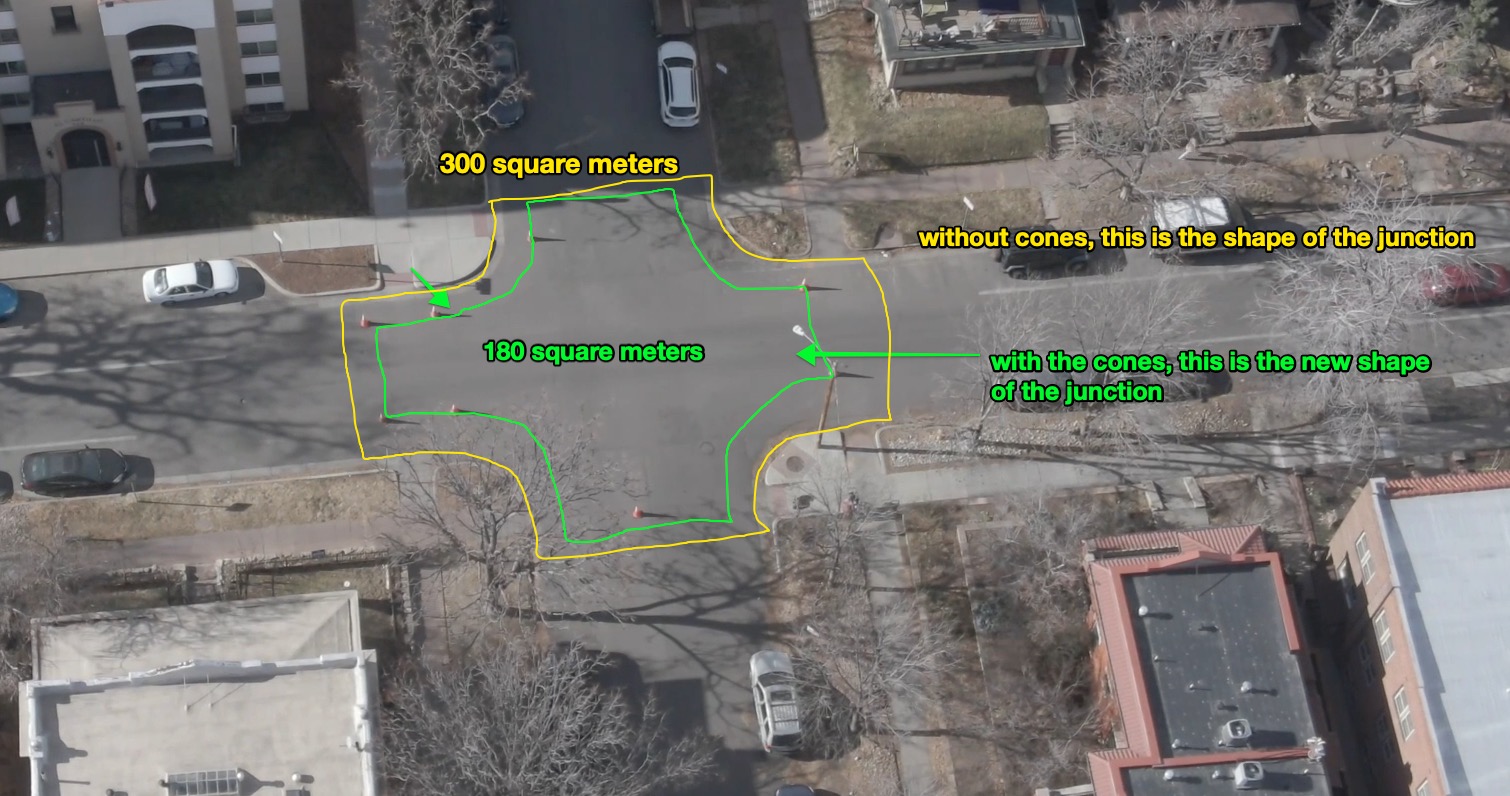
Here’s a graphic of the shape I had in my mind, as I placed the cones. I didn’t have as many as I’d like to have, else the finished shape would more closely match the green shape:
Changes From Placing These Cones #
Some phenomina is hard to even write about. It’s best seen with the video slider going back and forth, showing something about the path a car took on a turn or whatever.
Alas, plenty of the changes are visible in the timelapse (like the effect the cones have on the path a vehicle takes), I’ll list that and more.
here’s a list:
before: 30 foot crossings for pedestrians on all sides, having to look left and right in some cases, sorta at the same time after: max crossing is 15 feet, with possible car traffic arriving from one side only
before: regular vehicle speeds of 40 mph after: most vehicle speeds much closer to 20 mph (no speed bump or stop sign or path deviation required)
more things:
reduced width means:
- reduced time spent in the crossing for pedestrians AND other vehicles.
- Much less space one has to be concerned about being inside of. Sharper delineations between the spaces
Reduced junction size #
A huge component of this roads and junctions thing is that to dramatically increase the junction efficiency, one has to be able to reduce the size. Huge and inefficient becomes small and efficient.
The way to get some space back is to sorta ‘scribe’ the outer edge, define it with cones. Compare these two shapes:
They may look almost the same in size, but the inner shape is like 40% smaller than the outer one.
Here’s how I see in my mind the unimproved junction shape, and then the improved junction shape:
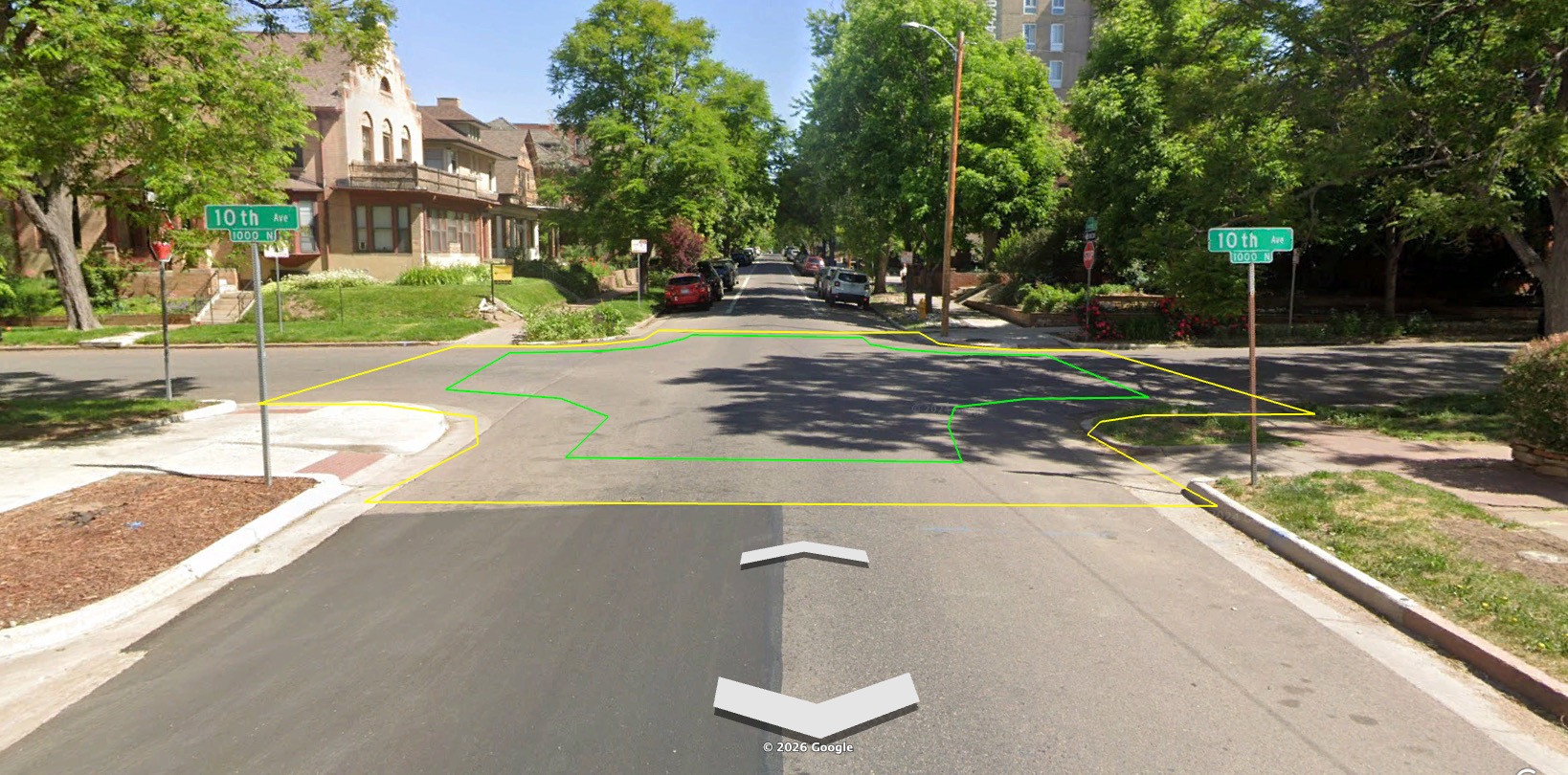
- before-size: 300 square meters. After-size: 180 sq meters1
- the sounds improved. It used to be that many vehicles were accelerating through the junction. It’s one block from a traffic light and super market exit and it looks super open and wide. With the cones, almost every vehicle coasted or at worst very gently accelerated through it.
shared space vibes #
In theory, someone should not be eligible to be destroyed by a car, simply for being in the wrong spot at the wrong time. Nor should they have to wait and defer a crossing to a person that is still hundreds of yards away, which is what happens when pedestrians are waiting to cross unbroken streams of vehicular traffic.
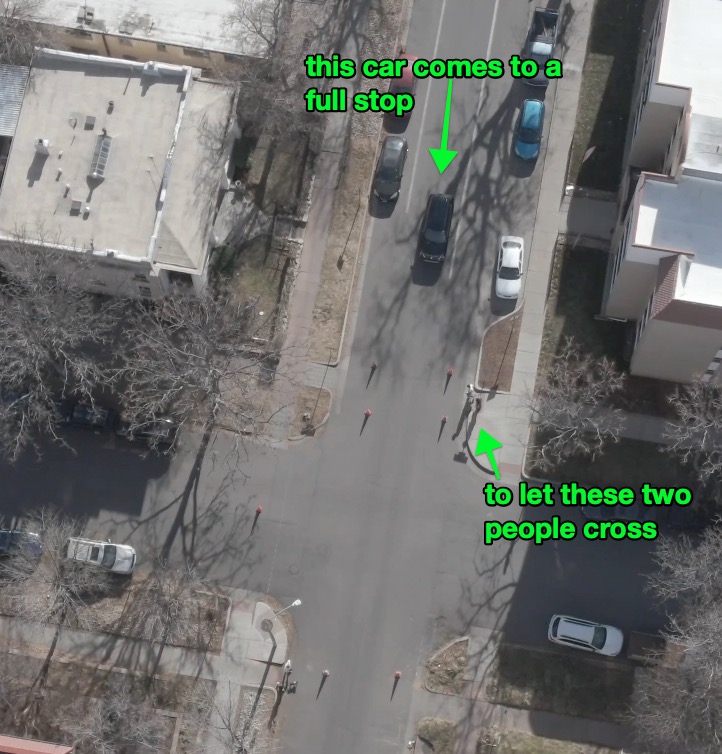
At the 2:51 point, a person in a car stops it to let some people on foot cross. This is a big deal. No signs demanded that the right of way be given to pedestrians in the crosswalk. There wasn’t a stop sign or a speed bump. It was a chill handoff of that space.
A little more squeezing of the lanes with the cones, and more and more of the passing vehicle traffic would stop as soon as pedestrians showed up to cross.
my ideal junction treatment turns it into a ‘shared space’ (vs a car-dominated space) where the larger/motorized vehicles defer to smaller/non-motorized/leg-powered vehicles. (counting walking people as vehicles here)
- the experience for turning left and right off of downing is much improved
Notice the changed shape of left and right turns #
I could imagine overlaying a line representing all the possible different left and right turns - sometimes cars turn fast, taking a wide turn. Sometimes too wide, too fast. Once the cones go out, some of the least desireable possible turning paths are eliminated, and more vehicles take a slower, defined turn.
That sort of turn makes it much safer for pedestrians crossing the road at the same time.
The turning into and out of the darkness of the shadow also complicates the junction. Reducing speed and complexity (as I did) makes everything move in a much flowier way.
Rear ending/tailgating/racing past behavior is eliminated #
since both sides of the junction are constrained, if a vehicle stops to make a left or right turn and is waiting for the path to be clear, the vehicle behind them cannot fit around and race past.
There’s a tremendous rear-ending danger in the original intersection design.2
If a car were turning right, for instance, and suddenly stopped, noticing a pedestrian in the space in front of it, and got rear ended, it could end up bouncing into the space the person was occupying anyway.
The sounds. so much better. #
cars are loud. so freaking loud. especially when accelerating up a hill, which is what every single car going north on downing is doing. this cone treatment encouraged gentler driving. While I was standing near it, I noticed that while some vehicles still drove very fast straight through the junction, the vast majority would at least remove their foot completely from the gas and would coast through the junction.
The acoustics were very improved. And the sound of racing/tailgating/rushing is unmistakable, even from a great distance.
manifesting Repair as a Service #
In this capitalistic hellscape we live in, I could imagine Repair as a Service, sorta like Software as a Service. (in some circles, SaaS is the stuff).
TODO: add a section about why this satisfies capitalism, and not just via general harm reduction, risk mitigation, though there are billions of dollars of industry doing just that. Maybe this improves customer access. It’s known that foot traffic makes money, this is all in line with pedestrianizing/making pedestrian friendly spaces.
I have this thing about parking that’s conceptually related. A bit more capitalistic.
if something were a service, that means it can be purchased, and this is america, so if something is available for purchase, that means it’s available at all. Currently, however, one cannot, to my knowledge, quite purchase a repaired junction, the same way one can purchase a repair to some commonly repaired physical items, like vehicles, houses, devices.
In the spirit of write it now and the iterative nature of the internet, here’s two different options plausible ‘junction repair as a service’ solutions, and everything technically works so I can get this page live.
the ‘let josh truthfully say at any point in the future “someone has hired me/is hiring me at this very moment to run a pop-up experiment right here”:’ option:
👉 purchase ‘Josh’s Junction Coning’ via Stripe. google pay/apple pay works
A three-cheers-for-capitalism option. Includes above plausibility beard, and some recorded outputs and magical calculations:
👉 purchase ‘Josh’s Junction Repair Writeup’ via Stripe.
I’m pleased to talk about any of this. Email or Whatsapp or a walk is preferred, ranked by preference, reverse sorted.
Additional Reading #
Footnotes #
-
I popped this open on google earth. 300sq meters to 180 sq meters is a 40% reduction in size. WE REDUCED THE SIZE OF A CRITICAL PIECE OF INFRASTRUCTURE BY ALMOST HALF. It’s interesting to me. the junction was never ‘maxed out’ in terms of vehicles moving through it for a time frame, so a direct count of vehicles per minute doesn’t quite make sense, but the principal of it’s efficiency being unaffected even as the space required is reduced by over a third is, I think, clear enough. Here’s much more about this
vehicles per square meter per minutevalue ↩ -
and of course ‘danger still persists’ with this treatment. ‘spot fixing’ a mobility network isn’t a thing. One fixes a route, for a vehicle class, at minimum ‘legs’ is a vehicle class, and ‘the other side of the street’ is a valid route, but most trips will include at least a few junctions in sequence. This treatment is best applied to junctions in sequence, a little of the video I have shows an adjacent junction a block away I fixed. I think three fixed junctions in a row is a nice thing, so doing two in a row is getting close. To appreciate three of these in a row starts with experiencing one. ↩